
What is dn(u, k)?
The Jacobi elliptic function dn(u, k), called the "delta amplitude," is one of the three principal Jacobi elliptic functions alongside sn and cn. They generalize the ordinary trigonometric functions and appear throughout physics and engineering: the exact period of a pendulum, soliton solutions of nonlinear wave equations, the motion of a rigid body (Euler's equations), and elliptic filter design. This calculator evaluates dn for any real argument u and modulus k in the range -1 to 1.
How to use it
Enter the argument u (any real number) and the modulus k with \(-1 \le k \le 1\). Because dn depends only on \(k^2\), the sign of k does not affect the result. Click calculate to obtain dn(u, k). Internally the calculator sets the parameter \(m = k^2\).
The formula explained
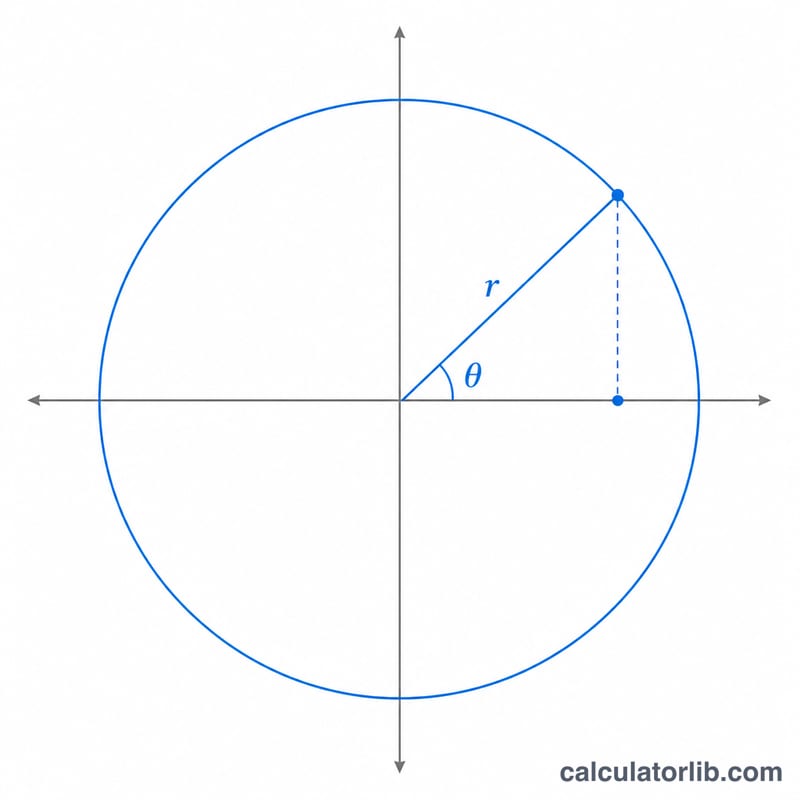
Let φ = am(u, m) be the amplitude, defined implicitly by the incomplete elliptic integral of the first kind \(F(\phi \mid m) = u\). Then \(\operatorname{sn} = \sin(\phi)\), \(\operatorname{cn} = \cos(\phi)\), and $$\operatorname{dn}(\text{u},\, \text{k}) = \sqrt{1 - \text{k}^{2}\,\operatorname{sn}^{2}(\text{u},\, \text{k})}$$ We compute am(u, m) numerically with the descending Landen / arithmetic-geometric-mean transformation (the classic Numerical Recipes "sncndn" routine), which converges quadratically and is accurate across the whole domain.
Worked example
Take \(u = 4\) and \(k = 0.7\), so \(m = 0.49\). The amplitude \(\operatorname{am}(4, 0.49) \approx 3.4179\) rad, giving \(\operatorname{sn}(4, 0.7) \approx -0.27156\). Then $$\operatorname{dn} = \sqrt{1 - 0.49 \times (-0.27156)^{2}} = \sqrt{1 - 0.036131} = \sqrt{0.963869} \approx \mathbf{0.981768}$$
FAQ
What happens when k = 0? \(\operatorname{dn}(u, 0) = 1\) for every u, because the modulus term vanishes and \(\operatorname{am}(u, 0) = u\).
What about k = 1? \(\operatorname{dn}(u, 1) = \operatorname{sech}(u) = \frac{1}{\cosh(u)}\); for example \(\operatorname{dn}(4, 1) \approx 0.036644\).
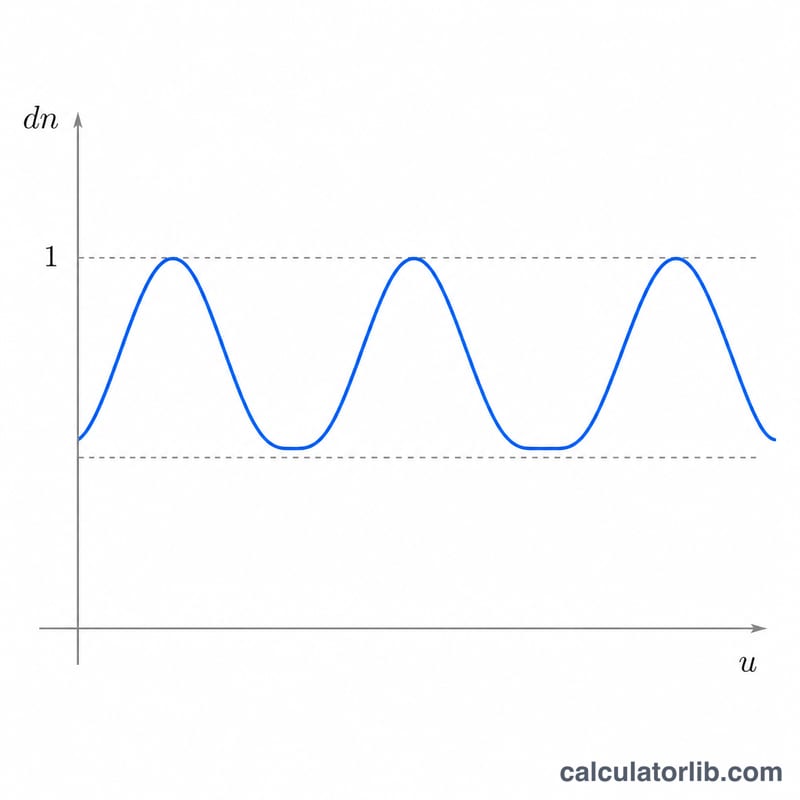
What is the range of dn? For \(|k| < 1\), dn is always positive and oscillates between \(k' = \sqrt{1 - k^2}\) at its minimum and 1 at \(u = 0\) (mod 2K), where K is the complete elliptic integral of the first kind.