
What is the Pochhammer symbol?
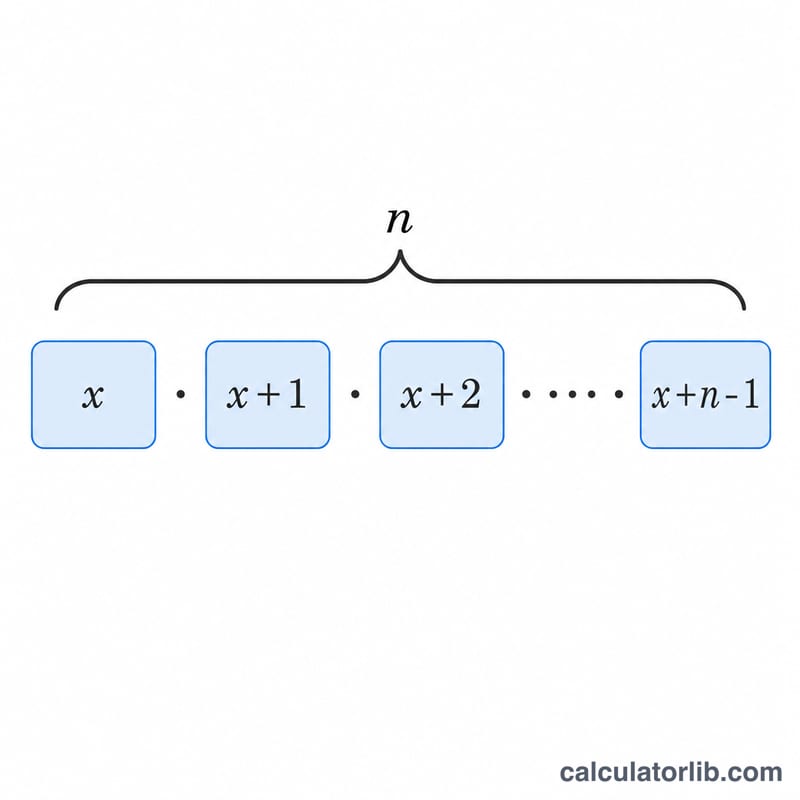
The Pochhammer symbol, also called the rising factorial, is written \((x)_n\) and denotes the product of n consecutive ascending factors beginning at x: $$(x)_n = x(x+1)(x+2)\cdots(x+n-1).$$ It generalizes the ordinary factorial because \((1)_n = n!\), and it appears throughout combinatorics, hypergeometric series, and special-function theory. This calculator evaluates \((x)_n\) for any real base \(x\) and any non-negative integer count \(n\).
How to use this calculator
Enter the base value x (it may be negative, fractional, or zero) and the number of factors n (a whole number 0 or greater). Press calculate to get the rising-factorial value. The empty product convention sets \((x)_0 = 1\) for every \(x\), and \((x)_1 = x\). If \(x\) is a non-positive integer and one of the factors lands exactly on zero, the product is exactly 0.
The formula explained
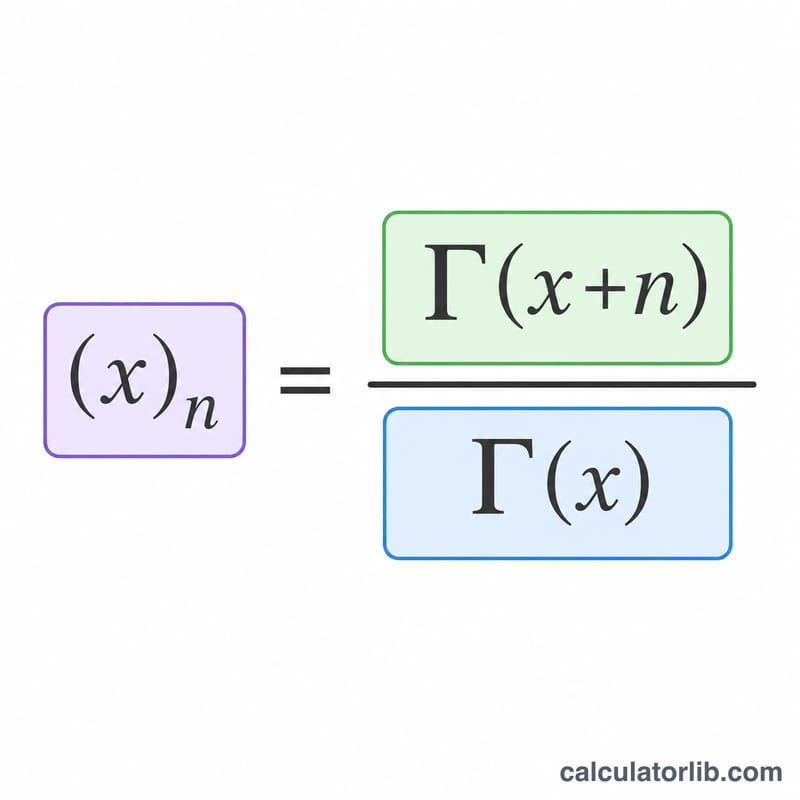
The product form multiplies \(x\) by \(x+1\), then \(x+2\), and so on, up to \(x+n-1\) — a total of \(n\) terms. Equivalently it can be written with the Gamma function as $$(x)_n = \frac{\Gamma(x+n)}{\Gamma(x)}.$$ This calculator uses the direct product, which is exact for integer \(n\), avoids Gamma-function overflow, and correctly returns 0 whenever a factor vanishes.
Worked example
With the defaults \(x = -10\) and \(n = 6\): $$(-10)(-9)(-8)(-7)(-6)(-5).$$ Multiplying step by step gives \(-10 \times -9 = 90\), \(90 \times -8 = -720\), \(-720 \times -7 = 5040\), \(5040 \times -6 = -30240\), and \(-30240 \times -5 = 151200\). So $$(-10)_6 = 151200.$$
FAQ
What does \((x)_0\) equal? Always 1, by the empty-product convention, no matter what \(x\) is.
Can x be negative or a fraction? Yes. The product handles any real \(x\); for example \((5)_3 = 5 \times 6 \times 7 = 210\), and a non-positive integer base can produce zero.
Why might large inputs lose precision? The rising factorial grows extremely fast, so very large \(|x|\) or \(n\) can exceed the range of standard floating-point arithmetic and show rounding or overflow.