
What is the Fibonacci sequence?
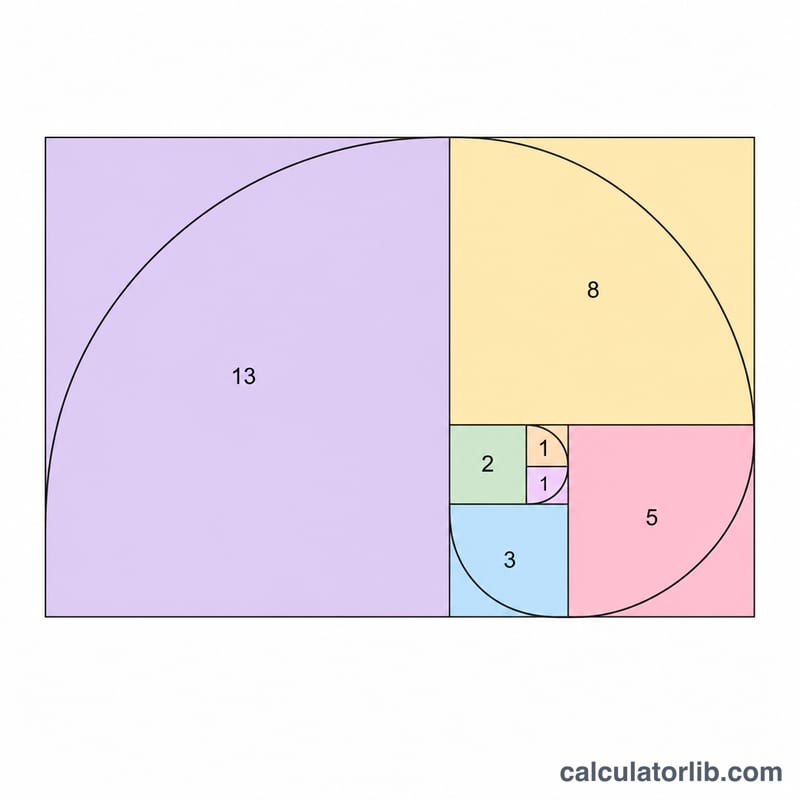
The Fibonacci sequence is one of the most famous patterns in mathematics. It starts with 0 and 1, and every following number is the sum of the two before it: 0, 1, 1, 2, 3, 5, 8, 13, 21, 34, and so on. This Fibonacci calculator finds the value of the nth term, plus the running sum of all terms up to that point.
How to use the calculator
Enter the term position n (the index of the number you want, starting from 0) and submit. The calculator returns F(n), the cumulative sum \(F(0)+F(1)+\ldots+F(n)\), and the golden-ratio estimate from Binet's formula. Values up to \(n = 90\) are supported with full integer accuracy.
The formula explained
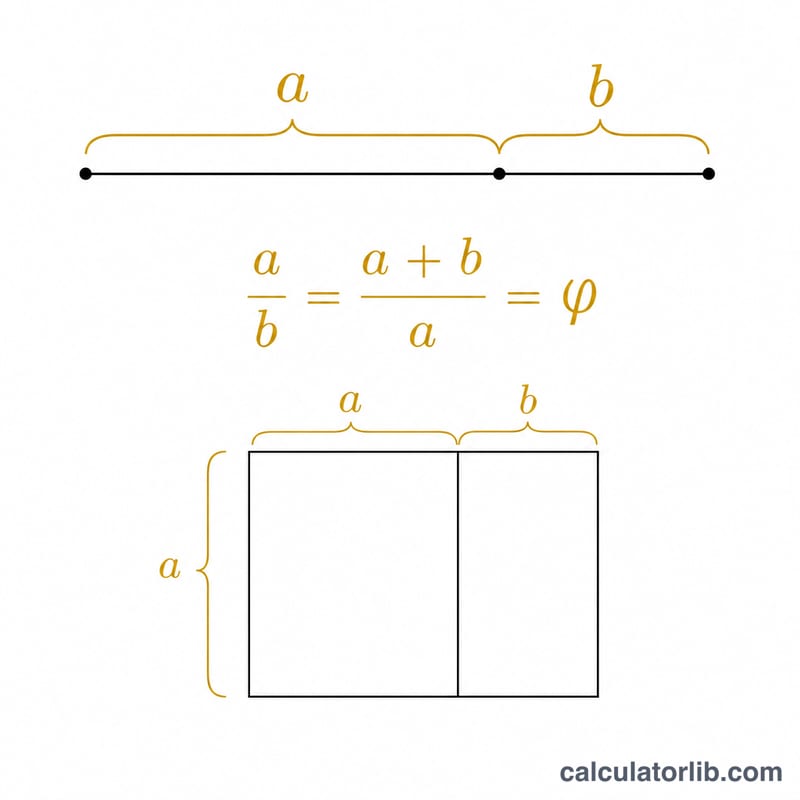
Two methods give the same answer. The simplest is the recursive rule \(F(n) = F(n-1) + F(n-2)\). The elegant closed form is Binet's formula, which uses the golden ratio \(\varphi = \frac{1+\sqrt{5}}{2} \approx 1.618\).
$$F_{\text{n}} = \frac{\varphi^{\text{n}} - (1-\varphi)^{\text{n}}}{\sqrt{5}}, \qquad \varphi = \frac{1+\sqrt{5}}{2}$$Because the second term \(\psi^{\text{n}}\) shrinks toward zero, F(n) is extremely close to \(\varphi^{\text{n}}/\sqrt{5}\), so rounding to the nearest integer gives the exact Fibonacci number. This calculator computes the result iteratively for perfect precision and also shows the Binet estimate for comparison.
Worked example
For \(n = 10\): the sequence is 0, 1, 1, 2, 3, 5, 8, 13, 21, 34, 55. So \(F(10) = 55\). The sum of the first eleven terms (F(0) through F(10)) is
$$\sum_{i=0}^{10} F_i = F_{12} - 1 = 144 - 1 = 143$$The Binet estimate \(\varphi^{10}/\sqrt{5} \approx 55.0036\), which rounds to 55.
FAQ
Does the sequence start at 0 or 1? This tool uses the standard convention \(F(0)=0\) and \(F(1)=1\), so position 0 returns 0.
Why limit n to 90? F(90) is about \(2.88 \times 10^{18}\), near the limit of exact 64-bit integer arithmetic. Beyond this, floating-point rounding could cause errors.
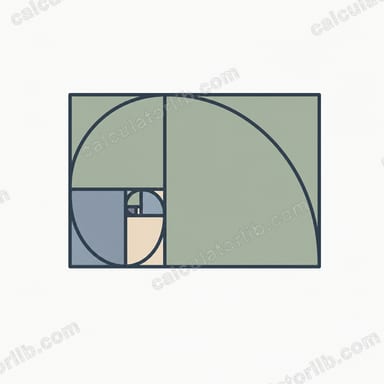
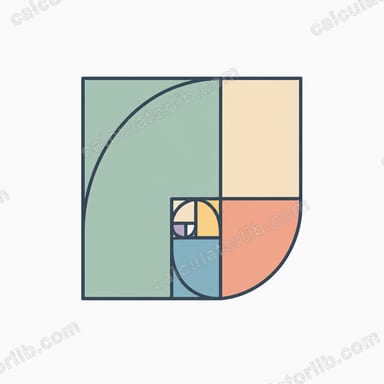
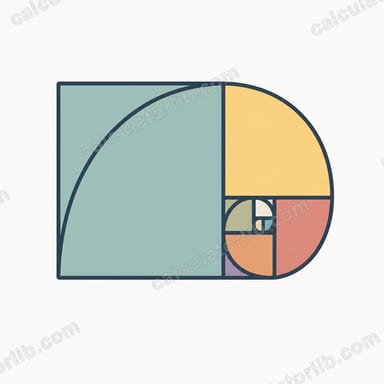
What is the golden ratio's connection? The ratio of consecutive Fibonacci numbers \(F(n+1)/F(n)\) converges to \(\varphi \approx 1.6180339887\) as n grows large.