
What Is the Dividing Exponents Calculator?
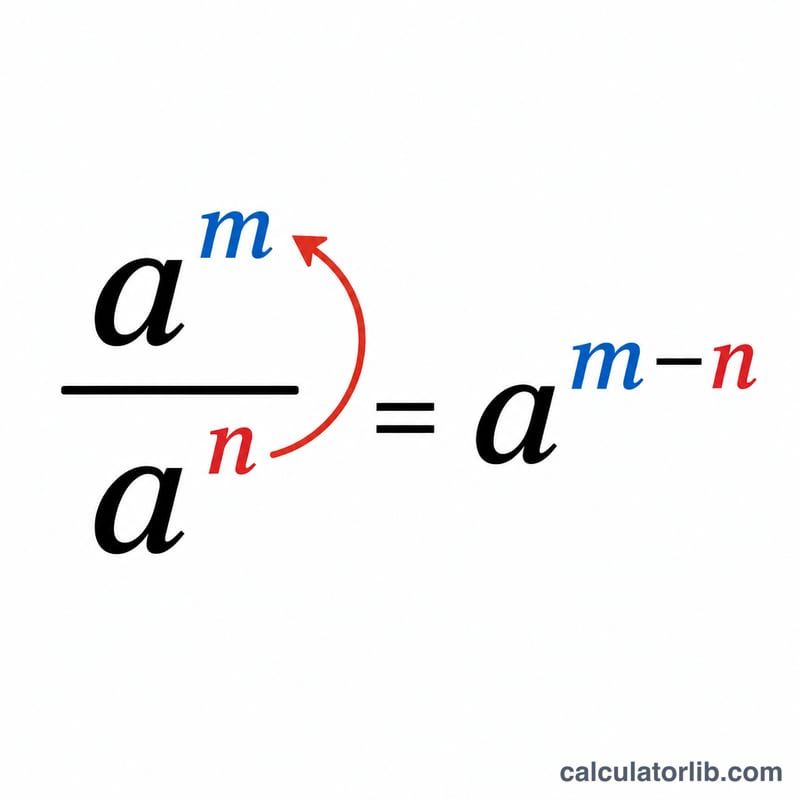
This calculator applies the quotient rule of exponents: when you divide two powers that share the same base, you subtract the exponents. In symbols, \(a^m \div a^n = a^{m-n}\). It returns both the simplified exponent (m − n) and the final numeric value, so you can check homework, simplify algebraic expressions, or work scientific-notation problems quickly.
How to Use It
Enter the common base a, the exponent of the numerator m, and the exponent of the denominator n. The tool subtracts n from m to get the simplified exponent, then raises the base to that power to give a decimal value. Exponents may be negative or fractional — for example a square-root cancellation produces a half-power.
The Formula Explained
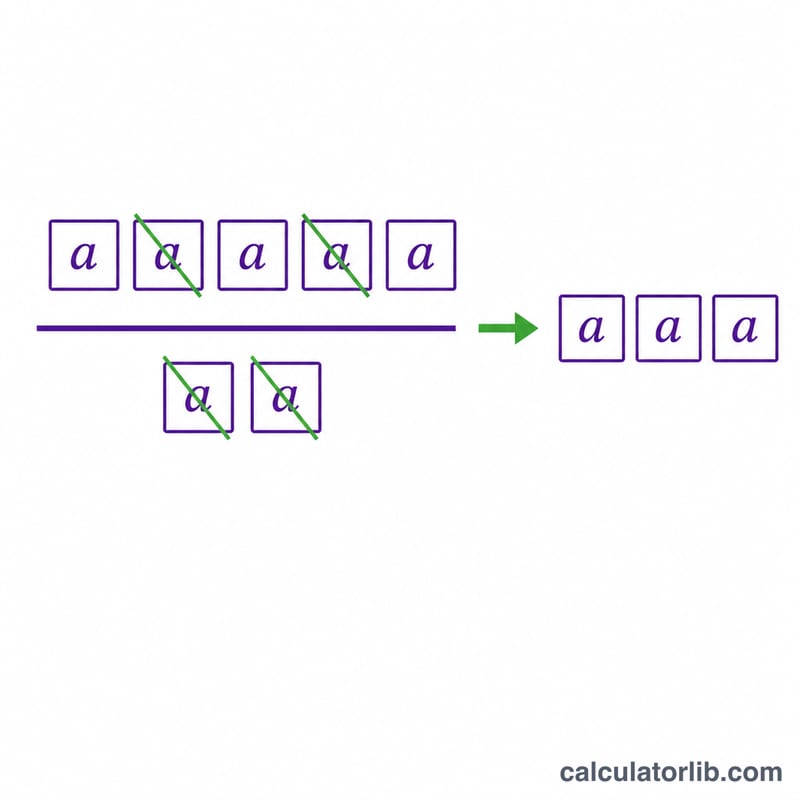
A power like \(a^m\) means a multiplied by itself m times. Dividing \(a^m\) by \(a^n\) cancels n of those factors from m of them, leaving m − n factors of a. That is why the exponents subtract rather than divide:
$$\frac{a^m}{a^n} = a^{\,m-n}$$
If m equals n the result is \(a^0 = 1\); if n is larger you get a negative exponent, which equals a fraction.
Worked Example
Simplify \(2^5 \div 2^2\). Keep the base 2 and subtract the exponents: \(5 - 2 = 3\). So the result is
$$2^3 = 8$$
The calculator shows a simplified exponent of 3 and a numeric value of 8.
FAQ
Do the bases have to match? Yes. The quotient rule only applies when both powers share the same base. Unlike bases must be evaluated separately.
What if m is smaller than n? You get a negative exponent, which represents a reciprocal — for instance \(a^{-2} = 1/a^2\). The calculator returns the equivalent decimal.
Can I use fractions or decimals? Yes, fractional and decimal exponents are supported, letting you handle roots and scientific notation as well as whole-number powers.