
What is a Harmonic Number?
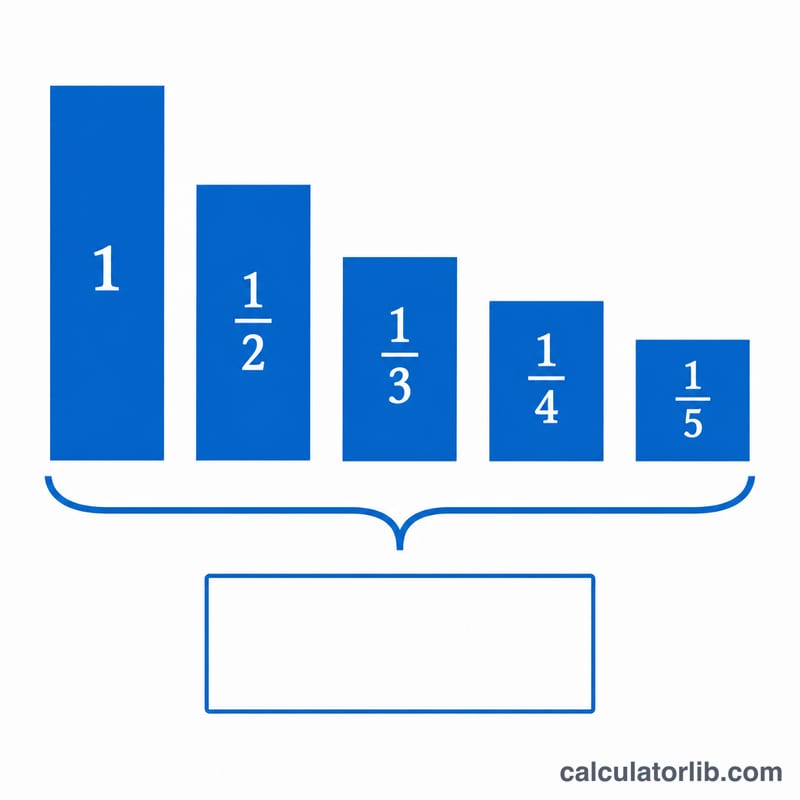
The nth harmonic number, written \(H(n)\), is the sum of the reciprocals of the first n positive integers: $$H(n) = 1 + \frac{1}{2} + \frac{1}{3} + \cdots + \frac{1}{n}.$$ It is the partial sum of the famous harmonic series, one of the most important slowly-diverging series in mathematics. Although each added term gets smaller, the total grows without bound as n increases — just very slowly, roughly like the natural logarithm of n.
How to Use This Calculator
Enter a positive whole number \(n\) (the number of terms) and the calculator sums \(\frac{1}{k}\) from \(k = 1\) up to \(k = n\). The result is the exact decimal value of \(H(n)\). You can compare it to the approximation \(H(n) \approx \ln(n) + \gamma\), where \(\gamma \approx 0.5772\) is the Euler–Mascheroni constant; this estimate becomes very accurate for large n.
The Formula Explained
The defining formula is $$H(n) = \sum_{k=1}^{n} \frac{1}{k}.$$ There is no simple closed form, so the value is computed term by term. For example, $$H(4) = 1 + \frac{1}{2} + \frac{1}{3} + \frac{1}{4} = 1 + 0.5 + 0.333\ldots + 0.25 = 2.08333\ldots$$
Worked Example
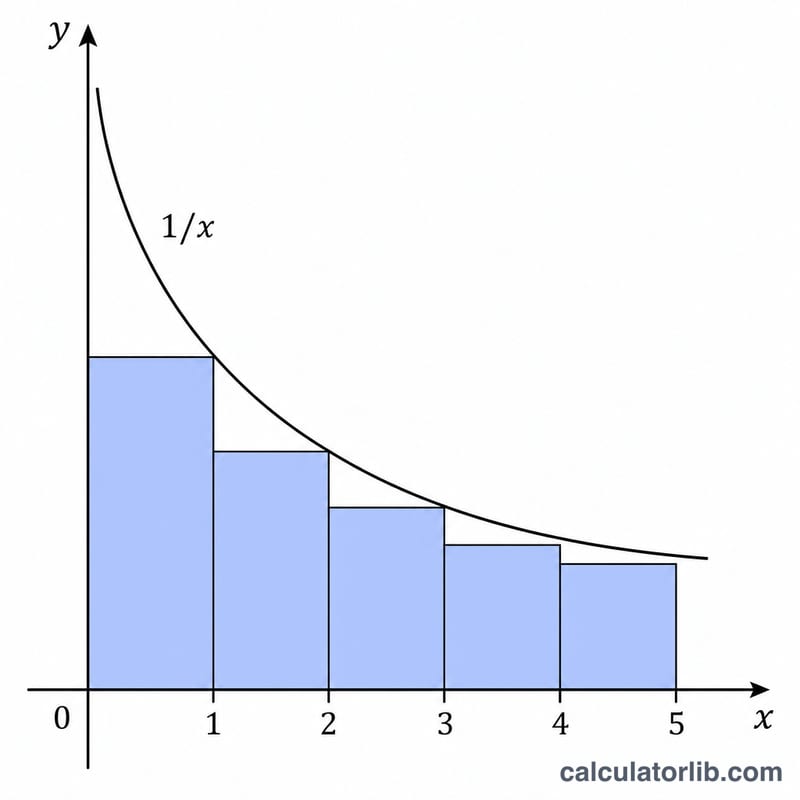
For \(n = 5\): $$H(5) = 1 + \frac{1}{2} + \frac{1}{3} + \frac{1}{4} + \frac{1}{5} = 1 + 0.5 + 0.333333 + 0.25 + 0.2 = 2.283333.$$ The calculator returns this directly.
FAQ
Does the harmonic series converge? No. The infinite harmonic series diverges, so \(H(n)\) keeps growing as n grows, though extremely slowly.
What is H(1)? \(H(1) = 1\), since the sum has a single term, \(\frac{1}{1}\).
Why is it called "harmonic"? The name comes from music: the wavelengths of overtones of a vibrating string are \(1, \frac{1}{2}, \frac{1}{3}, \frac{1}{4}, \ldots\) of the fundamental wavelength.