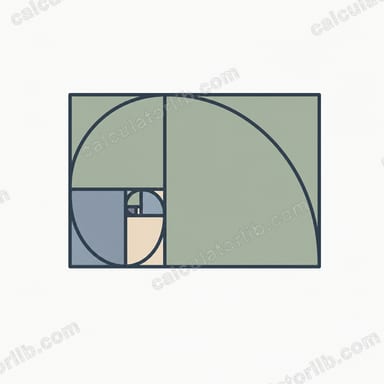

What is the Fibonacci sequence?
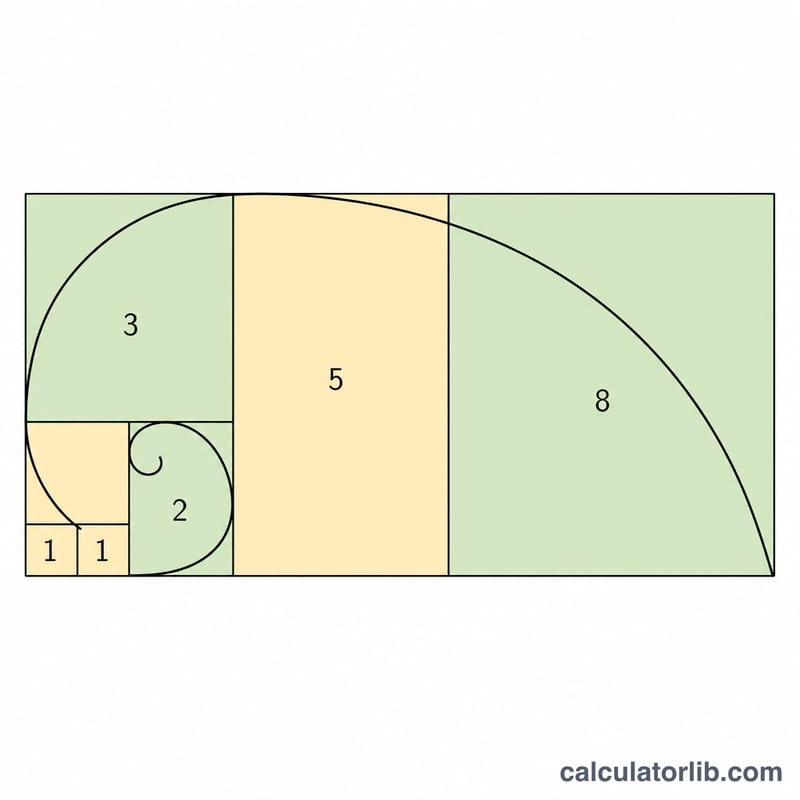
The Fibonacci sequence is one of the most famous patterns in mathematics. It starts with 0 and 1, and every later number is the sum of the two before it: 0, 1, 1, 2, 3, 5, 8, 13, 21, 34, and so on. This calculator returns \(F(n)\) — the n-th term — for any non-negative index you choose, along with the running sum of all terms up to that point and the golden ratio \(\varphi\) that the sequence approaches.
How to use this calculator
Enter the term index \(n\) (a whole number from 0 to 92) and the calculator returns \(F(n)\) instantly. The upper limit of 92 keeps results exact within standard 64-bit precision; beyond that the values become approximations. The result panel also shows the cumulative sum \(F(0)+F(1)+...+F(n)\), which conveniently equals \(F(n+2) - 1\).
The formula explained
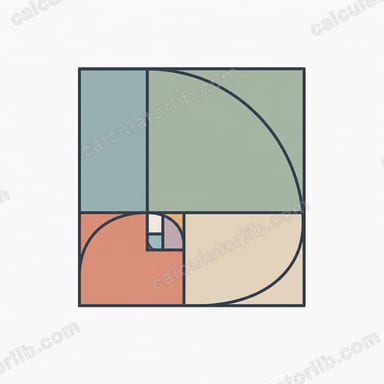
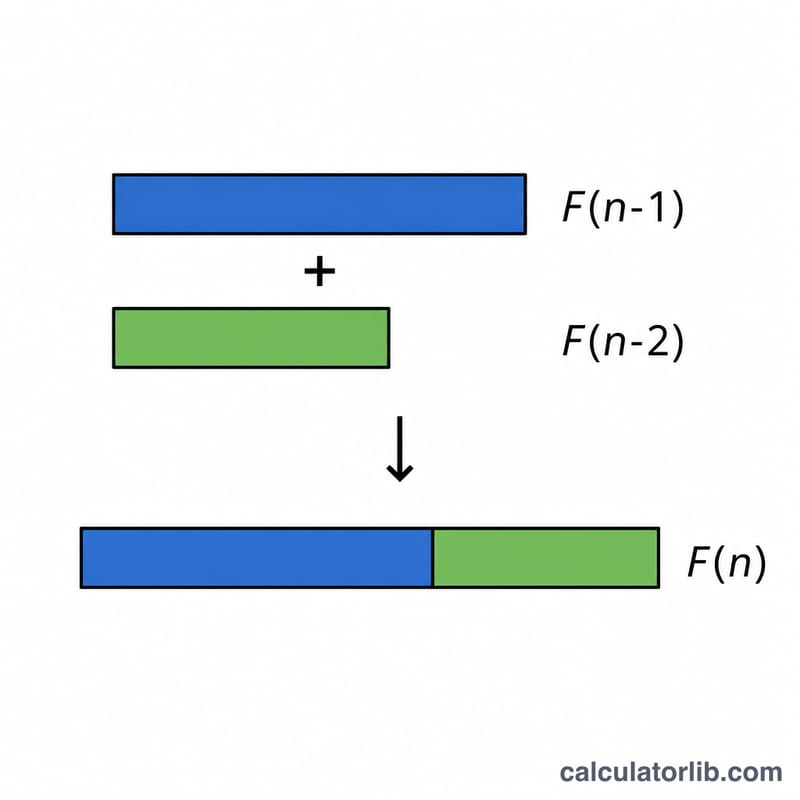
The defining rule is the recurrence $$F(n) = F(n-1) + F(n-2),\quad F(0)=0,\ F(1)=1$$ with seeds \(F(0)=0\) and \(F(1)=1\). There is also a closed form known as Binet's formula, $$F(n) = \frac{\varphi^{n} - \psi^{n}}{\sqrt{5}},\quad \varphi=\frac{1+\sqrt5}{2}$$ where \(\varphi = \frac{1+\sqrt5}{2} \approx 1.618\) is the golden ratio and \(\psi = \frac{1-\sqrt5}{2}\) is its conjugate. As \(n\) grows, the ratio of consecutive Fibonacci numbers \(F(n+1)/F(n)\) converges toward \(\varphi\).
Worked example
Suppose \(n = 10\). Building up the sequence: \(F(2)=1\), \(F(3)=2\), \(F(4)=3\), \(F(5)=5\), \(F(6)=8\), \(F(7)=13\), \(F(8)=21\), \(F(9)=34\), \(F(10)=55\). So \(F(10) = 55\). The sum of \(F(0)\) through \(F(10)\) is $$F(12) - 1 = 144 - 1 = 143$$
FAQ
Does the sequence start at 0 or 1? This calculator uses the standard convention \(F(0)=0\) and \(F(1)=1\), so \(F(2)=1\).
Why is n capped at 92? \(F(92)\) is the largest Fibonacci number that fits exactly in a 64-bit signed integer; larger indices would lose precision.
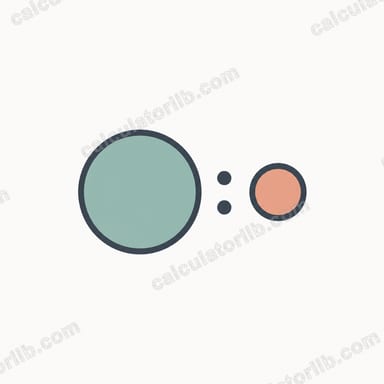
What is the golden ratio's link to Fibonacci? Dividing each Fibonacci number by the previous one gives a value that gets closer and closer to \(\varphi \approx 1.6180339887\).