
What is fixed declining balance depreciation?
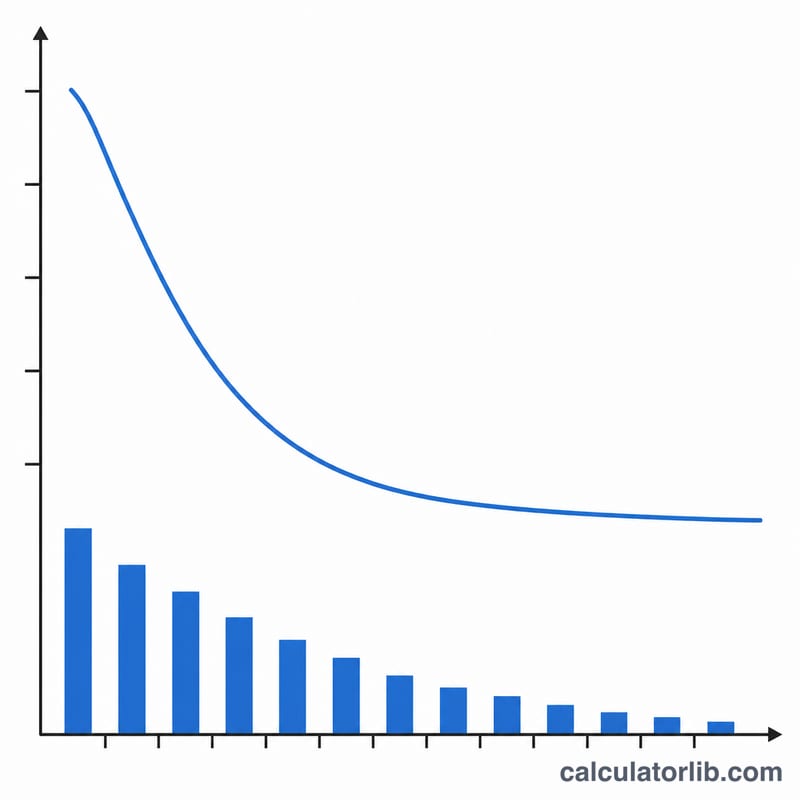
The fixed declining balance method is an accelerated depreciation technique that applies a constant percentage rate to the asset's book value each year. Because the book value shrinks over time, the dollar amount of depreciation is highest in the early years and falls as the asset ages. Unlike the double declining balance method, the rate here is derived directly from the cost, salvage value and useful life so the asset lands almost exactly on its salvage value at the end of its life.
How to use this calculator
Enter the original asset cost, its expected salvage (residual) value, the useful life in years, and the specific year you want to evaluate. The calculator returns the constant depreciation rate, that year's depreciation expense, the book value at the start and end of the year, and the accumulated depreciation through that year.
The formula explained
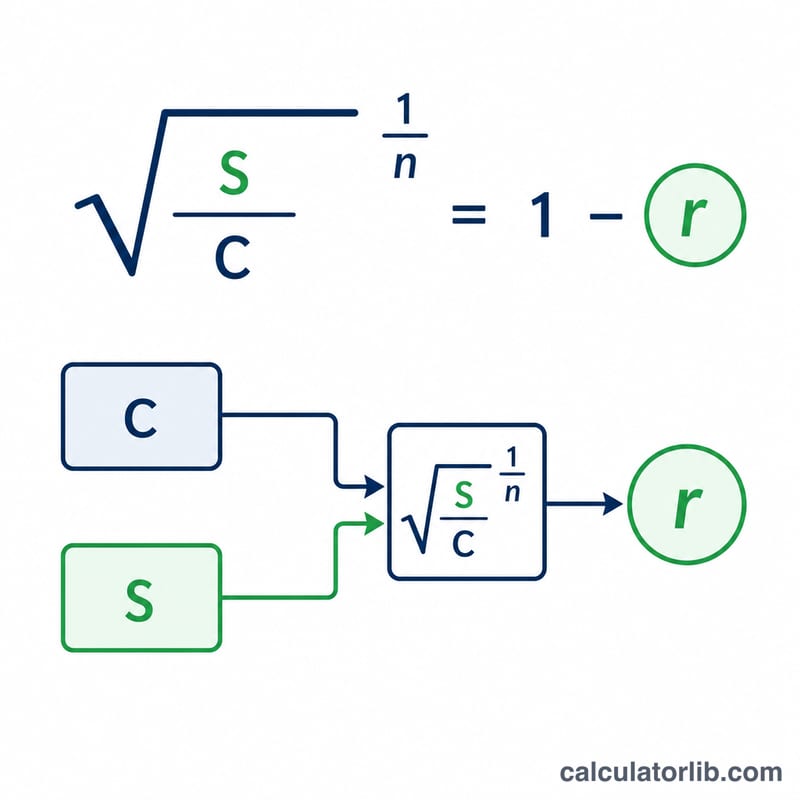
The constant rate is $$r = 1 - \left(\frac{\text{salvage}}{\text{cost}}\right)^{1/\text{life}}$$ For any year, the depreciation is the rate multiplied by the book value at the beginning of that year: $$D = BV_{start} \times r$$ The book value is reduced each year and never falls below the salvage value.
Worked example
Cost $10,000, salvage $1,000, life 5 years. The rate is $$r = 1 - (1000/10000)^{1/5} = 1 - 0.1^{0.2} \approx 0.36904 \ (36.9\%)$$ Year 1 depreciation = \(\$10{,}000 \times 0.36904 = \$3{,}690.42\), leaving a book value of $6,309.58. Year 2 depreciation = \(\$6{,}309.58 \times 0.36904 = \$2{,}328.63\), ending at $3,980.95 with $6,019.05 accumulated.
FAQ
How is this different from straight-line? Straight-line spreads cost evenly; declining balance front-loads the expense.
What if salvage is zero? The pure formula is undefined at zero salvage, so the calculator treats it as a 100% rate; in practice use a small salvage or another method.
Does book value go below salvage? No — depreciation in the final years is capped so the book value never drops below the salvage value.