
What is the Fibonacci sequence?
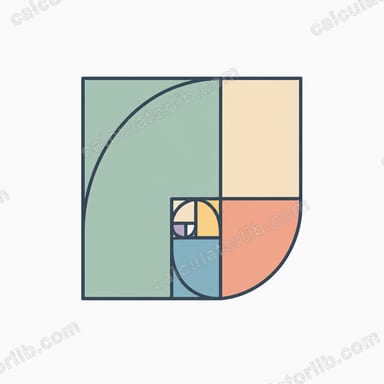
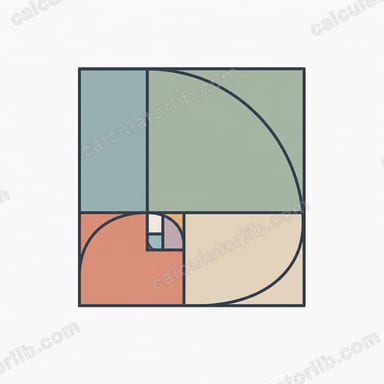
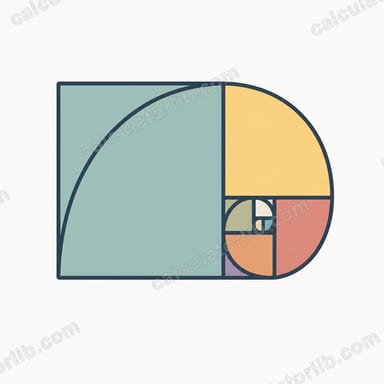
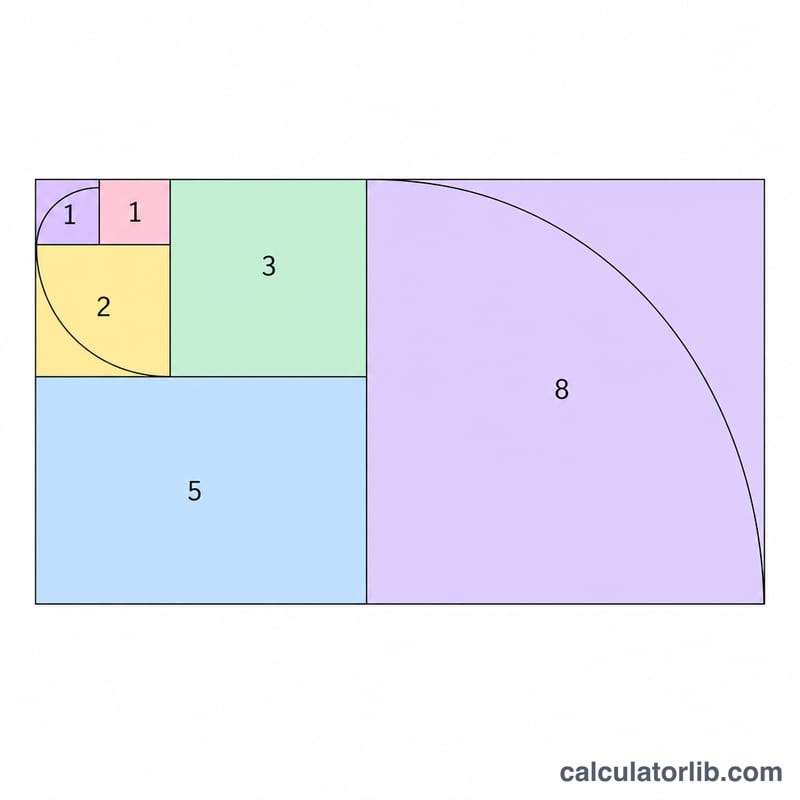
The Fibonacci sequence is a series of integers in which every number is the sum of the two preceding ones, starting from 0 and 1: 0, 1, 1, 2, 3, 5, 8, 13, 21, 34, 55, and so on. It appears throughout mathematics and nature, from spiral shells and sunflower seed heads to the golden ratio. This calculator can return a single Fibonacci number \(F_n\) for any index \(n\), or generate the whole sequence between a start and end index.
How to use this calculator
Choose a mode in the Generate dropdown. Select one Number and enter an index \(n\) to get the single value \(F_n\) together with its recurrence step. Select a Sequence and enter a Start \(n\) and End \(n\) to list every Fibonacci number across that inclusive range. Indices may be positive or negative; supported range is from -200 to 200.
The formula explained
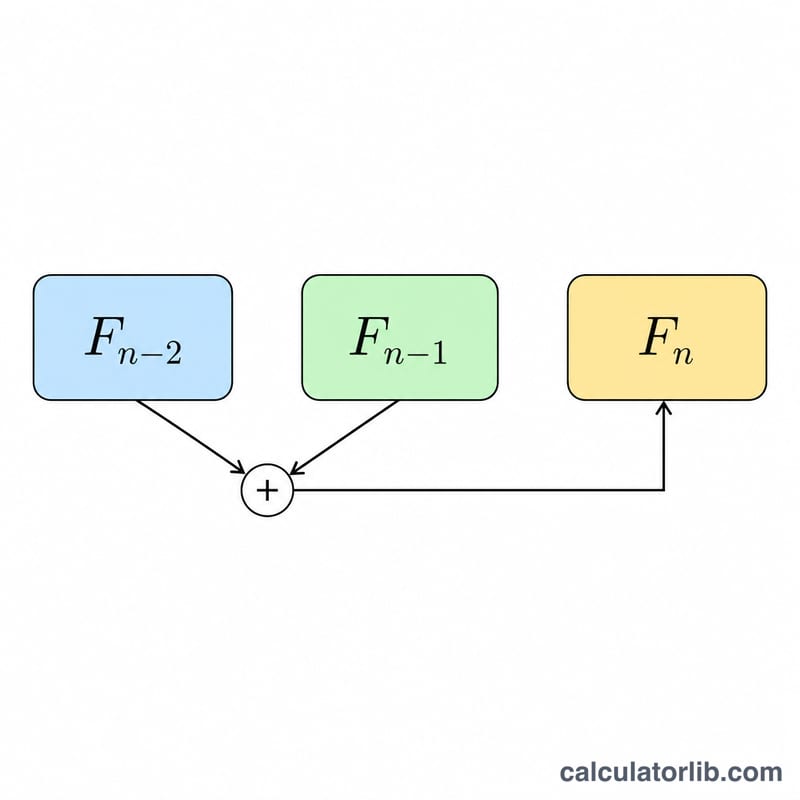
The defining rule is the recurrence $$F_n = F_{n-1} + F_{n-2}, \quad F_0 = 0, \; F_1 = 1$$ For exact results with large \(n\) this tool iterates using arbitrary-precision integers rather than the floating-point Binet formula, which loses accuracy beyond about \(n = 71\). Negative indices follow the negafibonacci rule \(F_{-n} = (-1)^{n+1} F_n\), so \(F_{-1} = 1\), \(F_{-2} = -1\), \(F_{-3} = 2\), \(F_{-4} = -3\), and so on.
Worked example
To find \(F_{15}\), iterate the sequence up to index 15: 0, 1, 1, 2, 3, 5, 8, 13, 21, 34, 55, 89, 144, 233, 377, 610. So $$F_{15} = 610 = F_{14} + F_{13} = 377 + 233 = 610$$
FAQ
Does it support negative indices? Yes. It uses the negafibonacci extension, producing alternating-sign results such as \(F_{-6} = -8\).
How large can n be? The supported range is -200 to 200. \(F_{200}\) has 42 digits and is computed exactly with arbitrary-precision integers.
Why not just use Binet's formula? Binet's closed form \(F_n = \frac{\varphi^n - \psi^n}{\sqrt{5}}\) is elegant for display, but double-precision rounding makes it unreliable for large \(n\), so exact integer iteration is used for the answer.