
What this calculator does
The Fibonacci Sequence Calculator generates the first n numbers of the Fibonacci sequence, where each term is the sum of the two before it. You simply tell it how many terms you want, and it returns the full list along with handy extras: the total length, the sum of all terms, the last value, and the nth term itself. It's a fast way to check homework, test code, or explore the pattern that appears throughout maths and nature.
The input field
- Number of Fibonacci terms: how many numbers you want in the sequence.
One important rule: the count is clamped to a valid range. If you enter less than 1 it becomes 1, and the maximum allowed is 100. So any value you type is automatically kept between 1 and 100 before the sequence is built.
The formula
The sequence is defined by the recurrence:
$$F_n = F_{n-1} + F_{n-2}$$
The calculator seeds the series with the standard starting values \(F_1 = 0\) and \(F_2 = 1\). From the third term onward, every number is simply the previous two added together. (Note: this tool uses the 0-based convention, beginning 0, 1, 1, 2, … rather than 1, 1, 2, …)
Worked example
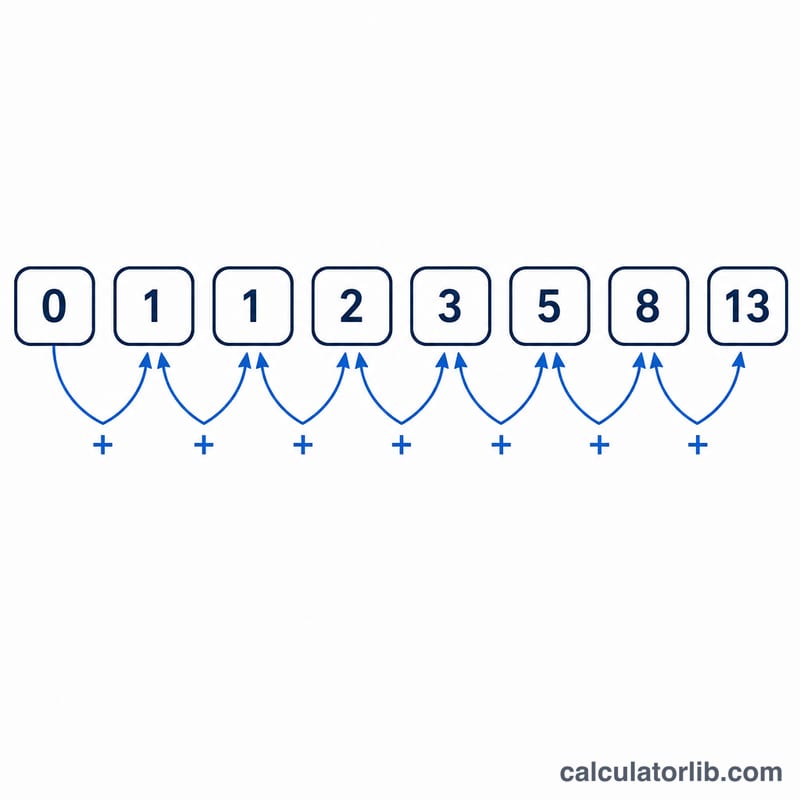
Suppose you request 8 terms. The calculator starts with 0 and 1, then keeps adding the last two values:
- 0, 1, 1, 2, 3, 5, 8, 13
- Length: 8 terms
- Sum: \(0 + 1 + 1 + 2 + 3 + 5 + 8 + 13 = 33\)
- Last (8th) term: 13
That 13 is also reported as the "nth term" because it sits in position 8 of the list.
Frequently asked questions
Why does the sequence start with 0? This calculator uses the common computing convention \(F = 0, 1, 1, 2, 3\dots\) If your textbook starts at 1, 1, 2, 3, just ignore the leading 0.
What is the largest sequence I can generate? Up to 100 terms. Anything higher is automatically reduced to 100, and anything below 1 is raised to 1.
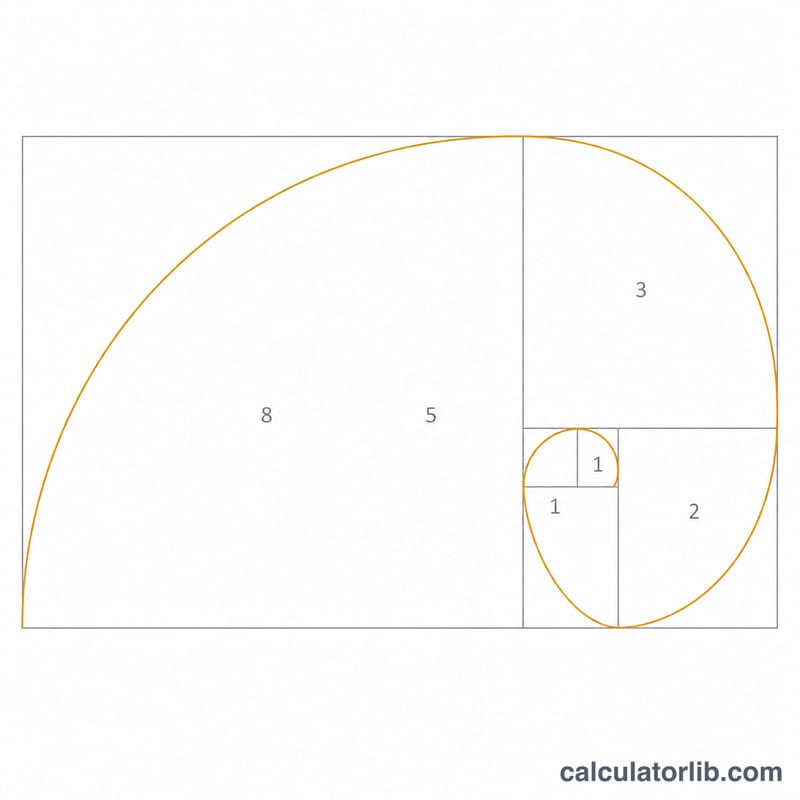
How big do the numbers get? Fibonacci numbers grow very quickly—roughly multiplying by 1.618 (the golden ratio) each step—so the 100th term is already a 21-digit number.