
What Is a Calorie Deficit?
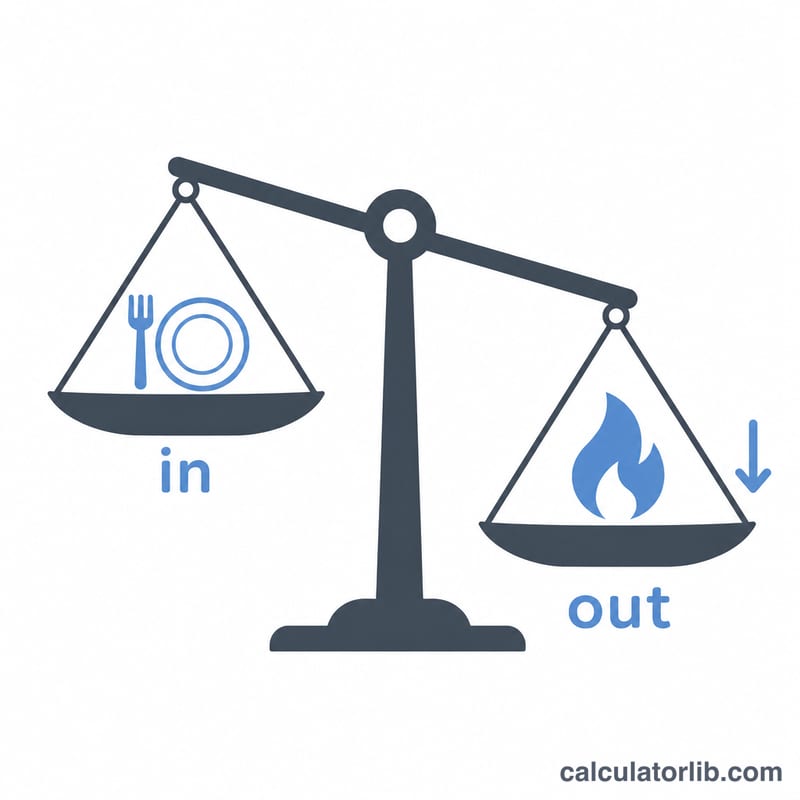
A calorie deficit occurs when you consume fewer calories than your body burns each day. Over time, this energy shortfall forces your body to use stored fat for fuel, resulting in weight loss. This calculator takes your Total Daily Energy Expenditure (TDEE) and your target daily intake to show your daily deficit and the estimated fat loss you can expect each week.
How to Use It
Enter your TDEE — the total calories you burn in a day, including activity. Then enter your target daily calorie intake. The calculator subtracts intake from TDEE to find your daily deficit, multiplies it by 7 for a weekly total, and converts that into estimated fat loss using the well-known 3,500-calories-per-pound rule.
The Formula Explained
Daily Deficit = TDEE − Target Intake. Weekly Deficit = Daily Deficit × 7. Because roughly 3,500 calories equal one pound of body fat, Weekly Fat Loss (lb) = Weekly Deficit ÷ 3,500. Kilograms are found by multiplying pounds by 0.45359237.
$$\text{Weekly Fat Loss (lb)} = \frac{7 \times \left( \text{TDEE} - \text{Intake} \right)}{3500}$$where:
$$\begin{aligned} \text{Daily Deficit} &= \text{TDEE} - \text{Intake} \\ \text{Weekly Deficit} &= 7 \times \text{Daily Deficit} \\ \text{Fat (kg)} &= \text{Fat (lb)} \times 0.4536 \end{aligned}$$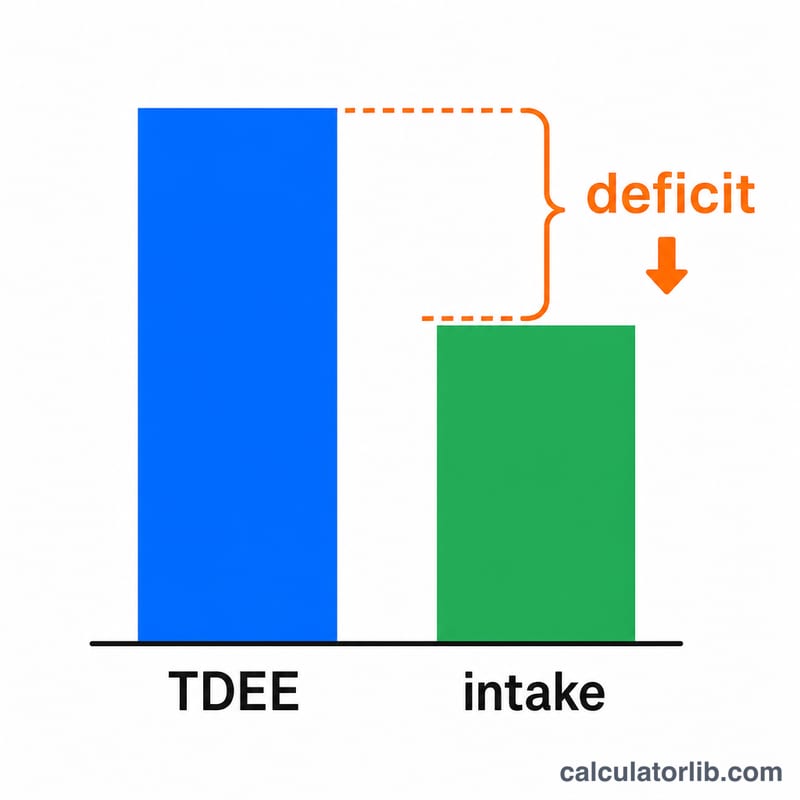
Worked Example
Suppose your TDEE is 2,500 cal/day and you eat 2,000 cal/day. Your daily deficit is \(2500 - 2000 = 500\) cal. Over a week that is \(7 \times 500 = 3500\) cal, which equals \(\frac{3500}{3500} = 1\) lb (about 0.45 kg) of estimated fat loss per week.
Interpreting Your Calorie Deficit
Your daily calorie deficit is simply the gap between the calories your body burns each day (your TDEE, or Total Daily Energy Expenditure) and the calories you eat (your intake). When intake is lower than TDEE, your body makes up the difference by drawing on stored energy — primarily fat — which is the mechanism behind weight loss.
The weekly fat loss figure converts that deficit into an estimated rate of change. The calculation rests on the widely cited approximation that roughly 3,500 calories equals about one pound of body fat. For example, a 500-calorie daily deficit produces a weekly deficit of 3,500 calories, which estimates a loss of about 1 pound per week.
Most general health guidance recommends a safe, sustainable rate of about 0.5 to 1 kg (roughly 1 to 2 lb) per week, or equivalently around 0.5%–1% of body weight per week. Slower rates within this band are often easier to sustain and tend to preserve more lean muscle.
Treat the result as an estimate, not a precise prediction. Real-world weight change is affected by several factors the formula cannot capture:
- Water and glycogen shifts can cause day-to-day swings of several pounds that have nothing to do with fat.
- Lean mass changes mean not all weight lost is fat, especially with very aggressive deficits or low protein intake.
- Adaptive thermogenesis — your TDEE typically falls as you lose weight and your metabolism adapts, so a deficit that worked early on may shrink over time.
- Estimation error in TDEE itself, since the starting number is calculated, not measured.
Finally, many guidelines reference minimum intake floors of roughly 1,200 calories/day for women and 1,500 calories/day for men for unsupervised dieting. Eating below these levels can make it hard to meet nutrient needs and is generally not advised without medical supervision. This is general information, not professional or medical advice; consult a qualified professional before starting any weight-loss program.
Recommended Deficit Ranges
Calorie deficits are commonly grouped into a few standard tiers. Larger deficits lose weight faster but are harder to sustain and carry greater risk of muscle loss, fatigue, and nutrient shortfalls. The table below summarizes typical ranges and their approximate rate of loss.
| Deficit level | Daily deficit | Weekly deficit | Approx. weekly loss | Typical use |
|---|---|---|---|---|
| Mild | ~250 cal | ~1,750 cal | ~0.5 lb (0.23 kg) | Gradual, highly sustainable; good for lean individuals |
| Moderate | ~500 cal | ~3,500 cal | ~1 lb (0.45 kg) | Most commonly recommended general target |
| Aggressive | ~750–1,000 cal | ~5,250–7,000 cal | ~1.5–2 lb (0.7–0.9 kg) | Higher starting body weight; often best with supervision |
As a worked example, a person with a TDEE of 2,400 calories eating 1,650 calories runs a 750-calorie daily deficit, for an estimated weekly loss of about 1.5 pounds.
Minimum intake floors. Regardless of the deficit you choose, intake should generally not drop below commonly referenced floors of about 1,200 calories/day for women and 1,500 calories/day for men without professional guidance. If your target intake falls below these levels, a smaller deficit or increased activity is usually the safer way to keep losing weight.
These ranges reflect general health and weight-management guidance and apply to typical healthy adults. Individual needs vary with age, sex, body composition, activity, and medical history. This is general information, not professional advice — consult a doctor or registered dietitian for guidance tailored to you.
FAQ
Is the 3,500-calorie rule exact? No — it is a useful approximation. Real fat loss varies with metabolism, water weight, and muscle changes.
How big should my deficit be? A deficit of 500–750 cal/day is commonly considered safe and sustainable for steady fat loss.
Can my deficit be too large? Yes. Very aggressive deficits can cause muscle loss and fatigue, so consult a professional for personalized advice.