
What Is the Keto Macros Calculator?
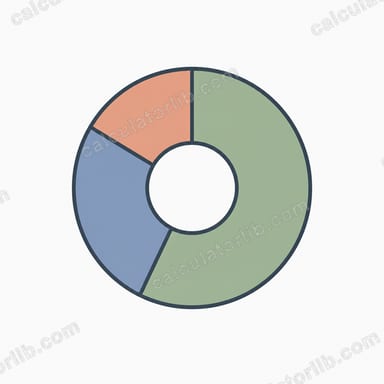
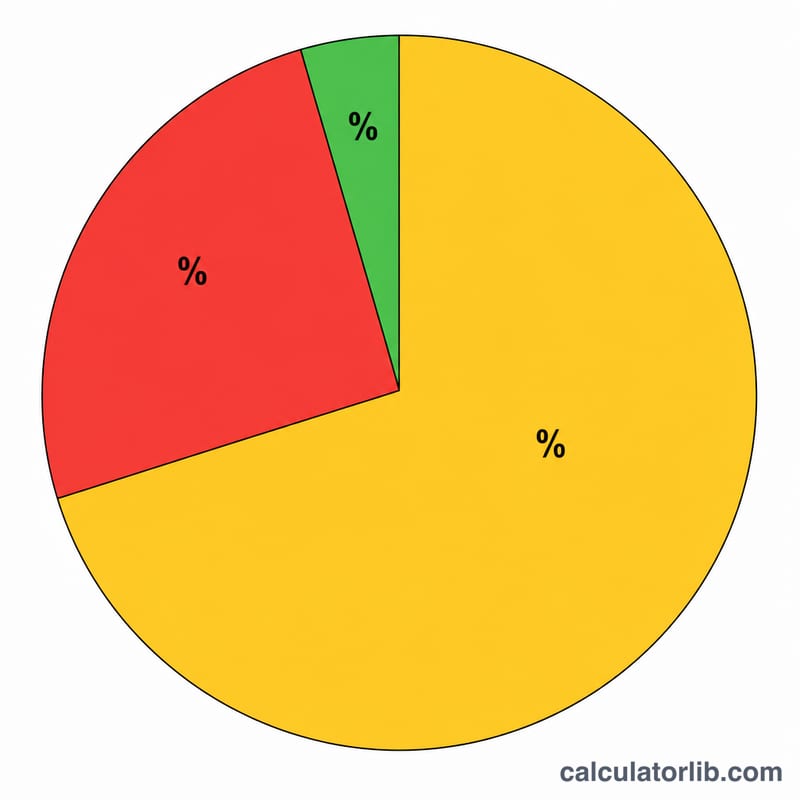
The ketogenic diet is built around a specific balance of macronutrients: high fat, moderate protein, and very low carbohydrates. This calculator turns your daily calorie target into concrete gram amounts for fat, protein, and carbs so you can plan meals without guessing. By default it uses the classic 70% fat / 25% protein / 5% carbs split, but you can adjust each percentage to match your own plan.
How to Use It
Enter your daily calorie goal (for example, the calories needed to maintain or lose weight). Optionally adjust the fat, protein, and carb percentages — for best results they should add up to 100%. The calculator then shows how many grams of each macronutrient that target translates into.
The Formula Explained
Each macronutrient supplies a known amount of energy per gram: fat provides 9 kcal/g, while protein and carbohydrates each provide 4 kcal/g. To find grams, take the calories assigned to that macro and divide by its energy density:
$$\text{Fat (g)} = \frac{\text{Calories} \times \dfrac{\text{Fat \%}}{100}}{9}$$$$\text{Protein (g)} = \frac{\text{Calories} \times \dfrac{\text{Protein \%}}{100}}{4}$$$$\text{Carbs (g)} = \frac{\text{Calories} \times \dfrac{\text{Carb \%}}{100}}{4}$$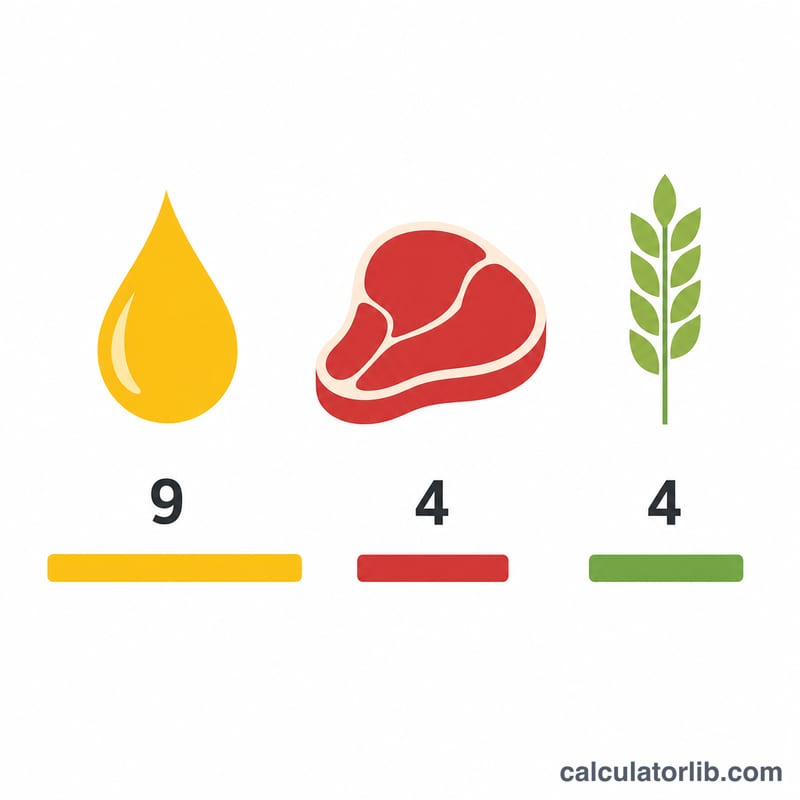
Worked Example
Suppose your daily target is 2,000 kcal on a standard keto split. Fat = \((2000 \times 0.70) \div 9 = 1400 \div 9 \approx\) 155.6 g. Protein = \((2000 \times 0.25) \div 4 = 500 \div 4 =\) 125 g. Carbs = \((2000 \times 0.05) \div 4 = 100 \div 4 =\) 25 g. That gives roughly 156 g fat, 125 g protein, and 25 g net carbs per day.
FAQ
Why is fat so high? On keto, fat becomes your primary fuel source since carbohydrate intake is minimal, so most of your calories come from dietary fat.
How many carbs are allowed on keto? Most people stay under 20–50 g of net carbs per day. At 2,000 kcal the 5% setting gives about 25 g.
Should the percentages add to 100%? Yes — for accurate calorie accounting your fat, protein, and carb percentages should total 100%.