What is the Feet and Inches Arithmetic Calculator?
This tool adds, subtracts, multiplies, divides, scales, or converts lengths written in feet and inches. Each value can be a whole number, a decimal, a simple fraction, or a mixed number such as "61 3/4". Results appear as feet+inches with a tape-measure fraction, decimal feet, and decimal inches. It uses US-customary units (1 foot = 12 inches), but the arithmetic is universal.
How to use it
Enter the first length in the feet and inches boxes. Pick an operation. For two-length operations (add, subtract, multiply, divide) enter the second length. For "Multiply by factor" or "Divide by factor" enter a plain number in the factor box. Choose how finely to round the inch fraction (default 1/8"). Then read the answer in all formats.
The formula
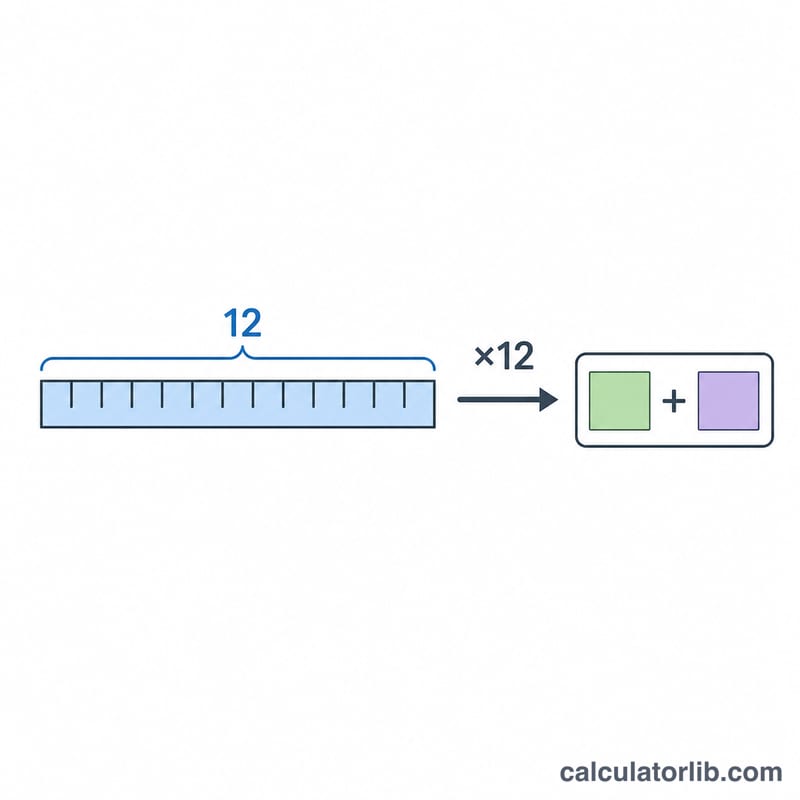
Every value is normalized to decimal inches: $$\text{total} = \text{feet} \times 12 + \text{inches}$$. The chosen operation runs on those inch totals. The result R is converted back: whole \(\text{feet} = \left\lfloor R/12 \right\rfloor\); remaining inches are rounded to the nearest 1/denominator and reduced to lowest terms; a carry pushes 12 in up to 1 ft.
Worked example
First value: 0 ft, 61 3/4 in = \(61.75\) in. Add a second value of 21 ft 7 3/8 in = \(252 + 7.375 = 259.375\) in. $$R = 61.75 + 259.375 = 321.125 \text{ in} = 26.7604 \text{ ft} = 26 \text{ ft } 9\tfrac{1}{8} \text{ in} = 321\tfrac{1}{8} \text{ in}$$
Inch Fraction to Decimal Conversion Table
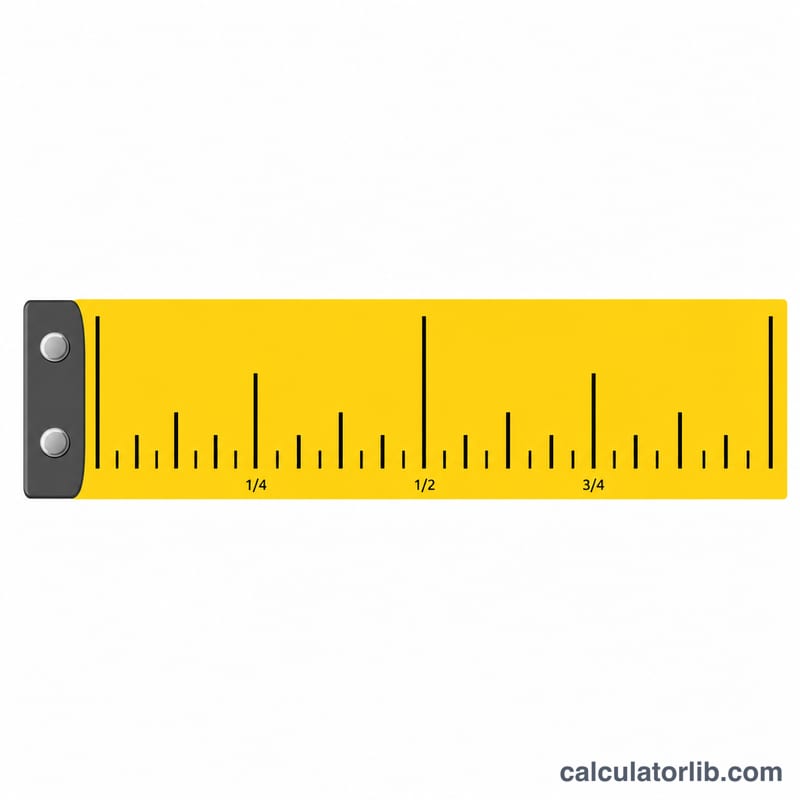
Tape measures in the US and Canada are usually marked in sixteenths of an inch. The table converts each 1/16 step to decimal inches and millimetres, using the exact definition of 25.4 mm per inch.
| Fraction (in) | Reduced | Decimal inches | Millimetres |
|---|---|---|---|
| 1/16 | 1/16 | 0.0625 | 1.5875 |
| 2/16 | 1/8 | 0.125 | 3.175 |
| 3/16 | 3/16 | 0.1875 | 4.7625 |
| 4/16 | 1/4 | 0.25 | 6.35 |
| 5/16 | 5/16 | 0.3125 | 7.9375 |
| 6/16 | 3/8 | 0.375 | 9.525 |
| 7/16 | 7/16 | 0.4375 | 11.1125 |
| 8/16 | 1/2 | 0.5 | 12.7 |
| 9/16 | 9/16 | 0.5625 | 14.2875 |
| 10/16 | 5/8 | 0.625 | 15.875 |
| 11/16 | 11/16 | 0.6875 | 17.4625 |
| 12/16 | 3/4 | 0.75 | 19.05 |
| 13/16 | 13/16 | 0.8125 | 20.6375 |
| 14/16 | 7/8 | 0.875 | 22.225 |
| 15/16 | 15/16 | 0.9375 | 23.8125 |
Common inches to decimal feet
| Inches | Decimal feet |
|---|---|
| 1 in | 0.0833 ft (1/12, rounded) |
| 3 in | 0.25 ft |
| 4 in | 0.3333 ft (rounded) |
| 6 in | 0.5 ft |
| 9 in | 0.75 ft |
| 12 in | 1 ft |
To convert any number of inches to decimal feet, divide by 12.
How to Add and Subtract Feet and Inches by Hand
- Line up the units. Either convert each length to inches (feet × 12 + inches), or keep feet and inches in separate columns and work on each column.
- Use a common denominator for fractions. To combine 1/2 and 3/8, rewrite 1/2 as 4/8 first. Then add or subtract the numerators.
- Adding: carry. If the inches total 12 or more, subtract 12 from the inches and add 1 to the feet. For example, 15 in becomes 1 ft 3 in. If the fractions total 1 or more, carry 1 whole inch.
- Subtracting: borrow. If the inches (with fraction) of the first length are smaller than those of the second, take 1 ft from the feet and add 12 in to the inches. Borrow 1 in (as a full fraction, e.g. 16/16) in the same way when the fractions need it.
- Subtract the columns and write the answer as feet, inches and a reduced fraction.
Example with borrowing
Compute 10 ft 3 in − 4 ft 9 1/2 in.
- 3 in is less than 9 1/2 in, so borrow 1 ft: 10 ft 3 in becomes 9 ft 15 in.
- Inches: 15 − 9 1/2 = 5 1/2 in.
- Feet: 9 − 4 = 5 ft.
Check in inches: 123 in − 57.5 in = 65.5 in, and 65.5 ÷ 12 = 5 remainder 5.5. The result is 5 ft 5 1/2 in.
FAQ
What does multiplying two lengths give? Length x length is technically an area; the calculator carries the raw numeric product through the same length formatting for convenience.
What about dividing two lengths? Length / length is a dimensionless ratio (a pure number), so it is shown as a single value.
Can results be negative? Yes. Subtraction can produce a negative length; the sign is shown and the magnitude is formatted normally.