

What is the Resin 3D Print Cost Calculator?
Resin (SLA, MSLA/LCD or DLP) 3D printing uses liquid photopolymer measured in millilitres. Slicing software such as Lychee, ChiTuBox or PrusaSlicer reports the estimated resin volume for each model. This calculator turns that volume figure into a real money cost using the price and size of your resin bottle, so you can quote jobs, set Etsy prices, or simply track your hobby spend.
How to use it
Enter three numbers: the resin volume used (ml) from your slicer, the bottle price you paid, and the bottle size in ml (commonly 500, 1000 or 5000 ml). The calculator first works out the price per millilitre, then multiplies it by the volume used to give the material cost of the print.
The formula explained
The math is two simple steps. First, price per ml = bottle price ÷ bottle volume. Second, cost = volume used × price per ml. Equivalently, cost = volume × (bottle price ÷ bottle volume). This counts only raw resin — it ignores wash alcohol (IPA), FEP wear, electricity and failed prints, which you can add as a markup.
$$\text{Cost} = \text{Volume}_{ml} \times \dfrac{\text{Bottle Price}}{\text{Bottle Volume}_{ml}}$$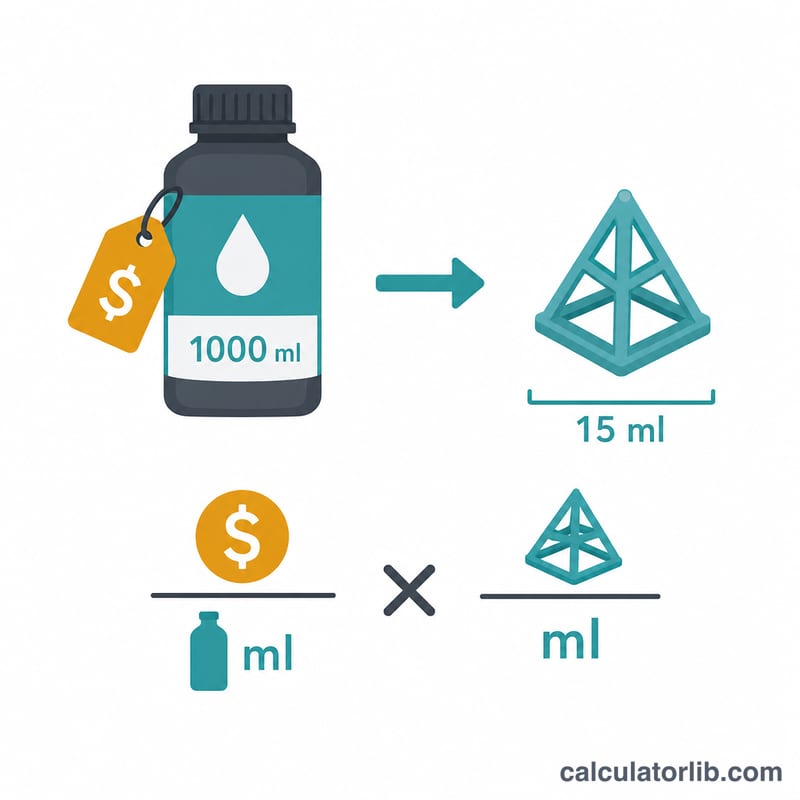
Worked example
Suppose a miniature uses 30 ml of resin, your bottle cost $35 and holds 1000 ml. Price per ml = \(35 \div 1000 = \$0.035\). Cost = \(30 \times 0.035 = \$1.05\) of resin. Even a large 250 ml print from that bottle costs only $8.75 in material.
Typical Resin Bottle Prices and Sizes
Standard SLA/LCD photopolymer resin is most commonly sold in 500 ml, 1000 ml (1 litre) and 5000 ml (5 litre) bottles. The figure that actually drives your print cost is the price per millilitre, found by dividing the bottle price by its volume in millilitres:
$$\text{Price per ml} = \frac{\text{Bottle Price}}{\text{Bottle Size (ml)}}$$
The ranges below reflect typical retail pricing. Buying in larger bottles almost always lowers the per-ml cost, while specialty resins (ABS-like/tough, water-washable) usually sit at the higher end.
| Resin type | Bottle size | Typical price range | Approx. price per ml |
|---|---|---|---|
| Standard | 500 ml | $15 – $25 | $0.030 – $0.050 |
| Standard | 1000 ml | $20 – $35 | $0.025 – $0.035 |
| Standard | 5000 ml | $80 – $130 | $0.016 – $0.026 |
| ABS-like / Tough | 1000 ml | $28 – $45 | $0.028 – $0.045 |
| Water-washable | 1000 ml | $25 – $40 | $0.025 – $0.040 |
| Water-washable | 500 ml | $18 – $28 | $0.036 – $0.056 |
For example, a $25 standard resin sold in a 1000 ml bottle works out to $25 ÷ 1000 ml = $0.025 per ml.
Pricing and Margin Recommendations
The volume × price-per-ml figure is only the raw resin cost. If you sell prints, that number is rarely your true cost and is almost never a fair price. Build in the following before quoting:
- Supports and waste resin: supports, rafts and the resin clinging to the FEP/build plate are real consumption — add roughly 10–25% to the part volume your slicer reports.
- IPA / cleaning solution: isopropyl alcohol (or water for washable resin) is consumed and eventually replaced; allocate a small per-print amount.
- Consumables: FEP/nFEP film, gloves, paper towels, filters and the periodic LCD screen replacement all wear out. Spread their cost across the prints they produce.
- Electricity and curing: the printer and wash/cure station draw power — usually minor per print, but include it for accurate costing. You can estimate this with an electricity cost calculator using the device wattage and run time.
- Failed prints: resin printing has a real failure rate. Adding 10–20% covers the resin and time lost to failed or rejected parts.
- Labour: slicing, plating, washing, support removal, curing and finishing take time. Cost this at a realistic hourly rate — it is often the largest line item for finished pieces.
A common rule of thumb for hobby sellers is to at least double the raw material cost to absorb consumables, failures and basic handling, then add labour on top for finished or painted pieces. Always round up to a clean price — it protects your margin and simplifies quoting.
For pricing decisions, treat the resin figure as your cost of goods and check your markup with a gross margin calculator: if a part costs $6 in resin and consumables and you sell it for $20, that is a 70% gross margin. Aim for a margin that genuinely covers your time and equipment depreciation, not just the resin.
This is general information to help with cost estimation, not professional financial or business advice. Prices, tax treatment and what the market will bear vary by region and product — adjust to your own situation.
FAQ
Where do I find the volume used? Your slicer shows it after slicing, usually labelled "resin" or "volume" in ml.
Should I add a margin? Yes — for selling, add waste, supports, consumables and labour. Doubling the raw resin cost is a common rough rule.
What currency does it use? Any. The result is in the same currency as the bottle price you enter.