What Is Available Credit?
Available credit is the amount you can still borrow or spend on a credit card or line of credit. It is what remains after your current balance and any pending (not-yet-posted) charges are subtracted from your total credit limit. Knowing this number helps you avoid declined transactions, over-limit fees, and surprises at checkout.
How to Use This Calculator
Enter your credit limit, your current balance (what you already owe), and any pending charges that haven't posted yet. The calculator returns your available credit, your total credit used, and your credit utilization ratio — a key factor in your credit score.
The Formula
The math is a simple subtraction:
$$\text{Available Credit} = \text{Credit Limit} - \text{Current Balance} - \text{Pending Charges}$$
Utilization is calculated as $$\text{Utilization} = \frac{\text{Balance} + \text{Pending}}{\text{Limit}} \times 100$$ Many lenders suggest keeping utilization below \(30\%\) to protect your credit score.
Worked Example
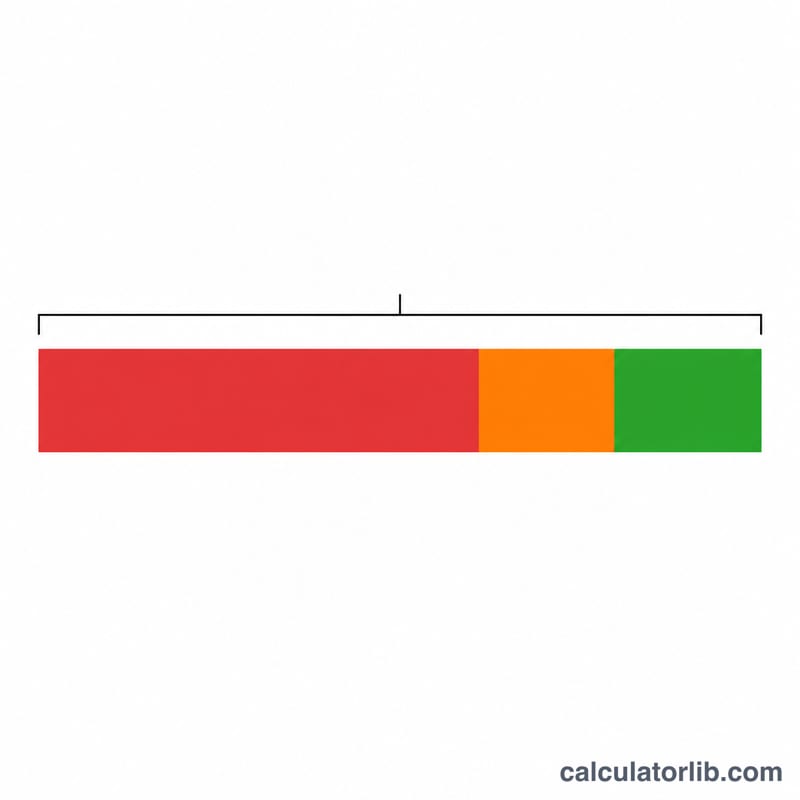
Suppose your credit limit is $5,000, your current balance is $1,200, and you have $300 in pending charges. Your available credit is $$\$5{,}000 - \$1{,}200 - \$300 = \$3{,}500$$ Your credit used is $1,500, giving a utilization of $$\$1{,}500 \div \$5{,}000 \times 100 = 30\%$$
Interpreting Your Available Credit and Utilization
Available credit is the part of your limit you can still spend: \(\text{Limit} - \text{Balance} - \text{Pending}\). A related figure is the credit utilization ratio, which compares what you owe with your limit:
$$\text{Utilization} = \frac{\text{Balance}}{\text{Credit Limit}} \times 100\%$$
Credit scoring commentary (for example around FICO and VantageScore, which are US-based models) commonly describes utilization in rough bands. These are rules of thumb, not official cutoffs, and the exact weighting is not published:
- Under 10%: often described as very low use, and typical of the strongest profiles.
- 10–30%: often described as low to moderate. Under 30% is a widely quoted benchmark.
- 30–50%: often described as moderate to elevated use.
- Above 50%: often described as high use that may weigh more heavily on scores.
- Above 100% (over-limit): the balance exceeds the limit. This is usually treated as the highest-risk band, and fees or a declined transaction may follow depending on the issuer and your account terms.
Some points to keep in mind:
- Per card and overall: utilization is usually evaluated both on each revolving account and across all of them combined, so one nearly maxed card can stand out even when your overall figure looks modest.
- Reporting timing: issuers typically report the balance as of the statement closing date, not your balance on the payment due date. The utilization on your credit report can therefore differ from what you see today.
- Pending charges: they reduce your available credit right away but usually are not in the reported balance until they post. This calculator includes them because they affect what you can spend now.
- Models vary: different scoring models and lenders treat utilization differently, and some also look at trends over time.
This is general information, not personal financial advice.
Scenario Comparison: Available Credit at Different Balances
All rows use a fixed $5,000 credit limit. "Total used" is current balance plus pending charges, and utilization here is total used ÷ limit. Scoring models may instead use only the reported statement balance.
| Current balance | Pending charges | Total used | Available credit | Utilization |
|---|---|---|---|---|
| $0 | $0 | $0 | $5,000 | 0% |
| $500 | $0 | $500 | $4,500 | 10% |
| $1,200 | $300 | $1,500 | $3,500 | 30% |
| $2,500 | $0 | $2,500 | $2,500 | 50% |
| $4,000 | $500 | $4,500 | $500 | 90% |
| $4,800 | $400 | $5,200 | -$200 (over limit by $200) | 104% |
Example for the last row: \(5{,}000 - 4{,}800 - 400 = -200\), and \(5{,}200 \div 5{,}000 = 1.04\), or 104%. A negative result means you have gone past your limit.
Key Terms: Credit Limit, Balance, Pending Charges
- Credit limit
- The maximum amount the issuer allows you to owe on a revolving account such as a credit card or line of credit.
- Current balance
- The amount you owe right now from posted transactions, including purchases, fees and interest, minus payments and credits.
- Statement balance
- The balance on your account at the close of a billing cycle. It is the amount printed on your statement and is often the figure reported to credit bureaus.
- Pending charges (authorizations)
- Transactions the merchant has authorized but not yet settled. They temporarily hold part of your limit and may later change in amount or drop off.
- Available credit
- What remains to spend: credit limit minus current balance minus pending charges.
- Credit utilization ratio
- The share of your limit that is in use, expressed as a percentage. It can be calculated for one account or across all revolving accounts.
- Over-limit
- A state in which the balance plus pending charges exceeds the credit limit, leaving negative available credit. Whether a transaction is declined or allowed, and whether fees apply, depends on the issuer and your account agreement.
FAQ
Why is my available credit lower than my limit minus balance? Pending charges (authorizations like gas holds or hotel deposits) reduce available credit before they post.
Can available credit be negative? Yes — if charges push you over your limit, the result is negative, signaling an over-limit situation.
Does available credit affect my credit score? Indirectly. High utilization (low available credit relative to your limit) can lower your score.