
What this calculator does
This tool converts your treadmill setting into two useful numbers: your running pace in minutes per mile, and an incline-equivalent flat pace — the speed you would have to run on flat ground to work as hard as you are working on the hill. It uses the American College of Sports Medicine (ACSM) running equation to estimate oxygen cost (VO2) so that incline effort can be compared fairly with flat running.
How to use it
Enter your treadmill speed in miles per hour and the incline as a percent grade (most treadmills display this directly). The calculator returns your raw flat pace, your estimated VO2, and the flat pace that matches the same metabolic effort as your incline run.
The formula explained
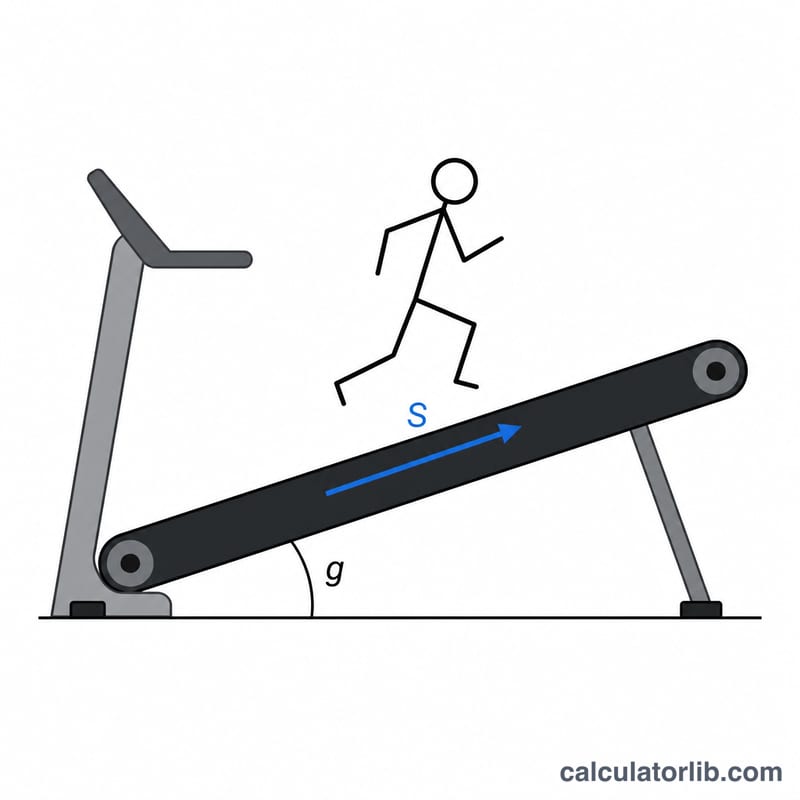
Flat pace is simply \(60 / \text{mph}\) minutes per mile. For effort, speed is converted to meters per minute (1 mph = 26.8224 m/min) and grade to a fraction. The ACSM running equation gives oxygen cost:
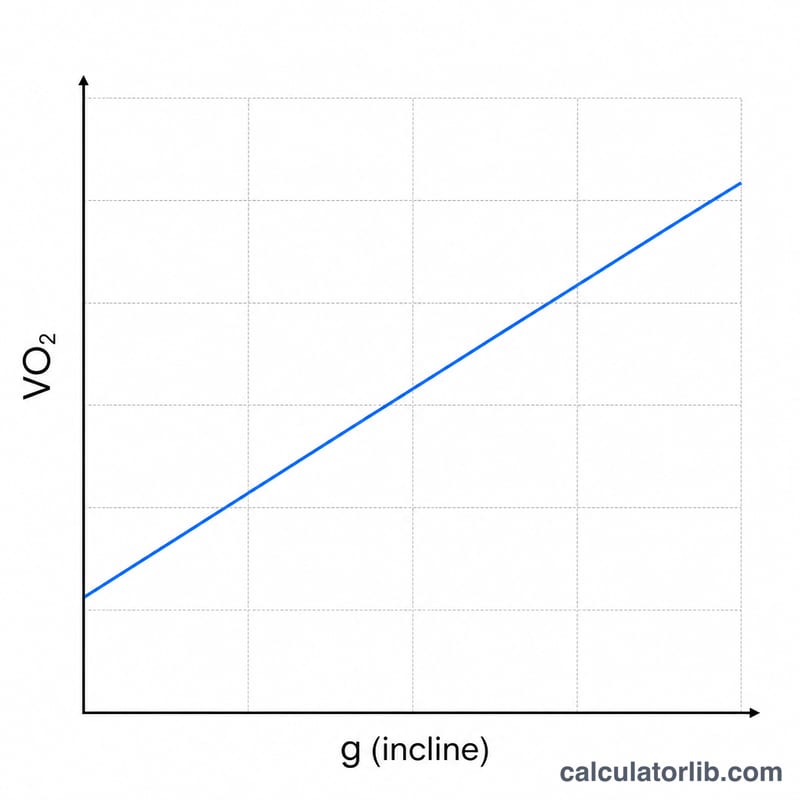
$$\dot{V}O_2 = 0.2\,S + 0.9\,S\cdot g + 3.5$$Setting grade to zero and solving for speed gives the equivalent flat speed, which is converted back into a pace.
Worked example
At 6 mph and 5% incline: flat pace = \(60/6 = 10{:}00\) min/mile. \(S = 6 \times 26.8224 = 160.93\) m/min, \(g = 0.05\).
$$\dot{V}O_2 = 0.2\cdot 160.93 + 0.9\cdot 160.93\cdot 0.05 + 3.5 = 32.19 + 7.24 + 3.5 = 42.93\ \text{ml/kg/min}$$Equivalent flat speed = \(\frac{42.93 - 3.5}{0.2} = 197.17\) m/min = 7.35 mph, giving an effort-equivalent pace of about 8:09 min/mile.
FAQ
Why is my incline pace faster than my flat pace? Because hills add effort. The equivalent flat pace shows how fast you would be running on level ground for the same energy cost.
Is the VO2 value exact? It is an estimate from the ACSM model and assumes steady-state running above ~5 mph; treat it as a guide.
Does this account for my weight? No — VO2 is expressed per kilogram of body weight, so it is independent of mass.