
What is the APFT Push-Up Score Calculator?
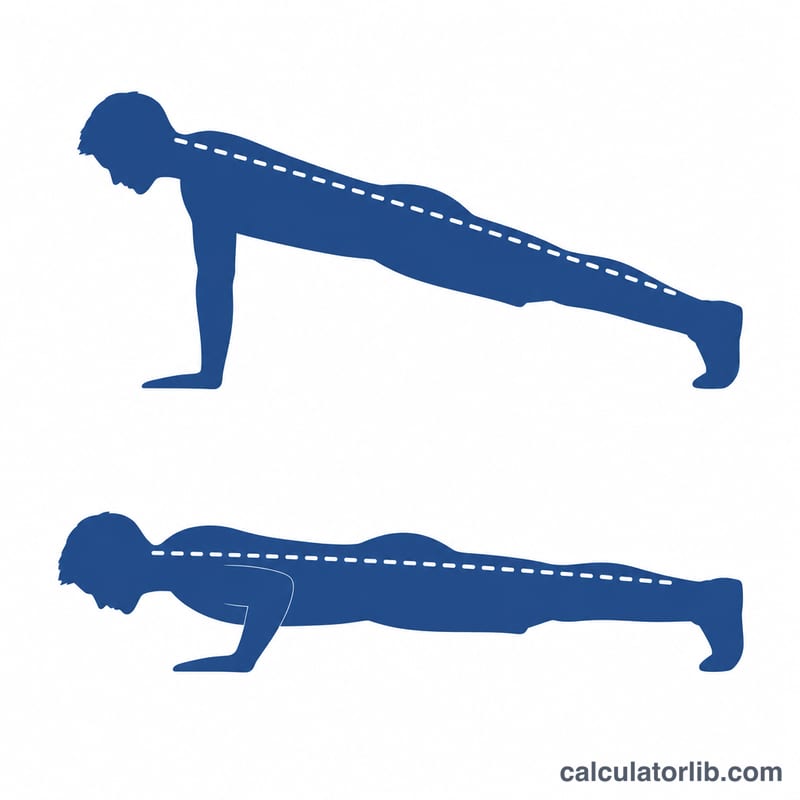
This tool applies to the US Army Physical Fitness Test (APFT). It estimates the 0–100 point score awarded for the two-minute push-up event based on the number of repetitions you complete, your age, and your gender. Scoring is age- and gender-graded, so the same number of reps earns different points depending on your category. Note: the APFT has been replaced by the Army Combat Fitness Test (ACFT) for most purposes; this calculator models the legacy APFT push-up scale and is intended for training reference, not official record-keeping.
How to use it
Select your gender, enter your age, and enter the number of correct push-ups you completed in the two-minute window. The calculator returns your estimated point score, the points earned per rep for your age band, the reps needed for a perfect 100, and the reps required to reach the 60-point minimum passing mark.
The formula explained
Each age/gender band has a target number of reps that earns the maximum 100 points. The points-per-rep value is \(p = 100 / R_{\max}\). Your raw score is \(\text{reps} \times p\), rounded to the nearest whole point and clamped between 0 and 100. A score of 60 or higher is a pass in the event.
$$\text{Score} = \min\left(100,\ \operatorname{round}\left(\text{Push-Ups} \times \frac{100}{R_{\max}}\right)\right)$$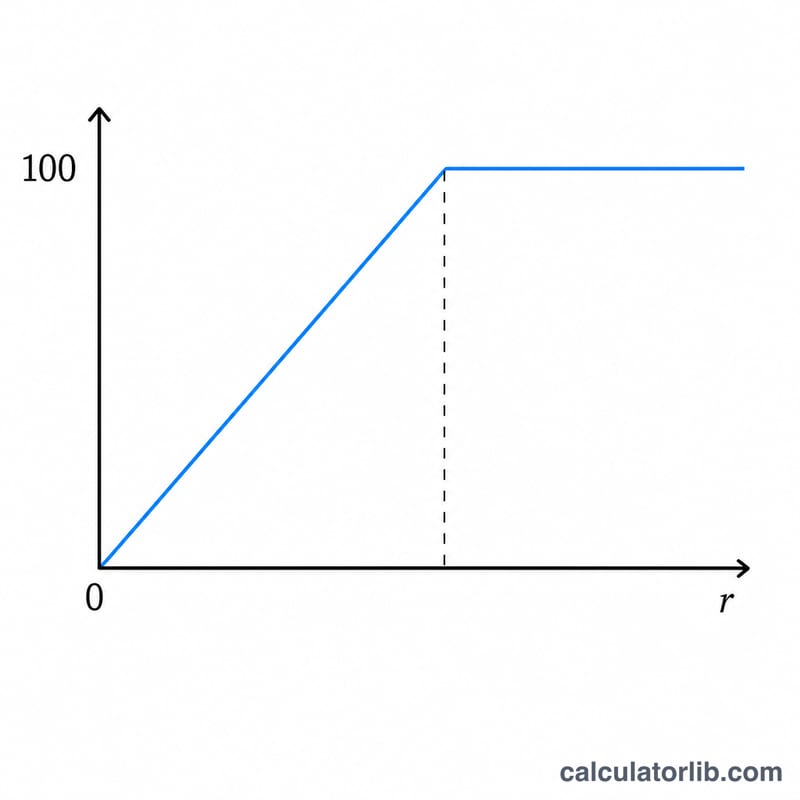
Worked example
A 24-year-old male falls in the 22–26 age band, where 75 reps earn 100 points. So \(p = 100 / 75 = 1.333\) points per rep. With 50 push-ups: $$50 \times 1.333 = 66.67,$$ which rounds to 67 points — a pass. To max the event he would need 75 reps; to pass (60 points) he needs \(\lceil 60 / 1.333 \rceil = 45\) reps.
What Your Push-Up Score Means
The Army Physical Fitness Test (APFT) push-up event is scored on a 0–100 point scale. Your raw number of correct repetitions, completed in the two-minute time limit, is converted to points using an age- and gender-based standard. The fewer reps required for a given score as you get older, the more the scale adjusts to account for age.
There are three reference points worth understanding:
- 60 points — the passing minimum. To pass the APFT, a soldier must score at least 60 points in each of the three events. Scoring 59 or below on push-ups is a failure of the push-up event, regardless of how well you do elsewhere.
- 90+ points — the high-performer / promotion context. Strong scores (90 and above in each event) are commonly used as an informal benchmark of excellent fitness and contribute to the overall total that factors into promotion-point and badge considerations. A balanced 90/90/90 reflects a soldier comfortably above standard in all areas.
- 100 points — the maximum. Once you reach the number of repetitions required for a max score in your age and gender bracket, additional reps earn no extra points — the score is capped at 100.
Because each event tops out at 100, the highest possible APFT total is 300 points (100 push-ups + 100 sit-ups + 100 two-mile run). To pass the overall test, you must both score a minimum of 60 in every event and reach an aggregate of at least 180 points across the three events. Hitting 180 by maxing one event while failing another does not pass — the 60-per-event floor must be met independently.
Note on standards: This calculator scores the legacy APFT (push-ups, sit-ups, two-mile run), which the Army has replaced with the six-event Army Combat Fitness Test (ACFT). The hand-release push-up and scoring used in the ACFT differ from the traditional APFT push-up scored here, so use these results for legacy APFT reference and training benchmarks rather than as current official ACFT standards.
FAQ
Is this the official scoring chart? No. It is a simplified linear model that matches the max-rep targets per band. Official APFT scorecards use fixed lookup tables; use those for any official test.
What counts as passing? 60 points per event was the APFT minimum standard for most soldiers.
Why does my score drop after age 26? Both the model and the official scale set lower max-rep targets in older bands, which can change your points per rep.