
What It Does
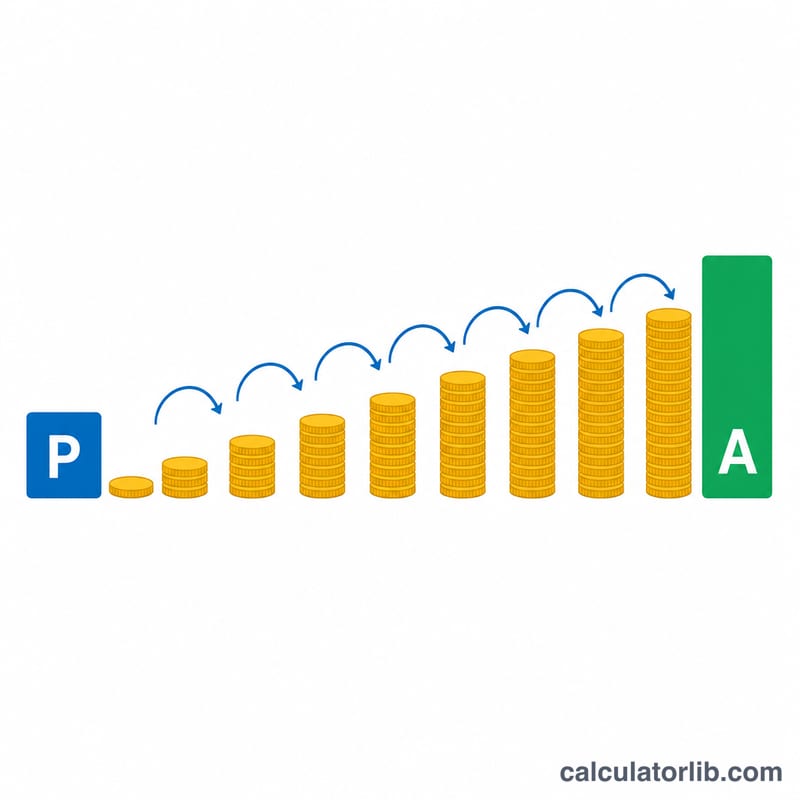
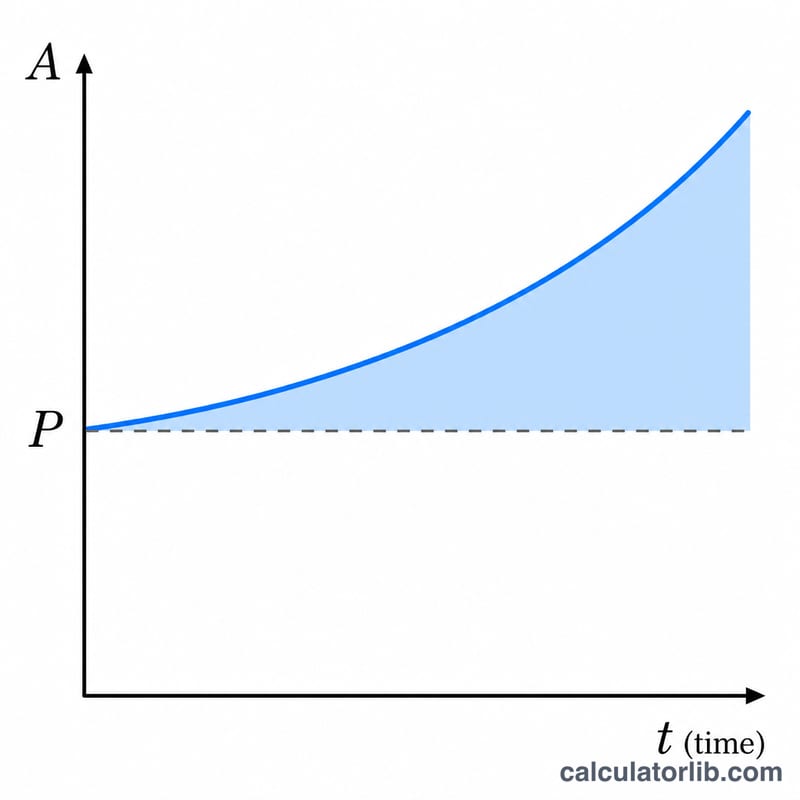
This calculator shows how much a single lump-sum deposit grows when interest is compounded daily. Daily compounding adds interest to your balance every day, so the next day's interest is calculated on a slightly larger amount. Over months and years, this "interest on interest" effect produces a noticeably higher balance than annual compounding.
How to Use It
Enter your initial deposit (the principal), the annual interest rate as a percentage, and the term in years. The calculator returns the future value of the account at the end of the term, plus the total interest earned. You can use decimals for the term — for example, 2.5 years.
The Formula Explained
The formula is $$A = P \times \left(1 + \frac{r}{365}\right)^{365t}$$ where P is the principal, r is the annual rate written as a decimal (5% = 0.05), and t is the number of years. Dividing the rate by 365 gives the daily rate, and the exponent \(365t\) is the total number of days the deposit compounds. Interest earned is simply \(A - P\).
Worked Example
Deposit $10,000 at a 5% annual rate for 5 years. The daily rate is \(0.05/365 \approx 0.00013699\), and there are \(365 \times 5 = 1{,}825\) compounding periods. So $$A = 10{,}000 \times (1.00013699)^{1825} \approx \$12{,}840.03$$ meaning about $2,840.03 in interest.
FAQ
Is daily better than monthly compounding? Yes, but only slightly. The more frequent the compounding, the closer the result gets to continuous compounding, with diminishing differences.
Does this include regular contributions? No — this tool assumes a single one-time deposit with no extra payments.
Should I use 365 or 360 days? This calculator uses a 365-day year, which is the most common convention for savings accounts.