
What Is the Residential Clean Energy Credit?
This calculator applies to the United States only. The Residential Clean Energy Credit (formerly the Solar Investment Tax Credit) is a federal income tax credit claimed on IRS Form 5695. Under the Inflation Reduction Act, the credit equals 30% of qualified expenditures for systems placed in service from 2022 through 2032, stepping down to 26% in 2033 and 22% in 2034. It covers solar electric panels, solar water heaters, wind turbines, geothermal heat pumps, fuel cells, and battery storage (3 kWh or larger).
How to Use This Calculator
Enter your total qualified clean energy cost — including equipment, labor for installation, wiring, and mounting hardware. The credit rate defaults to 30%; adjust it only if your system is placed in service in a step-down year. The tool shows your estimated credit and your net cost after the credit.
The Formula Explained
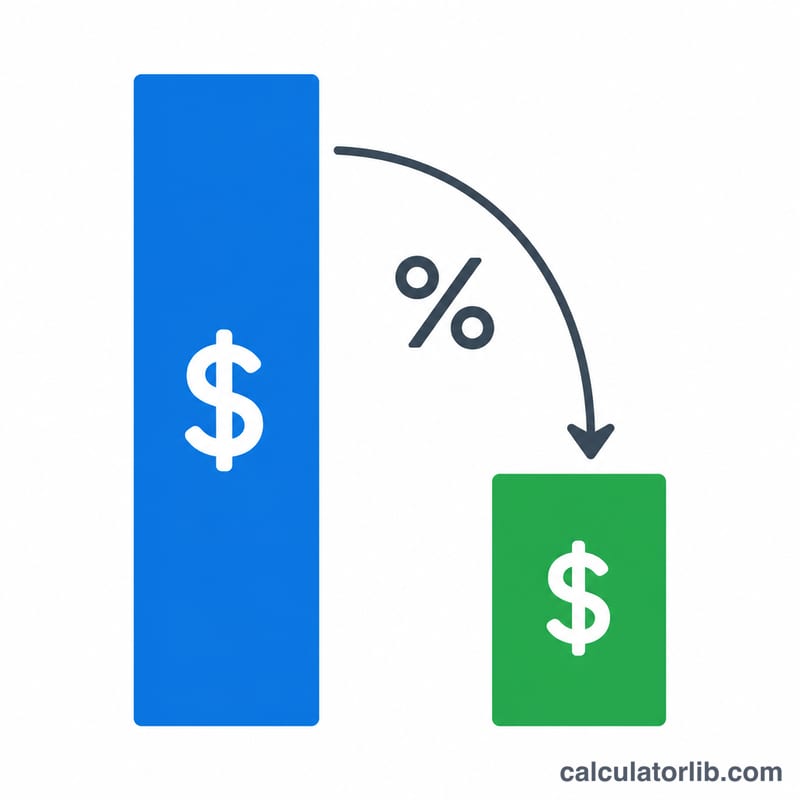
The math is simple: $$\text{Credit} = \text{Cost} \times \frac{\text{Rate (\%)}}{100}$$. With a 30% rate, a $20,000 solar installation yields a $6,000 credit, leaving a $14,000 net cost. The credit is nonrefundable, meaning it reduces the tax you owe but won't generate a refund beyond your liability — though any unused amount can be carried forward to future years.
Worked Example
Suppose you install a solar system costing $25,000. At the 30% rate: $$25{,}000 \times 0.30 = 7{,}500$$ credit. Your net out-of-pocket cost becomes $$25{,}000 - 7{,}500 = 17{,}500$$.
FAQ
Is there a maximum credit? For most solar and clean energy property there is no dollar cap (fuel cells have a limit). Does it include the roof? Generally no — only the solar property and directly related costs qualify, not a full re-roof. Can I claim it on a rental? The credit is for your residence; landlords generally cannot claim it for property they don't live in. Always confirm details with a tax professional or IRS guidance.