
What Is Percent Markup on Cost?
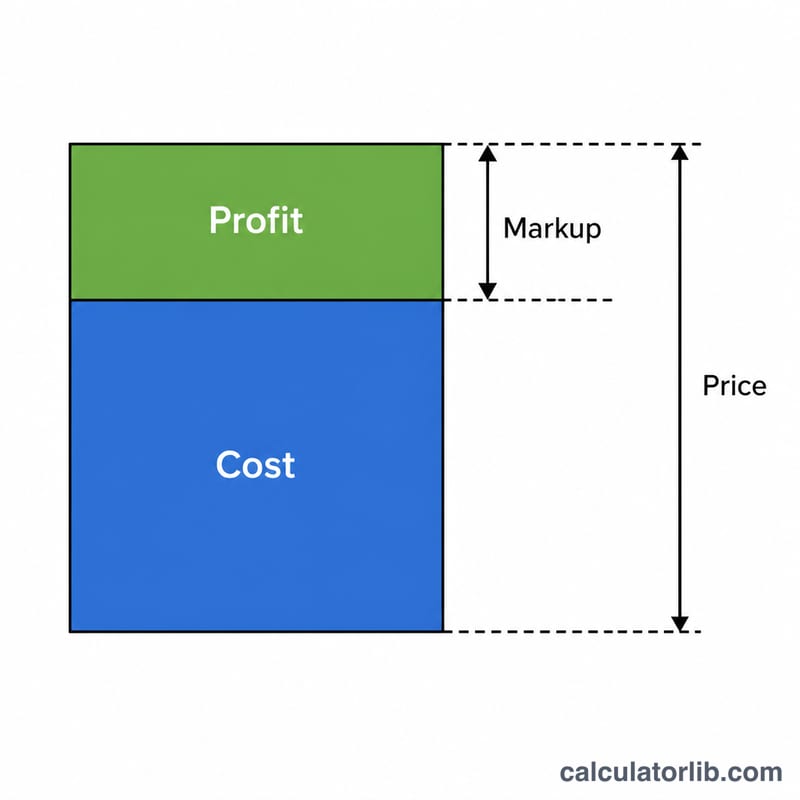
Markup on cost is the amount you add to the cost of a product, expressed as a percentage of that cost. It tells you how much profit you are layering on top of what you paid. If you buy an item for $80 and sell it for $100, your $20 profit represents a 25% markup on cost. Markup is one of the simplest pricing tools used by retailers, wholesalers, and service businesses to set selling prices that cover costs and deliver a target profit.
How to Use This Calculator
Enter the cost you paid for the item and the selling price you charge customers. The calculator returns the percent markup on cost, the profit per unit (price minus cost), and the profit margin measured against the selling price. Use it to compare suppliers, test new price points, or confirm a markup hits your business target.
The Formula Explained
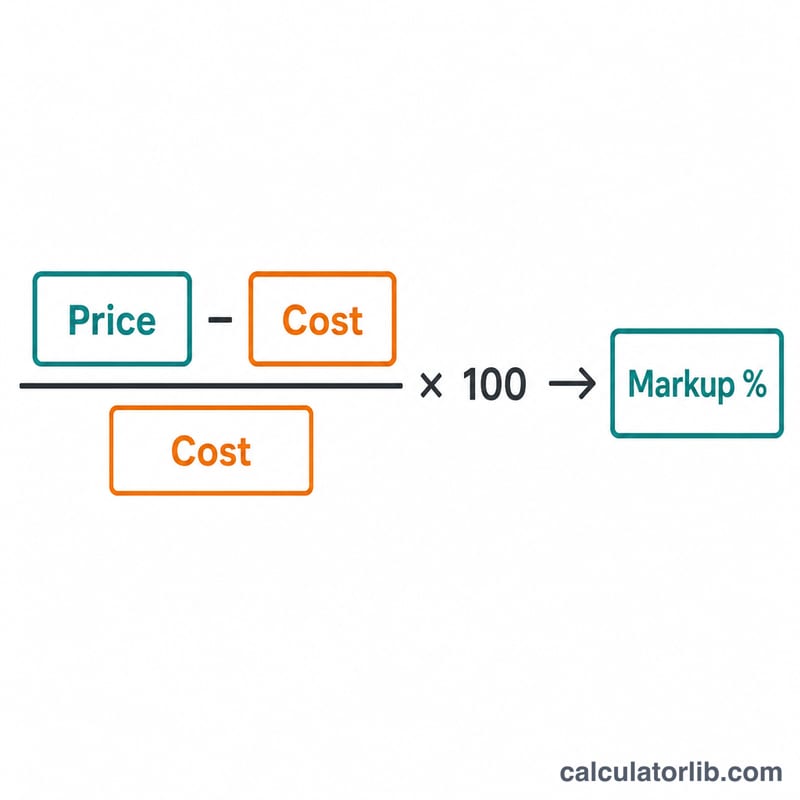
The markup percentage is calculated as:
$$\text{Markup \%} = \frac{\text{Price} - \text{Cost}}{\text{Cost}} \times 100$$
The numerator (Price − Cost) is your gross profit per unit. Dividing by cost expresses that profit relative to what you spent, then multiplying by 100 turns it into a percentage. Markup is always measured against cost, whereas margin is measured against the selling price — which is why the two figures differ.
Worked Example
Suppose a product costs $80 and you sell it for $100. Profit = \(\$100 - \$80 = \$20\). Markup:
$$\frac{20}{80} \times 100 = \textbf{25\%}$$
The same sale has a profit margin of \(\$20 \div \$100 \times 100 = 20\%\). So a 25% markup equals a 20% margin.
FAQ
What is the difference between markup and margin? Markup is profit as a percentage of cost; margin is profit as a percentage of selling price. Markup is always the larger number.
Can markup exceed 100%? Yes. If you double the price relative to cost, the markup is 100%; selling for triple the cost gives a 200% markup.
How do I find price from a target markup? Multiply cost by \((1 + \text{markup}/100)\). For a 25% markup on an $80 cost: \(\$80 \times 1.25 = \$100\).