
What Is the Margin With Discount Calculator?
When you offer a discount on a product, your selling price drops but your cost stays the same — which means your profit margin shrinks. This calculator shows exactly how much margin remains after a discount, so you can decide whether a promotion is still profitable. It works for any currency; just enter your figures in the same units.
How to Use It
Enter three numbers: the list price (the full pre-discount price), the unit cost (what the item costs you), and the discount percentage you plan to offer. The calculator returns your discounted revenue, the profit per unit, the resulting profit margin, and the equivalent markup on cost.
The Formula Explained
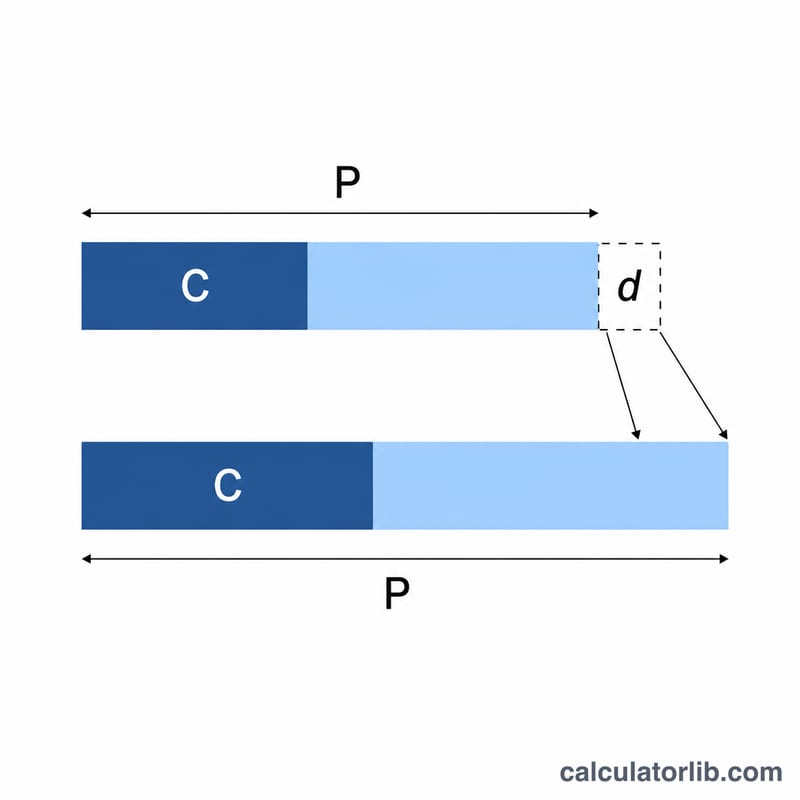
First, the discount reduces the price to find the actual revenue: $$\text{Revenue} = \text{Price} \times \left(1 - \frac{\text{Discount}}{100}\right)$$ Profit is simply \(\text{Revenue} - \text{Cost}\). Margin expresses that profit as a share of revenue: $$\text{Margin} = \frac{\text{Revenue} - \text{Cost}}{\text{Revenue}} \times 100$$ Because the denominator is the discounted revenue, deeper discounts cut margin faster than they cut price.
Worked Example
Suppose an item lists at $100, costs you $60, and you apply a 10% discount. Discounted revenue is $$\$100 \times (1 - 0.10) = \$90$$ Profit is $$\$90 - \$60 = \$30$$ Margin is $$\frac{\$30}{\$90} \times 100 = 33.33\%$$ Without the discount your margin would have been 40%, so a 10% price cut trimmed about 6.7 percentage points of margin.
FAQ
What's the difference between margin and markup? Margin is profit divided by selling price; markup is profit divided by cost. A 33.33% margin equals a 50% markup.
Can margin go negative? Yes — if the discounted price falls below your cost, profit and margin become negative, signalling a loss-making sale.
Is this before or after tax? The calculation is pre-tax gross margin. It ignores taxes, shipping, and overhead unless you build those into your unit cost.