
What the Triple Discount Calculator Does
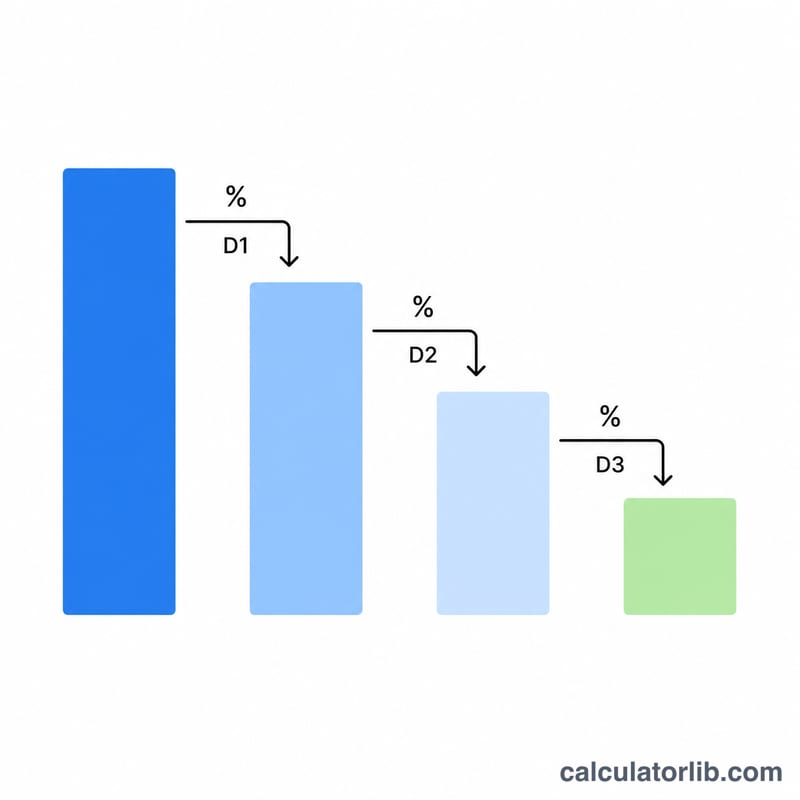
This calculator works out the final price of an item after three separate discounts are applied one after another (cascading), not all at once. This is common with stacked promotions — for example a sale price, plus a coupon, plus a loyalty discount. Each percentage is applied to the price that remains after the previous discount, which is why three "20% off" deals do not equal 60% off.
The Inputs You Enter
- Initial Price — the original price before any discount.
- First Discount (%) — applied to the initial price.
- Second Discount (%) — applied to the price that remains after the first discount.
- Third Discount (%) — applied to the price that remains after the second discount.
The Formula
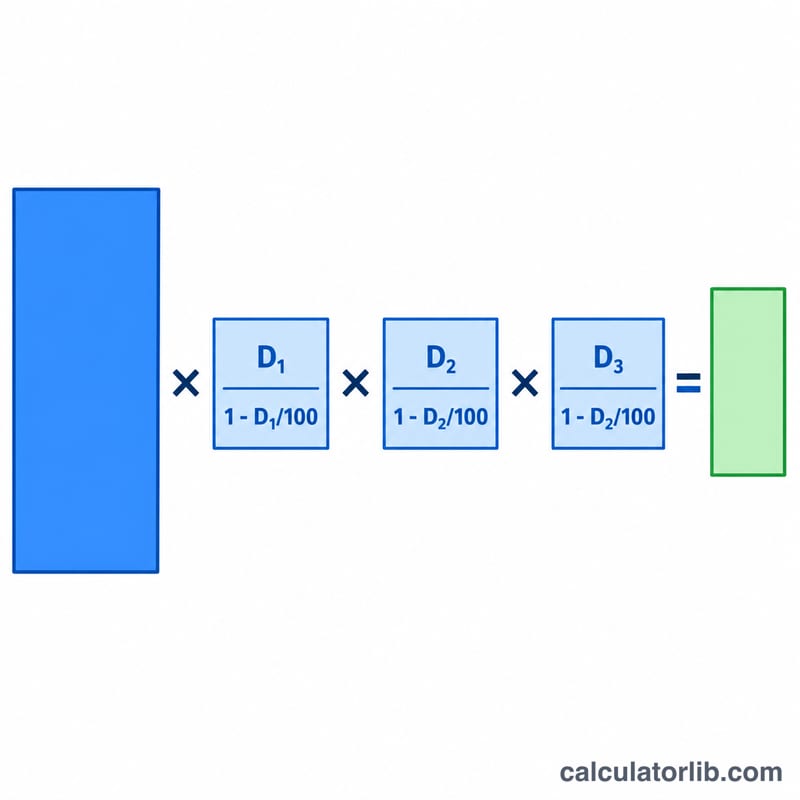
The calculator multiplies the price by each discount factor in turn:
P = Pinit × (1 − d₁/100) × (1 − d₂/100) × (1 − d₃/100)
It also reports the price after each step, the total savings (initial price − final price), and the effective discount rate = (total savings ÷ initial price) × 100, which tells you the single equivalent discount.
Worked Example
Suppose the initial price is $200 with discounts of 20%, 10% and 5%:
- After first discount: 200 × (1 − 0.20) = $160
- After second discount: 160 × (1 − 0.10) = $144
- After third discount (final price): 144 × (1 − 0.05) = $136.80
- Total savings: 200 − 136.80 = $63.20
- Effective discount rate: (63.20 ÷ 200) × 100 = 31.6%
Notice the combined 35% in nominal discounts only delivers a 31.6% effective saving.
Frequently Asked Questions
Why isn't 20% + 10% + 5% equal to 35% off? Because each discount applies to a smaller, already-reduced amount. Only the first discount applies to the full price.
Does the order of the discounts matter? No. Multiplication is commutative, so the final price is the same regardless of which discount is applied first — though the intermediate prices will differ.
Can I use it for just one or two discounts? Yes. Set any unused discount field to 0; multiplying by (1 − 0/100) = 1 leaves the price unchanged.