
What Is an Oblique Triangle?
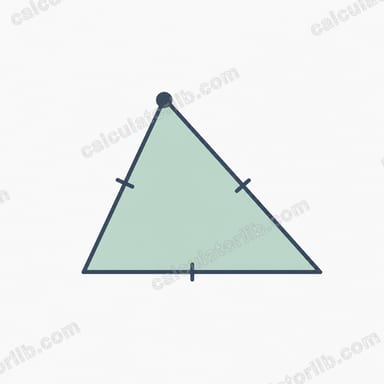
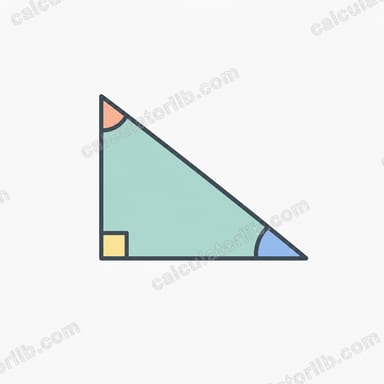
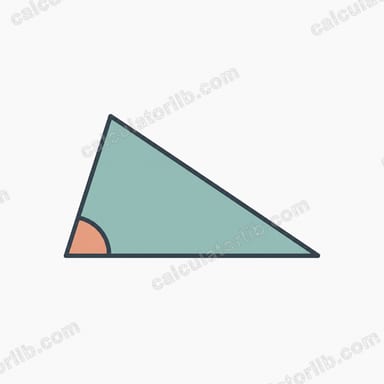
An oblique triangle is any triangle that does not contain a 90° angle. Because the simple right-triangle trig (SOH-CAH-TOA) no longer applies, oblique triangles are solved with two general rules: the law of sines and the law of cosines. This calculator accepts any valid combination of three known parts (with at least one side) and returns the remaining sides, all three angles, the perimeter and the area.
How to Use It
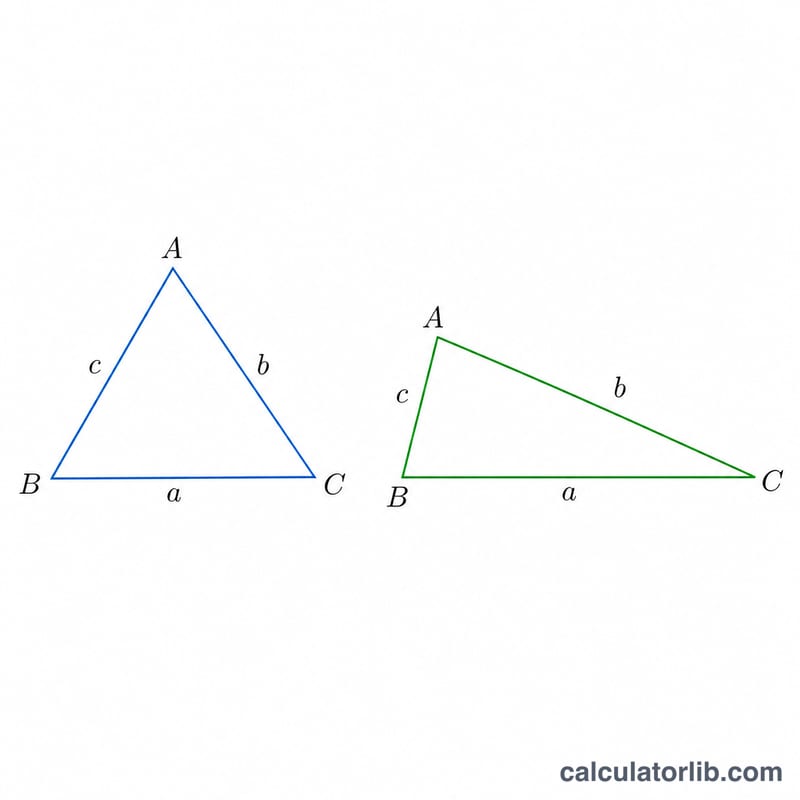
Enter exactly three values — for example two sides and an included angle (SAS), two angles and a side (ASA/AAS), or all three sides (SSS). Leave the unknown boxes blank. Angles are entered in degrees. The solver fills in the missing parts automatically and computes the area using Heron's formula.
The Formulas Explained
The law of sines states that the ratio of a side to the sine of its opposite angle is constant for all three pairs: $$\frac{a}{\sin A} = \frac{b}{\sin B} = \frac{c}{\sin C}$$ It is ideal when you know an angle-side pair plus one more part. The law of cosines, $$c^2 = a^2 + b^2 - 2ab\cdot\cos C,$$ generalises the Pythagorean theorem and is used when the law of sines cannot start — namely SAS (find the third side) and SSS (find an angle). Once enough parts are known, the angle sum \(A + B + C = 180°\) completes the triangle.
Worked Example
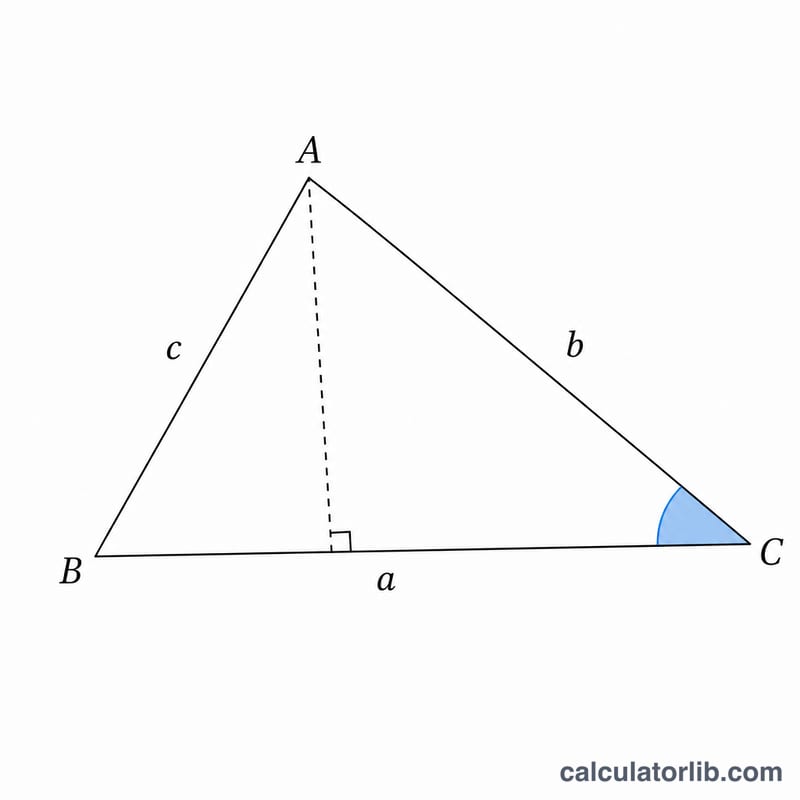
Suppose sides \(a = 5\), \(b = 7\) and the included angle \(C = 60°\). By the law of cosines, $$c^2 = 25 + 49 - 2\cdot5\cdot7\cdot\cos 60° = 74 - 35 = 39,$$ so \(c \approx 6.245\). The remaining angles follow from the law of sines, and the area is $$\tfrac{1}{2}\cdot a\cdot b\cdot\sin C = \tfrac{1}{2}\cdot5\cdot7\cdot\sin 60° \approx 15.155$$ square units.
FAQ
Can I solve a triangle from three angles? No — three angles (AAA) only fix the shape, not the size. You must supply at least one side.
What about the ambiguous SSA case? When you give two sides and a non-included angle there can be two valid triangles. This tool returns the acute solution from the law of sines; check the geometry if a second (obtuse) answer is possible.
What units are used? Sides are unitless lengths and angles are in degrees; the area is in the corresponding square units.