
What this calculator does
This tool builds a multi-day schedule of the five daily Islamic prayer times - Fajr, Dhuhr, Asr, Maghrib and Isha - together with Sunrise and Islamic midnight, for any location on Earth. It also reports the Qibla direction, the compass bearing toward the Kaaba in Makkah. The mathematics follow the widely used praytimes.org astronomical algorithm, so the tool is universal: it is not tied to any single country, only to the calculation-method convention you select.
How to use it
Enter the Gregorian start date, then choose how many consecutive days to tabulate (1 week, 2 weeks or 1 month). Provide your location as decimal-degree longitude (east positive, west negative) and latitude (north positive, south negative), your UTC offset in hours, and altitude in metres. Turn Daylight Saving Time on or off, pick a calculation method (each sets the Fajr and Isha twilight angles) and an Asr juristic method (Standard or Hanafi). The result is a calendar table with each prayer time as local clock time HH:MM.
The formula explained
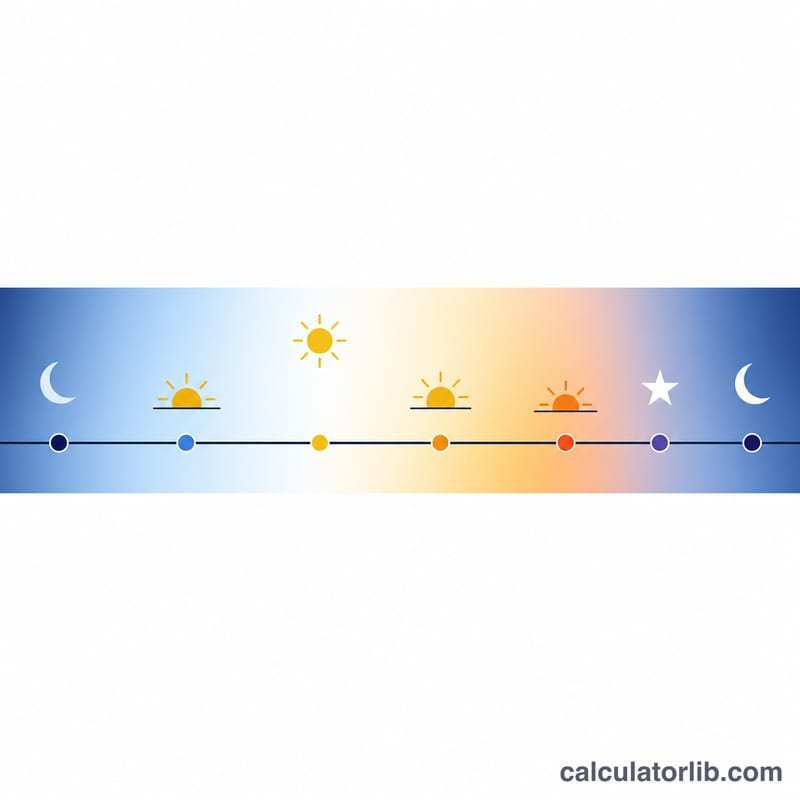
For each day the Julian date gives the Sun's declination and the equation of time. Dhuhr is solar noon adjusted for your meridian and time zone. Every other event is found by solving for the hour angle at which the Sun sits a chosen number of degrees above or below the horizon. Sunrise and Maghrib use a horizon angle that includes refraction and an altitude-dependent dip. Asr uses a shadow-length factor of 1 (Standard) or 2 (Hanafi). At high latitudes, when the Sun never reaches the required twilight depression, an Angle-Based correction places Fajr and Isha at a proportional fraction of the night.
$$\begin{gathered} T_{\text{prayer}} = 12 + \frac{\text{Lng}}{15} + \text{UTC} + \text{DST} - \frac{Eq}{60} \pm \frac{H(\alpha)}{15} \\[1.5em] \text{where}\quad \left\{ \begin{aligned} H(\alpha) &= \arccos\!\left(\frac{-\sin\alpha - \sin\phi\,\sin\delta}{\cos\phi\,\cos\delta}\right) \\ \phi &= \text{Lat} \\ \alpha_{\text{Fajr}} &= 18^{\circ},\quad \alpha_{\text{Isha}} = 17^{\circ} \\ \text{Asr} &: \operatorname{arccot}\!\left(k + \tan|\phi-\delta|\right) \end{aligned} \right. \end{gathered}$$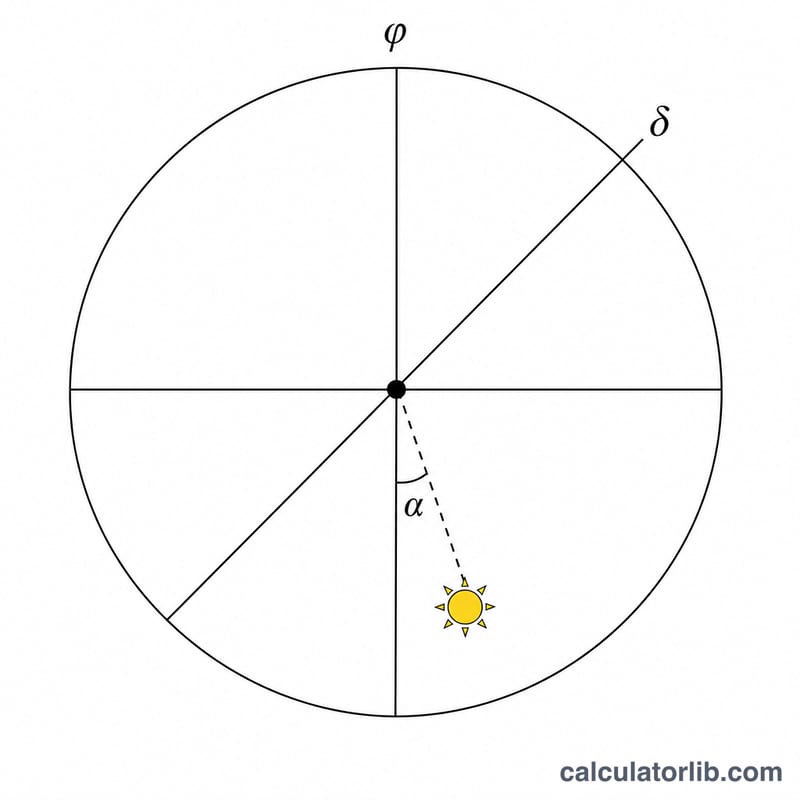
Worked example
For Berlin (latitude 52.5167, longitude 13.4, UTC+1, DST on) on 15 June 2024 with the Muslim World League method, Dhuhr lands near 13:06, Asr near 17:31 and Maghrib near 21:30; because the high summer Sun never sinks to -18 degrees, Fajr and Isha are clamped by the Angle-Based night rule. The Qibla from Berlin is about 136.7 degrees from true north.
FAQ
Why are Fajr and Isha unusual in summer at high latitudes? The Sun does not reach the twilight angle, so the Angle-Based method estimates them as a fraction of the night.
Do I add DST myself? No - leave your UTC offset as the standard zone value and switch DST on; the tool adds one hour.
How accurate is it? The low-precision solar formulas are good to roughly one minute, which is fine for prayer schedules.