What This Calculator Does
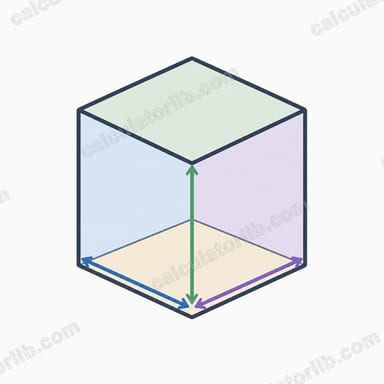
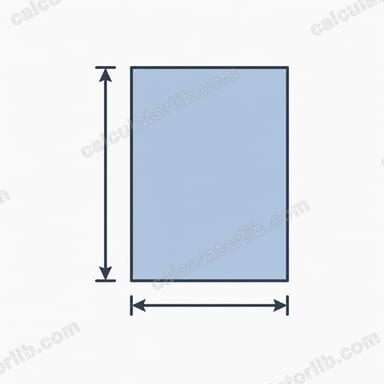
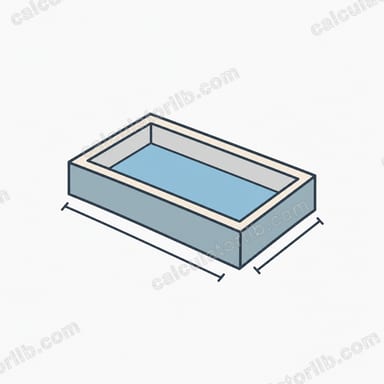
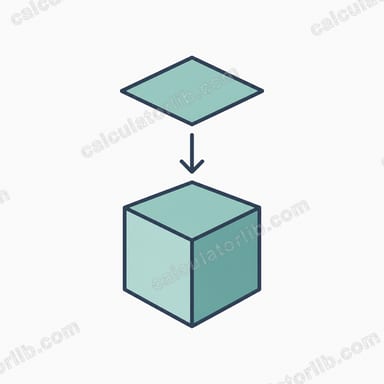
Square feet measure a flat area, while cubic feet measure a three-dimensional volume. To turn a square-foot measurement into cubic feet you simply need one more dimension: the depth, height, or thickness of the material. This calculator multiplies your area by that depth to give you the total volume in cubic feet (and conveniently in cubic yards as well).
How to Use It
Enter the floor area in square feet — for example the surface of a patio, garden bed, or room. Then enter the depth or height in feet. If your depth is in inches, divide by 12 first (a 3-inch layer is 0.25 ft). Click calculate and you get the volume in cubic feet, plus cubic yards for ordering bulk materials like concrete, soil, gravel, or mulch.
The Formula Explained
The relationship is direct:
$$\text{Cubic Feet} = \text{Area (ft}^2\text{)} \times \text{Depth (ft)}$$Because area already accounts for length × width, multiplying by a single depth value completes the third dimension. To convert to cubic yards, divide cubic feet by 27, since a cubic yard is \(3\,\text{ft} \times 3\,\text{ft} \times 3\,\text{ft} = 27\,\text{ft}^3\).

Worked Example
Suppose you have a 120 ft² patio and want a 4-inch concrete slab. Four inches is \(4 \div 12 = 0.333\,\text{ft}\). Volume:
$$120 \times 0.333 = 40\,\text{ft}^3$$Dividing by 27 gives about 1.48 cubic yards of concrete to order.
Inch-to-Foot Depth Conversion Table
The calculator multiplies area in square feet by depth in feet, so depths given in inches must be divided by 12 first: \(\text{depth (ft)} = \text{depth (in)} \div 12\). The table shows common depths and the volume they produce over 100 ft² (cubic feet = 100 × depth in feet). Volumes scale linearly, so 300 ft² needs three times the amount shown.
| Depth (in) | Depth (ft, decimal) | Cubic feet per 100 ft² |
|---|---|---|
| 1 | 0.083 | 8.33 |
| 2 | 0.167 | 16.67 |
| 3 | 0.25 | 25.00 |
| 4 | 0.333 | 33.33 |
| 6 | 0.5 | 50.00 |
| 8 | 0.667 | 66.67 |
| 12 | 1.0 | 100.00 |
Example: 100 ft² at 6 in (0.5 ft) gives \(100 \times 0.5 = \)50 ft³. To convert cubic feet to cubic yards, divide by 27 (1 yd³ = 27 ft³).
Typical Depths by Material
The depths below are commonly cited industry guidelines for residential projects. Actual requirements vary with the project, soil conditions, product manufacturer and local building code, so confirm them before ordering.
| Material / Use | Typical depth | Decimal feet |
|---|---|---|
| Concrete patio or slab | 4 in | 0.333 |
| Concrete driveway | 4–6 in | 0.333–0.5 |
| Mulch | 2–3 in | 0.167–0.25 |
| Topsoil for lawns | 4–6 in | 0.333–0.5 |
| Gravel base | 4–6 in | 0.333–0.5 |
| Garden bed soil | 6–12 in | 0.5–1.0 |
| Sand bed under pavers | 1 in | 0.083 |
Heavy loads, poor soils or freeze-thaw climates often call for thicker layers or reinforcement; follow local code and the product instructions where they differ from these ranges.
Practical Ordering Tips
- Add a buffer. Order about 5–10% extra to cover waste, spillage and an uneven subgrade.
- Round up to the supplier's increment. Bulk suppliers often sell by the cubic yard in steps such as 0.25 or 0.5 yd³. Divide cubic feet by 27 to get cubic yards, then round up.
- Check bag sizes. Bagged products are often sold in 0.5 ft³ or 1 ft³ bags (sizes vary by product). Divide total cubic feet by the bag volume and round up to whole bags.
- Verify depth over the whole area. Measure depth at several points, since slopes, dips and edges change the real average depth.
Example: 400 ft² at 3 in (0.25 ft) of mulch is \(400 \times 0.25 = 100\) ft³, or \(100 \div 27 \approx 3.70\) yd³. Adding 10% gives about 4.07 yd³, so ordering 4.25 or 4.5 yd³ would be sensible. In 0.5 ft³ bags, \(100 \div 0.5 = 200\) bags before the extra.
This is general information for planning purposes; confirm quantities with your supplier or a qualified contractor.
FAQ
Can I convert square feet to cubic feet without depth? No. Square feet is area only; you must supply a depth, height, or thickness to obtain a volume.
What if my depth is in inches? Divide inches by 12 to convert to feet before entering it.
How do I get cubic yards? Divide the cubic-feet result by 27 — this calculator does it for you automatically.