
What this calculator does
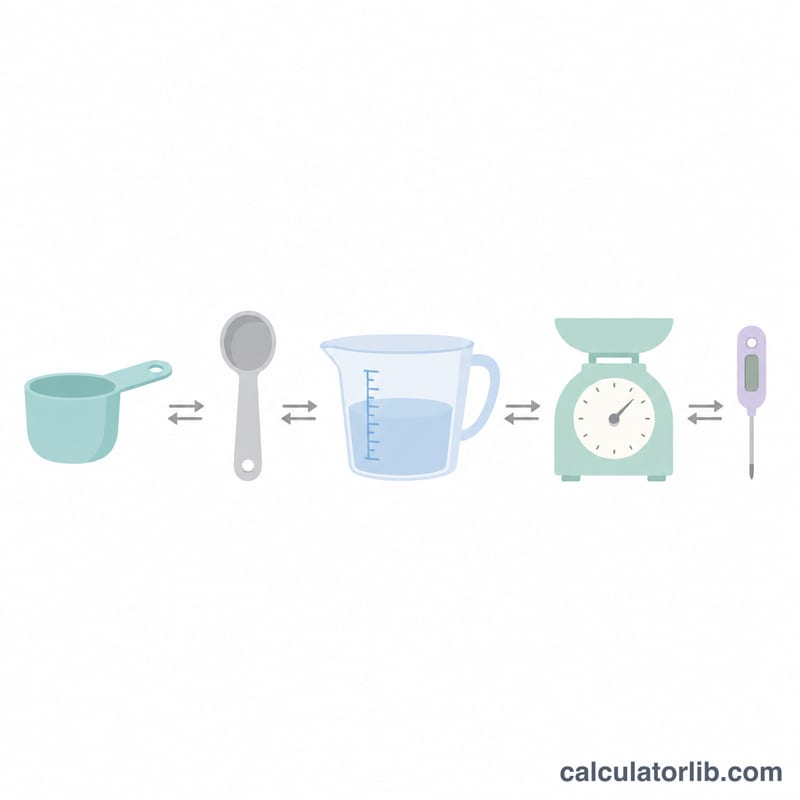
The Cooking Conversion Calculator converts common kitchen measurements between U.S. customary and metric units across five categories: liquid (volume) measures, dry (volume) measures, length, weight, and temperature. All U.S. volume units use the standard U.S. customary system (not Imperial), based on the U.S. fluid gallon of 3.785411784 liters.
How to use it
First choose a category under "Convert". Then pick a source unit under "From:" and a target unit under "To:" that belong to that same category, enter the value to convert, and read the result. Liquid, dry, length, weight, and temperature each have their own unit list, so make sure From and To match your chosen category.
The formula explained
For volume, length, and weight, each unit stores a scale-to-base factor B (liters for volume, meters for length, grams for weight). The calculator converts your input to the base unit and then to the target: $$\text{result} = \text{value} \times \frac{B_{\text{from}}}{B_{\text{to}}}$$ Because every B is greater than zero, there is never a divide-by-zero. Temperature is different: it uses an affine (offset) conversion through Celsius, since the scales do not share a zero point.
Worked example
Convert 2 cups (US) to milliliters. The base value is $$2 \times 0.2365882365 = 0.473176473 \text{ L}$$ Dividing by the milliliter factor 0.001 gives 473.176473 mL. For temperature, 350°F to Celsius is $$(350 - 32) \times \frac{5}{9} = 176.67\,^{\circ}\text{C}$$ a typical oven setting.
FAQ
Are these U.S. or Imperial units? U.S. customary. A U.S. fluid ounce, cup, pint, quart, and gallon are smaller than their Imperial counterparts.
Why are dry and liquid volumes different? The U.S. dry pint, quart, gallon, peck, and bushel form a separate dry-volume series larger than the fluid series, used for produce and grains.
Can I convert temperature with the same ratio method? No. Temperature scales have offsets, so the tool uses a dedicated Celsius-based affine conversion instead of a multiply/divide ratio.