
What is the Pentagon Calculator?
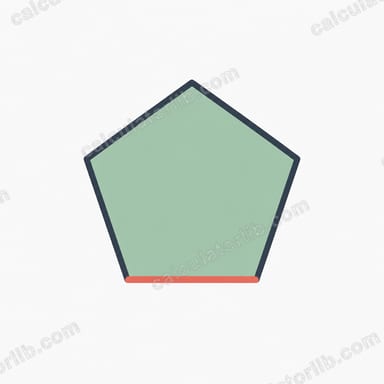
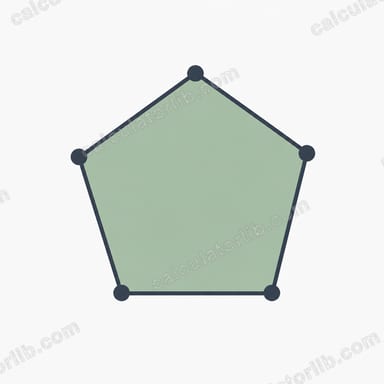
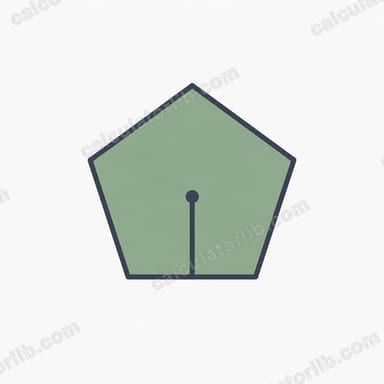
This calculator computes the key measurements of a regular pentagon — a five-sided polygon where every side and every interior angle is equal. From a single input, the side length s, it instantly returns the area, perimeter, apothem, circumradius, and diagonal. It works for any unit (cm, m, in, ft) as long as you stay consistent: the area comes out in square units, and the linear measurements in the same units you entered.
How to use it
Enter the length of one side of the pentagon and press calculate. The tool assumes a regular (equilateral, equiangular) pentagon. If your shape is irregular, these formulas do not apply.
The formula explained
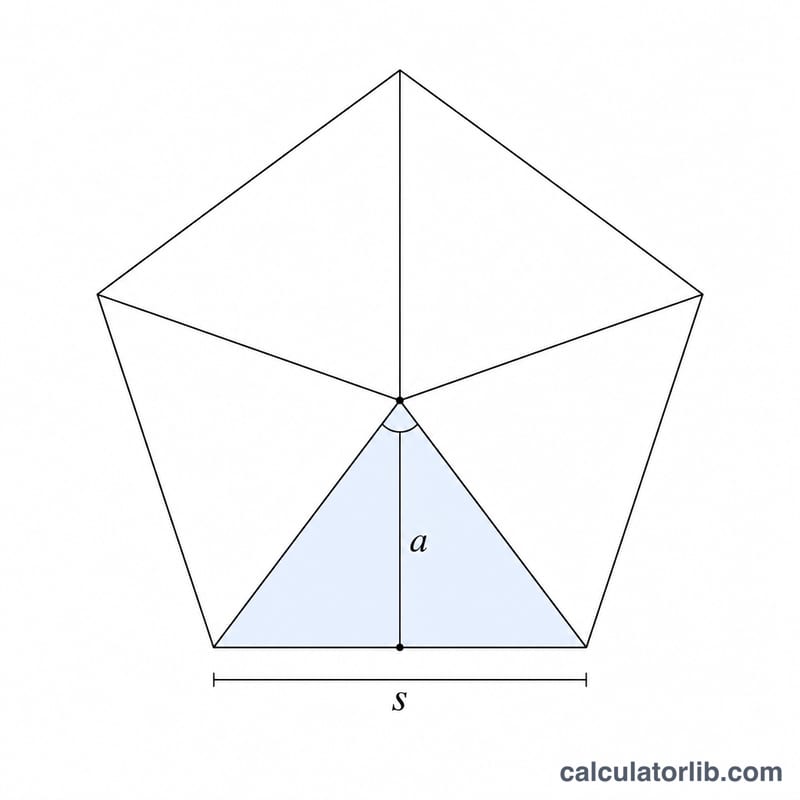
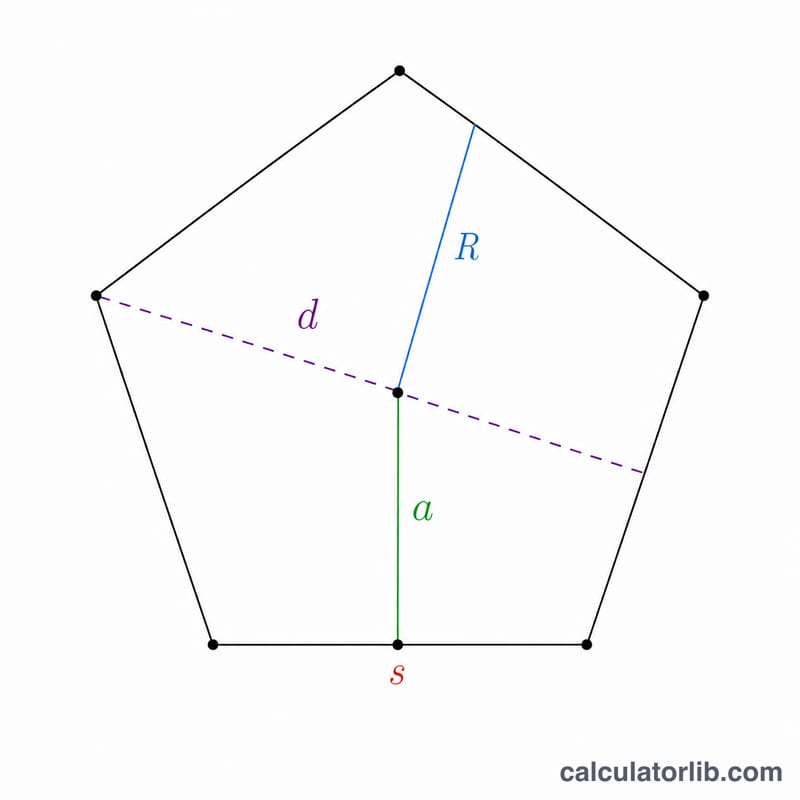
The area of a regular pentagon is $$A = \frac{1}{4}\sqrt{5\left(5 + 2\sqrt{5}\right)}\;s^{2}$$ which simplifies to roughly \(1.720477 \cdot s^{2}\). The perimeter is simply $$P = 5s$$ The apothem — the perpendicular distance from the center to the midpoint of a side — is $$a = \frac{s}{2\tan 36^{\circ}}$$ The circumradius (center to a vertex) is $$R = \frac{s}{2\sin 36^{\circ}}$$ and the diagonal equals \(s \cdot \varphi\), where \(\varphi = \frac{1+\sqrt{5}}{2}\) is the golden ratio.
Worked example
For a pentagon with side \(s = 10\): $$\text{Area} = 1.720477 \times 100 \approx 172.05 \text{ square units}$$ $$P = 5 \times 10 = 50$$ $$a = \frac{10}{2 \times \tan 36^{\circ}} = \frac{10}{1.453085} \approx 6.8819$$ \(R \approx 8.5065\). $$d = 10 \times 1.61803 \approx 16.1803$$
FAQ
What is the interior angle of a regular pentagon? Each interior angle is \(108^{\circ}\), and the angles sum to \(540^{\circ}\).
Why does the diagonal involve the golden ratio? In a regular pentagon, the ratio of a diagonal to a side is exactly the golden ratio \(\varphi \approx 1.618\).
Does this work for irregular pentagons? No. These formulas only hold for regular pentagons. For irregular shapes, split the figure into triangles and sum their areas.