
What is the Whittaker function M_{k,m}(z)?
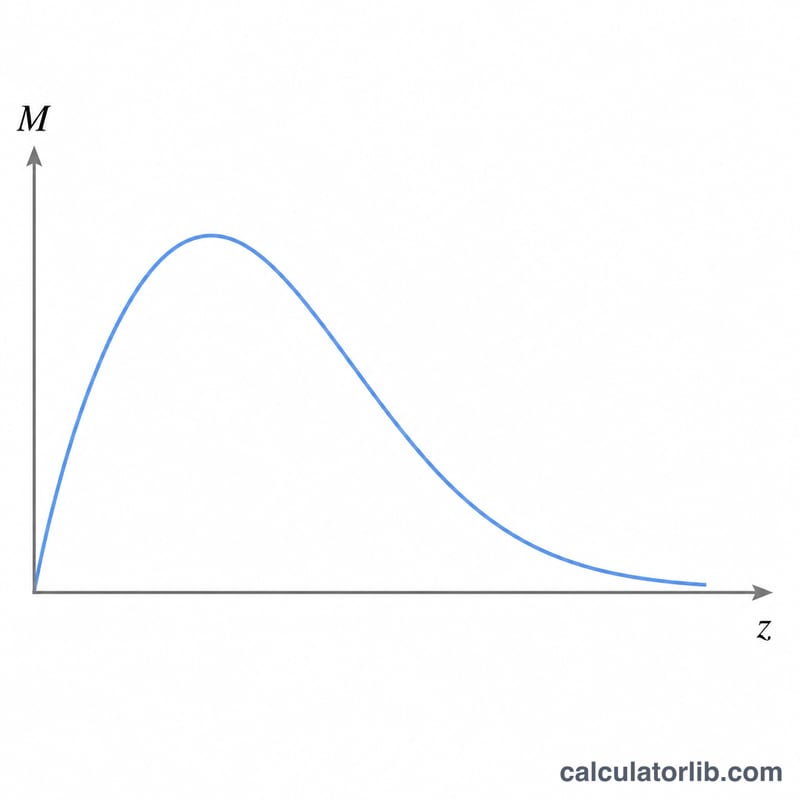
The Whittaker function of the first kind, \(M_{k,m}(z)\), is a special function that solves Whittaker's differential equation: \(y'' + \left( \frac{1}{4} - \frac{k}{z} + \frac{m^2 - \frac{1}{4}}{z^2} \right) y = 0\). Its general solution combines \(M_{k,m}(z)\) with the second-kind Whittaker function \(W_{k,m}(z)\). This calculator returns only \(M_{k,m}(z)\), the regular solution built from Kummer's confluent hypergeometric function. It appears throughout mathematical physics, including the radial Coulomb wave functions and parabolic-cylinder problems. This is pure mathematics and applies universally, with no region-specific assumptions.
How to use the calculator
Enter three real numbers: the parameters \(k\) and \(m\), and the argument \(z\). Use \(z > 0\) so that \(z^{m+1/2}\) gives a real result for non-integer \(m\). Avoid \(m\) values that make \(2m+1\) a non-positive integer (\(m = 0, -1/2, -1, \ldots\)), because that places a pole in the denominator of the series. The precision selector only controls how many digits are displayed; the underlying double-precision computation is accurate for moderate inputs (roughly \(|z|\) up to about 30).
The formula explained
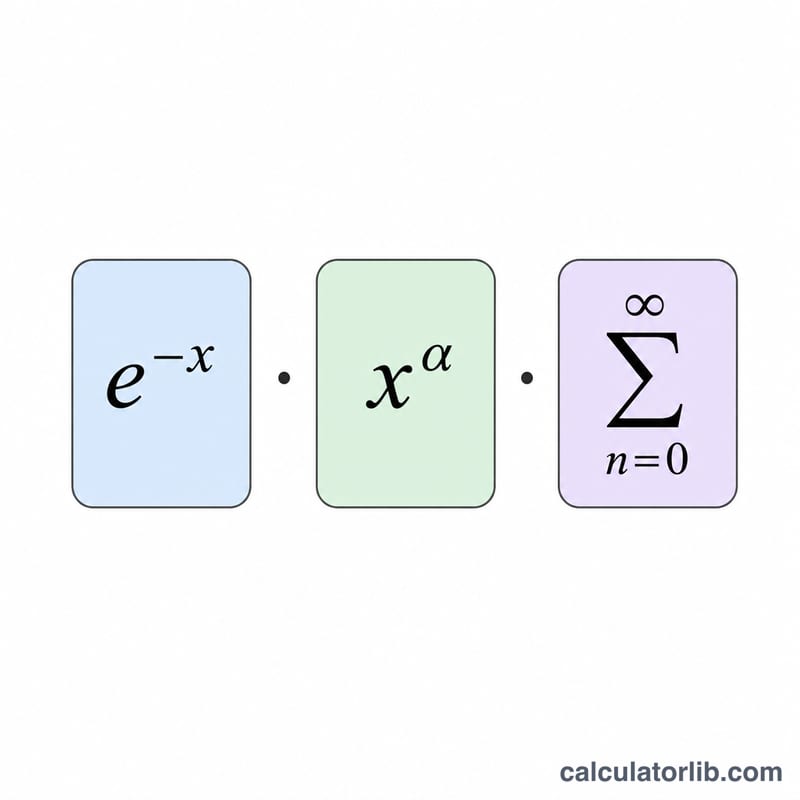
With \(a = m - k + \frac{1}{2}\) and \(b = 2m + 1\), the function is $$M = e^{-z/2} \cdot z^{m+\frac{1}{2}} \cdot {}_1F_1(a;\,b;\,z).$$ The confluent hypergeometric series \({}_1F_1\) is summed term by term using the recurrence \(\text{term}_n = \text{term}_{n-1} \cdot \frac{a + n - 1}{b + n - 1} \cdot \frac{z}{n}\), starting from \(\text{term}_0 = 1\). Terms are added until they become negligible relative to the running sum, capped to avoid infinite loops.
Worked example
Take \(k = 2\), \(m = 3\), \(z = 0.5\). Then \(a = 3 - 2 + 0.5 = 1.5\) and \(b = 7\). The series \({}_1F_1(1.5;\,7;\,0.5)\) converges to about \(1.1160881\). The prefactor is $$e^{-0.25} = 0.7788008 \quad\text{times}\quad 0.5^{3.5} = 0.0883883,$$ giving \(0.0688384\). Multiplying by the series yields \(M_{2,3}(0.5) \approx 0.0768344\).
FAQ
Why must z be positive? For non-integer \(m + \frac{1}{2}\), the factor \(z^{m+1/2}\) is multi-valued or complex for \(z \le 0\), so a real result requires \(z > 0\). At \(z = 0\) the function is 0 when \(m + \frac{1}{2} > 0\).
What if 2m+1 is a non-positive integer? The Pochhammer symbol in the denominator hits zero, so the series is undefined; the calculator returns 0 and you should change \(m\).
Does the series always converge? Yes, \({}_1F_1\) is entire in \(z\), though it converges slowly for large \(|z|\) and may lose accuracy in plain double precision.