
What is Kummer's function M(a,b,z)?
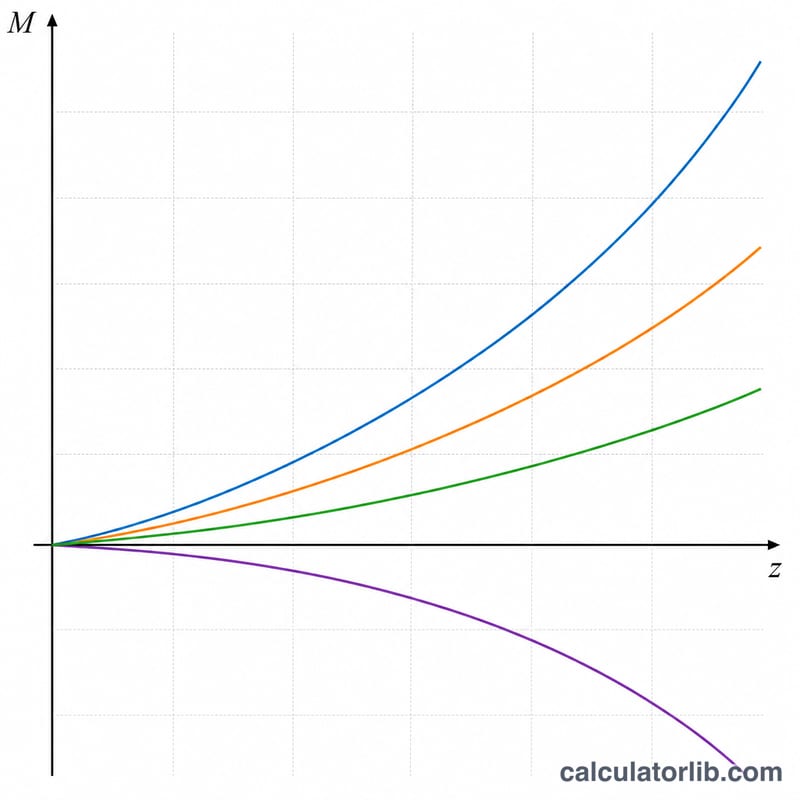
The confluent hypergeometric function of the first kind, written \(M(a,b,z)\) or \({}_1F_1(a;b;z)\), is one of the two independent solutions of Kummer's differential equation $$z\cdot y'' + (b - z)\cdot y' - a\cdot y = 0.$$ It appears throughout physics and applied mathematics — in quantum mechanics (the radial Coulomb wavefunction), probability (the noncentral chi-square and related distributions), heat conduction, and Bessel-function representations. This calculator evaluates it for real parameters \(a\) and \(b\) and a real argument \(z\). It is a pure-mathematics tool with no regional or unit assumptions.
How to use it
Enter the first parameter \(a\), the second parameter \(b\), and the argument \(z\), then read off \(M(a,b,z)\). The value \(b\) must not be zero or a negative integer, since those make a denominator vanish; the calculator flags such inputs as invalid. If \(a\) is a non-positive integer the series terminates and \(M\) reduces to a polynomial in \(z\) — that is correct behaviour, not an error.
The formula explained
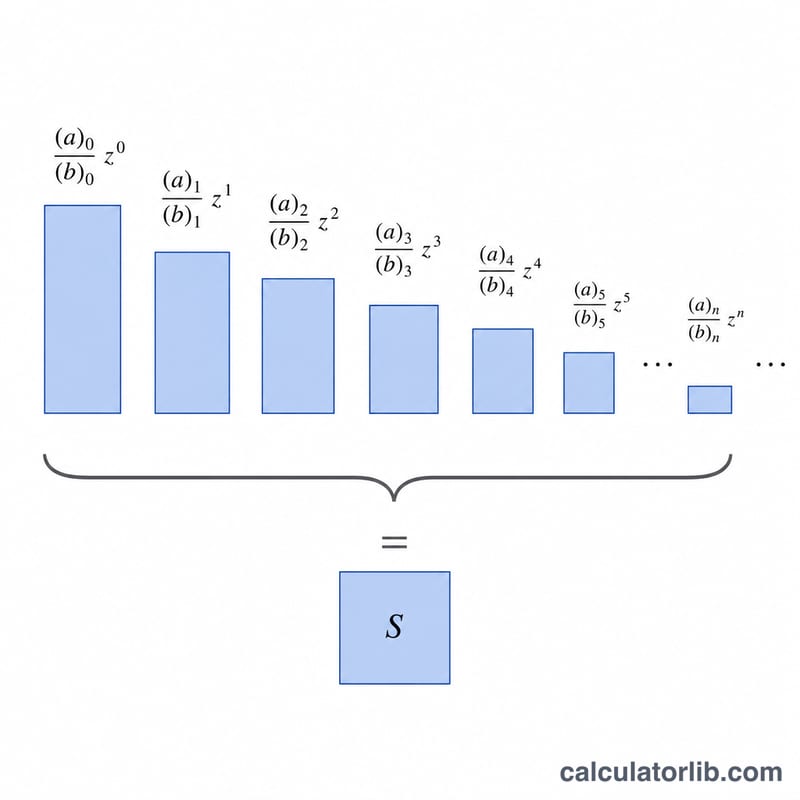
The series sums $$M(a,b,z) = \sum_{n=0}^{\infty} \frac{(a)_n}{(b)_n}\,\frac{z^{\,n}}{n!},$$ where the Pochhammer symbol \((x)_n = x(x+1)\cdots(x+n-1)\). Rather than computing factorials and rising factorials separately, the calculator builds each term from the previous one with $$t_{n+1} = t_n \cdot \frac{a+n}{b+n} \cdot \frac{z}{n+1},$$ starting from \(t_0 = 1\). Summation stops when a new term is negligible relative to the running sum (about 1e-17) or after a safe iteration cap.
Worked example
For \(a = 2\), \(b = 3\), \(z = 0.5\): the terms are $$1,\ 0.33333,\ 0.0625,\ 0.0083333,\ 0.00086806,\ 0.000074405,\ \ldots$$ which add up to \(M(2,3,0.5) \approx 1.4051145\).
FAQ
What is \(M(a,b,0)\)? Always exactly 1, for any \(a\) and \(b\), since every term after the first contains a factor of \(z\).
Why is b restricted? A zero or negative-integer \(b\) drives the Pochhammer denominator \((b)_n\) to zero, so the function is undefined there.
Is it accurate for large z? The series converges for all finite \(z\), but large positive \(z\) causes cancellation that erodes double precision; keep \(|z|\) moderate (roughly under 50) for reliable digits.