
What Is the Segment Addition Postulate?
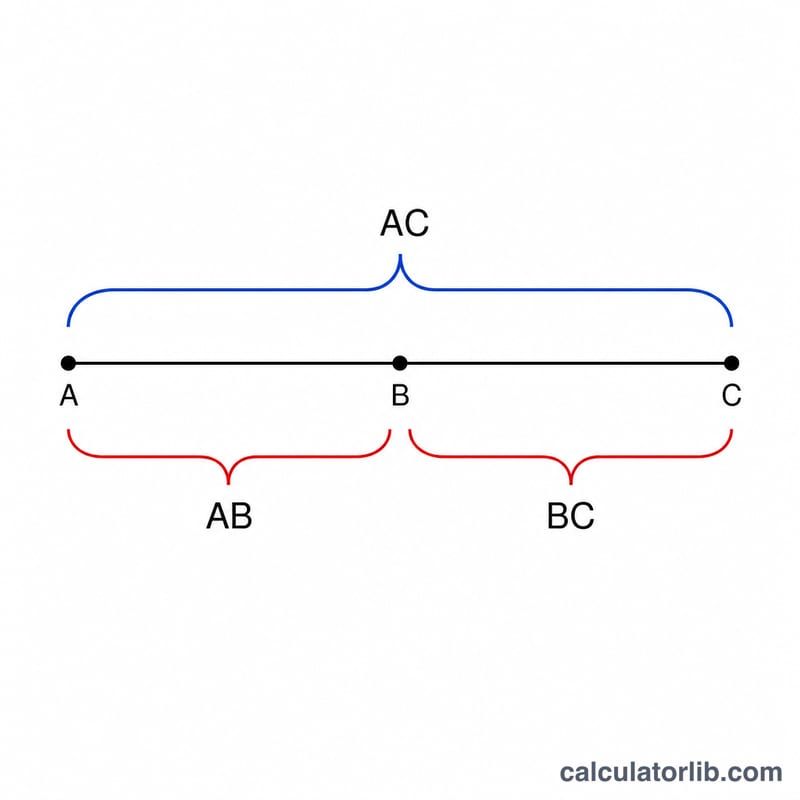
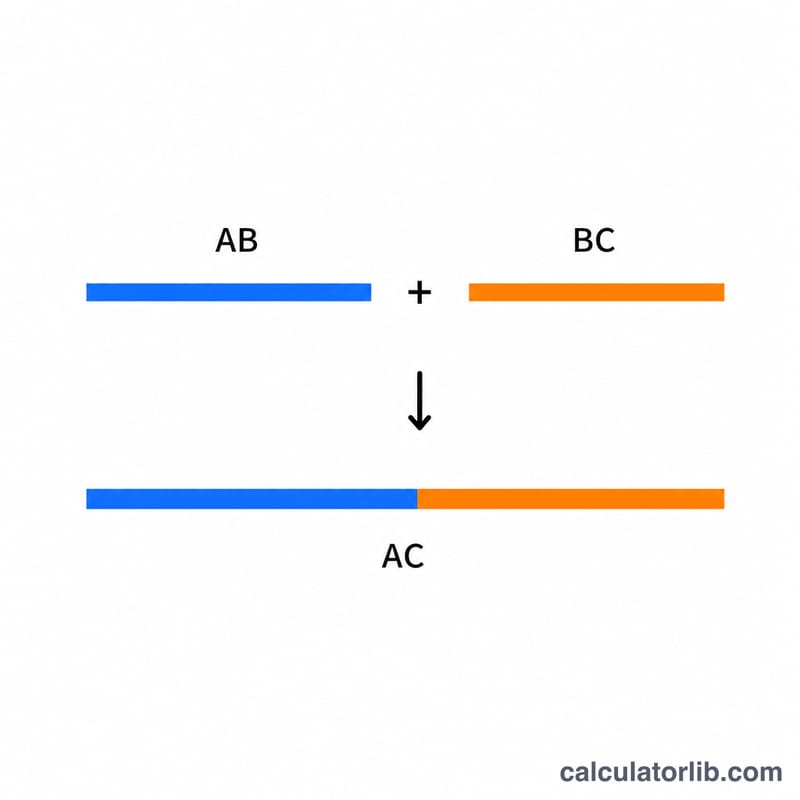
The segment addition postulate is a foundational rule in geometry. It states that if a point B lies on the line segment between two endpoints A and C, then the length of the whole segment equals the sum of its two parts: \(\text{AC} = \text{AB} + \text{BC}\). This calculator lets you enter any two of the three values and instantly solves for the missing one.
How to Use This Calculator
Fill in any two of the three fields — AB, BC, or AC — and leave the unknown one blank. The calculator detects which value is missing and applies the postulate to solve for it. If you fill in all three, it recomputes AC from AB + BC so you can check whether your point B is truly between A and C.
The Formula Explained
The postulate gives one equation with three quantities. Knowing any two determines the third:
- Find the whole: \(\text{AC} = \text{AB} + \text{BC}\)
- Find a part: \(\text{BC} = \text{AC} - \text{AB}\) or \(\text{AB} = \text{AC} - \text{BC}\)
Because subtraction is used to find a part, the whole (AC) must always be at least as large as either part for the configuration to be geometrically valid.
Worked Example
Suppose AB = 12 and BC = 8, and B is between A and C. Then $$\text{AC} = \text{AB} + \text{BC} = 12 + 8 = 20.$$ Conversely, if AC = 20 and AB = 12, then $$\text{BC} = 20 - 12 = 8.$$
FAQ
Does B have to be between A and C? Yes. The postulate only applies when B is a point on segment AC. If B is outside, the relationship does not hold.
What if I get a negative result? A negative part means your total (AC) is smaller than one of the parts, which is impossible for a point between the endpoints — recheck your inputs.
Can I use any unit? Yes. The postulate is unit-independent; just keep all three lengths in the same unit (cm, in, etc.).