
What Is pH?
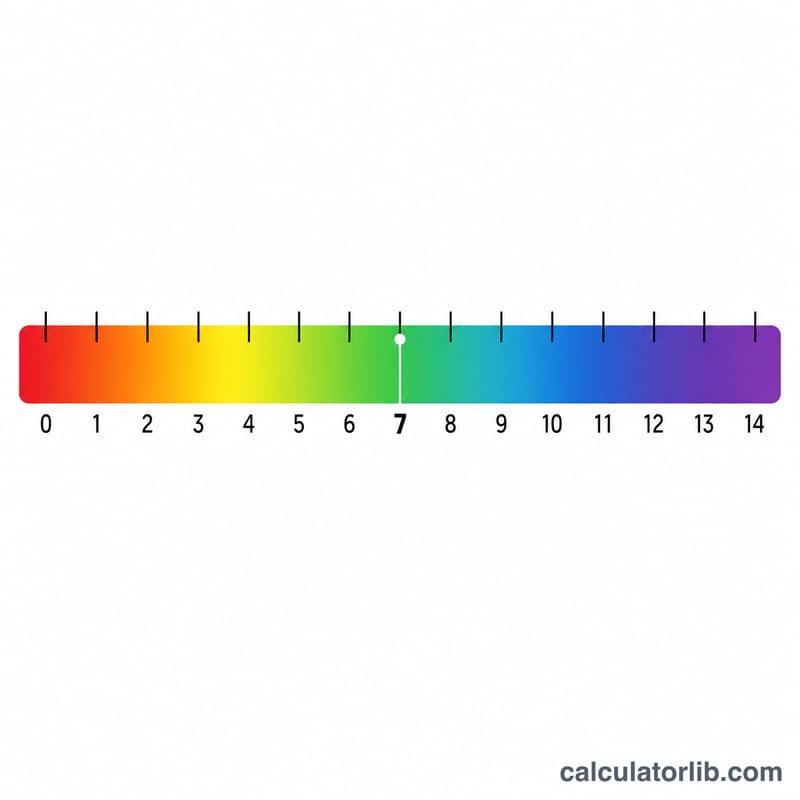
pH is a measure of how acidic or basic an aqueous solution is. It is defined as the negative base-10 logarithm of the hydrogen ion concentration, written \(\text{[H}^{+}\text{]}\), expressed in moles per liter (mol/L). The scale typically runs from 0 to 14: values below 7 are acidic, exactly 7 is neutral (pure water at 25 °C), and above 7 is basic or alkaline. This calculator converts in both directions — from \(\text{[H}^{+}\text{]}\) to pH, and from pH back to \(\text{[H}^{+}\text{]}\) — and also reports the pOH and hydroxide ion concentration \(\text{[OH}^{-}\text{]}\).
How to Use This Calculator
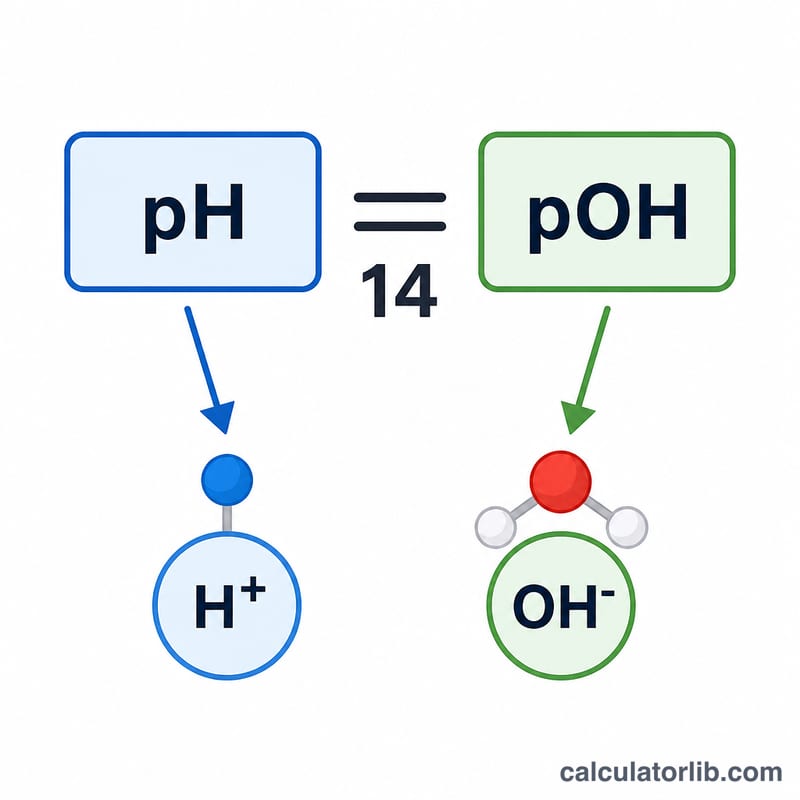
Pick a mode. In Concentration → pH, enter the hydrogen ion concentration in mol/L (for example 0.0001 for \(10^{-4}\)) and the tool returns the pH. In pH → Concentration, enter a pH value and it returns \(\text{[H}^{+}\text{]}\). Either way you also see \(\text{pOH} = 14 - \text{pH}\) and \(\text{[OH}^{-}\text{]} = 10^{-\text{pOH}}\), plus a label saying whether the solution is acidic, neutral, or basic.
The Formula Explained
The defining equation is $$\text{pH} = -\log_{10}\!\left(\text{[H}^{+}\text{]}\right)$$ Because it is logarithmic, each whole-number step on the pH scale represents a tenfold change in \(\text{[H}^{+}\text{]}\): a solution at pH 4 is ten times more acidic than one at pH 5. Inverting the equation gives $$\text{[H}^{+}\text{]} = 10^{-\text{pH}}$$ The companion relationship \(\text{pH} + \text{pOH} = 14\) holds for dilute aqueous solutions at 25 °C, derived from the water ion product \(K_w = 1.0 \times 10^{-14}\).
Worked Example
Suppose \(\text{[H}^{+}\text{]} = 0.0001\ \text{mol/L} = 10^{-4}\). Then $$\text{pH} = -\log_{10}\!\left(10^{-4}\right) = 4$$ The \(\text{pOH} = 14 - 4 = 10\), and \(\text{[OH}^{-}\text{]} = 10^{-10}\ \text{mol/L}\). Since pH 4 is below 7, the solution is acidic.
FAQ
Can pH go below 0 or above 14? Yes. Very concentrated strong acids can have negative pH, and concentrated strong bases can exceed 14. The 0–14 range is just typical, not a hard limit.
What temperature does this assume? The neutral point of 7 and the \(\text{pH} + \text{pOH} = 14\) relationship assume 25 °C. At other temperatures, \(K_w\) changes and neutral pH shifts.
Why use a logarithm? Hydrogen ion concentrations span many orders of magnitude. The log scale compresses these into a convenient, readable range.