
What is hydroxide ion concentration?
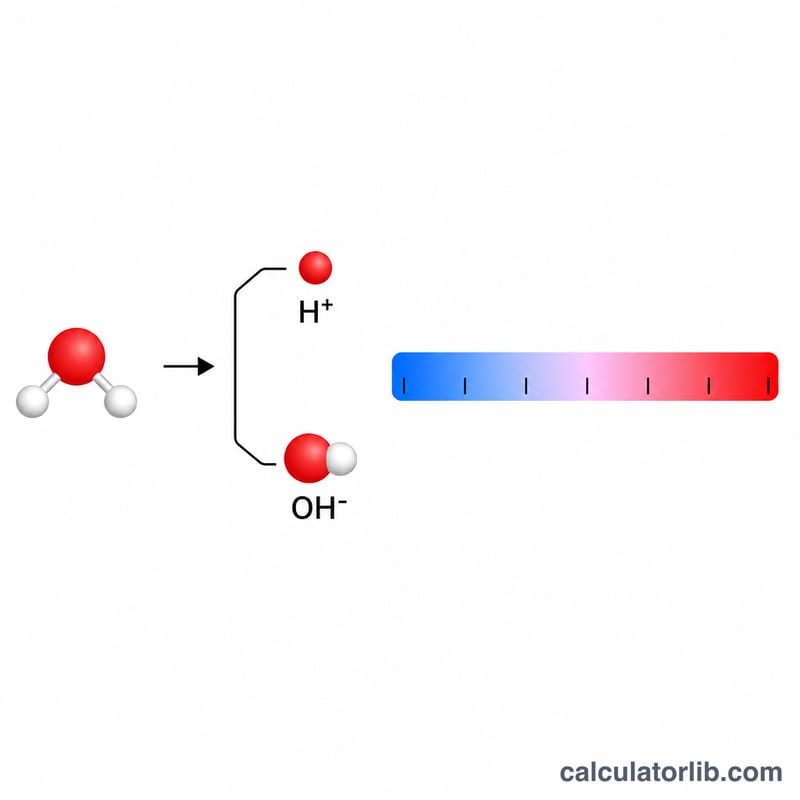
The hydroxide ion concentration, written [OH⁻], measures the amount of hydroxide ions present in an aqueous solution in moles per litre (mol/L). It is a direct indicator of how basic (alkaline) a solution is — the higher the [OH⁻], the more basic the solution. Chemists often express this on a logarithmic scale called pOH, which is more convenient for the very small numbers involved.
How to use this calculator
Choose whether you want to convert from pOH to concentration or from concentration to pOH. Enter the known value and the calculator returns [OH⁻], pOH, the corresponding pH, and the hydrogen ion concentration [H⁺]. This makes it easy to characterise a solution completely from a single measurement at 25 °C.
The formula explained
The two key relationships are:
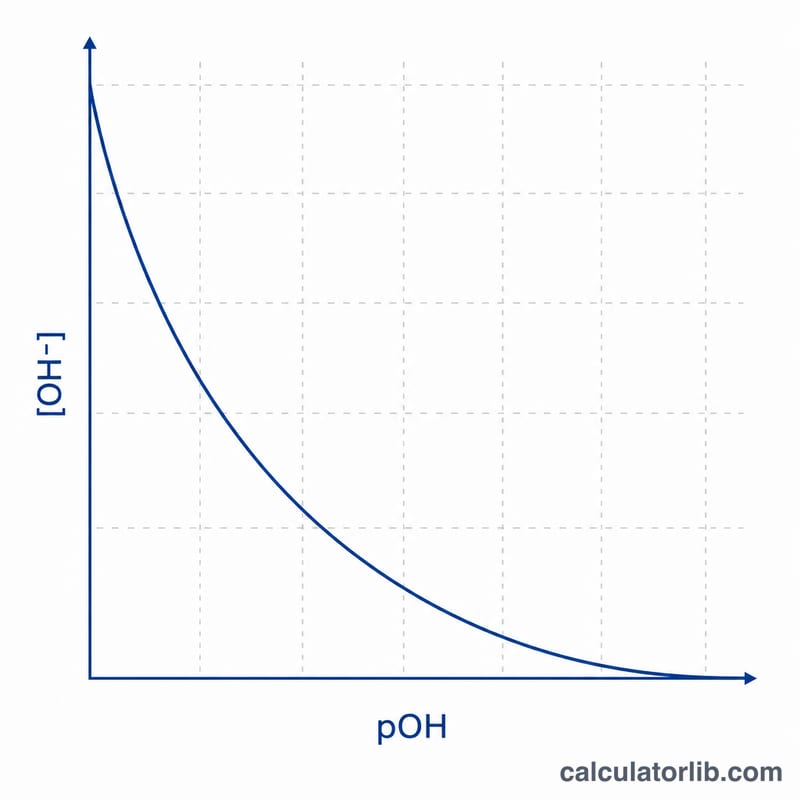
$$[\text{OH}^-] = 10^{-\text{pOH}}$$ and $$\text{pOH} = -\log_{10}\!\left([\text{OH}^-]\ (\text{mol/L})\right)$$
At 25 °C, water's ion product gives the convenient relation \(\text{pH} + \text{pOH} = 14\). So once pOH is known, \(\text{pH} = 14 - \text{pOH}\) and \([\text{H}^+] = 10^{-\text{pH}}\). These let you move freely between acidity and basicity descriptions of the same solution.
Worked example
Suppose a solution has pOH = 3. Then $$[\text{OH}^-] = 10^{-3} = 0.001\ \text{mol/L}$$ The pH is \(14 - 3 = 11\), and \([\text{H}^+] = 10^{-11} \approx 1\times10^{-11}\ \text{mol/L}\). A pH of 11 confirms this is a basic solution, consistent with its relatively high hydroxide concentration.
FAQ
Is pH + pOH always 14? Only at 25 °C. The ion product of water changes with temperature, so at other temperatures the sum differs slightly.
What does a low pOH mean? A low pOH (e.g. 1–3) means a high [OH⁻] and a strongly basic solution. A high pOH means a more acidic solution.
Can [OH⁻] be negative? No. Concentration is always positive; this tool clamps non-positive inputs to a tiny value to keep the logarithm defined.