
What Is the Is It a Multiple Calculator?
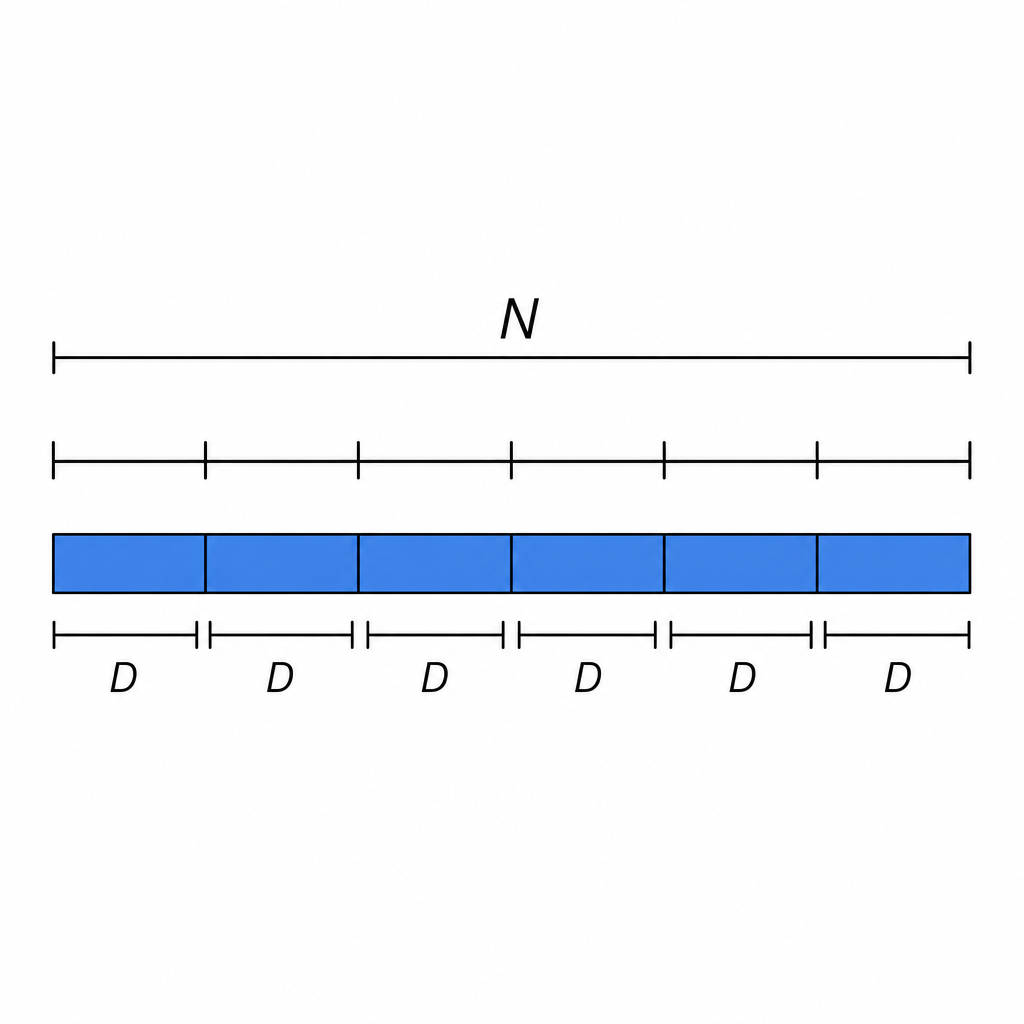
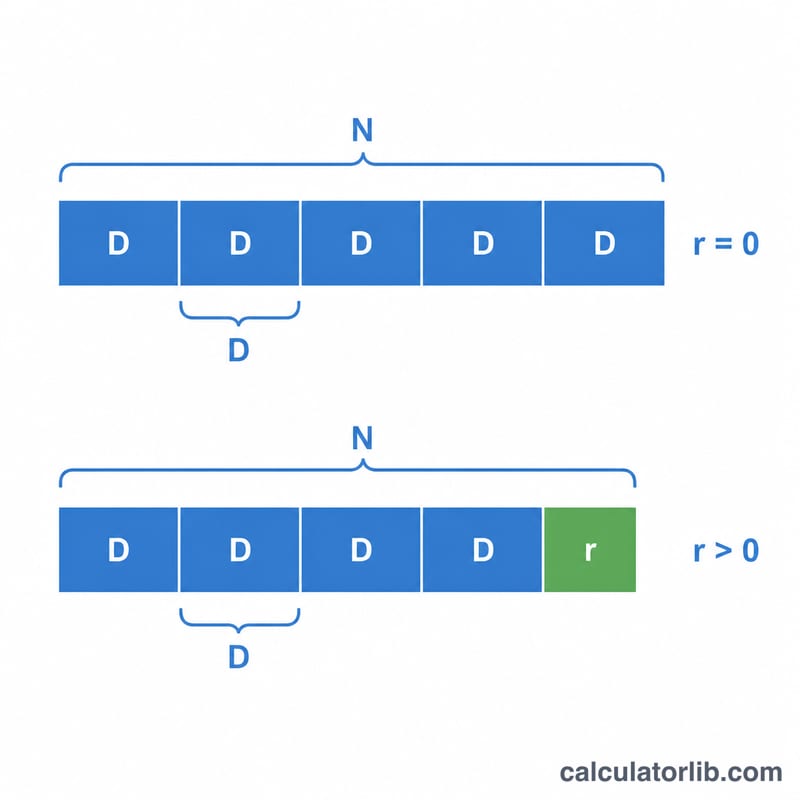
This tool tells you whether one number (N) is a multiple of another number (D). A number N is a multiple of D when dividing N by D produces a whole number with no leftover — in other words, when the remainder is zero. This is the same idea as asking "Is N divisible by D?" The calculator also shows the quotient and the remainder so you can see exactly how the division works out.
How to Use It
Enter the number you want to test as N, and the divisor as D. The calculator immediately reports "Yes" if N is a multiple of D, or "No" if it is not. Below the answer you'll find the floored quotient (N ÷ D rounded down) and the remainder (N mod D). If the remainder is 0, N is a multiple of D.
The Formula Explained
The core test is the modulo operation: $$\text{Is Multiple} \iff \left(\text{Number (N)} \bmod \text{Divisor (D)}\right) = 0$$ The modulo operator gives the remainder after division. For example, \(100 \bmod 5 = 0\), so 100 is a multiple of 5. By contrast, \(100 \bmod 7 = 2\), so 100 is not a multiple of 7. The quotient is \(q = \lfloor N \div D \rfloor\) and the remainder is \(r = N - qD\).
Worked Example
Is 100 a multiple of 5? Divide: \(100 \div 5 = 20\) with no remainder. Since \(100 \bmod 5 = 0\), the answer is Yes. The quotient is 20 and the remainder is 0. Now try 100 and 7: \(100 \div 7 = 14\) remainder 2, so \(100 \bmod 7 = 2 \neq 0\), and the answer is No.
FAQ
What if D is 0? Division by zero is undefined, so the calculator treats it as "not a multiple" and shows zero values.
Does it work with decimals? Yes, but multiples are most meaningful for whole numbers. The modulo still computes a remainder for decimals.
Is "multiple of" the same as "divisible by"? Yes. Saying N is a multiple of D is the same as saying N is divisible by D — both mean the remainder is zero.