
What this calculator does
This tool converts a wind direction (or any bearing) given in degrees into a standard 16-point compass heading such as N, NNE, NE, ENE, E and so on. Meteorological reports, weather stations and GPS devices often express direction in degrees from 0 to 360, while people communicate using named compass points. This converter bridges the two.
How to use it
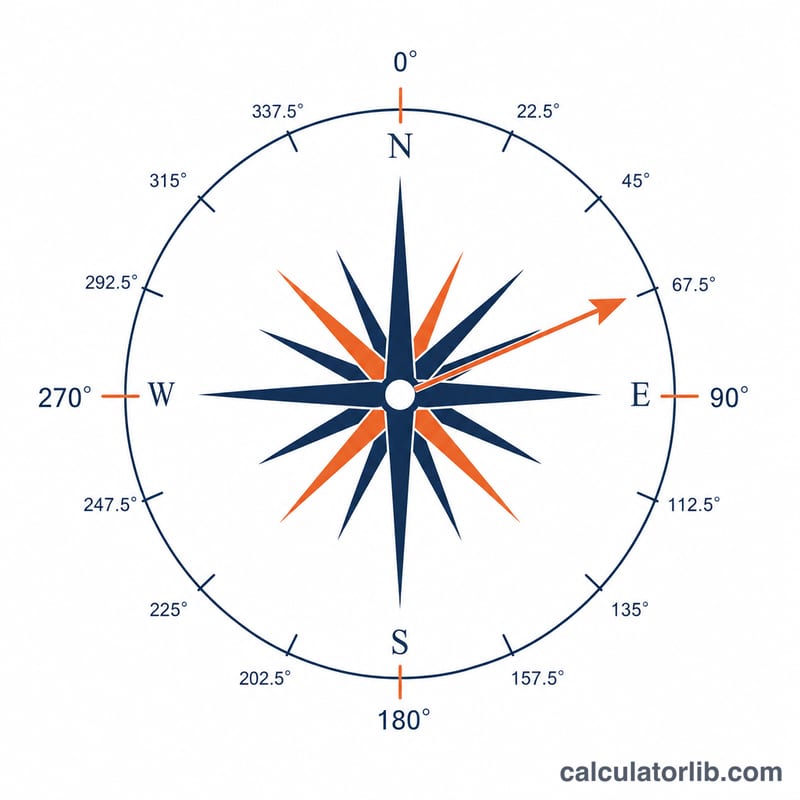
Enter the wind direction in degrees (0° is North, 90° is East, 180° is South, 270° is West). Values outside 0–360 are automatically wrapped, so 360°, 720° and -10° all resolve correctly. The result shows the compass name, the normalized angle, and the 0–15 index used internally.
The formula explained
The full circle (360°) is split into 16 equal sectors of 22.5° each. We divide the degrees by 22.5 and round to the nearest whole number, which selects the closest compass point. Taking that result modulo 16 wraps values near 360° back to North (index 0). The 16 labels in order are: N, NNE, NE, ENE, E, ESE, SE, SSE, S, SSW, SW, WSW, W, WNW, NW, NNW.
$$\text{Index} = \left( \text{round}\!\left( \frac{\text{Degrees} \bmod 360}{22.5} \right) \right) \bmod 16$$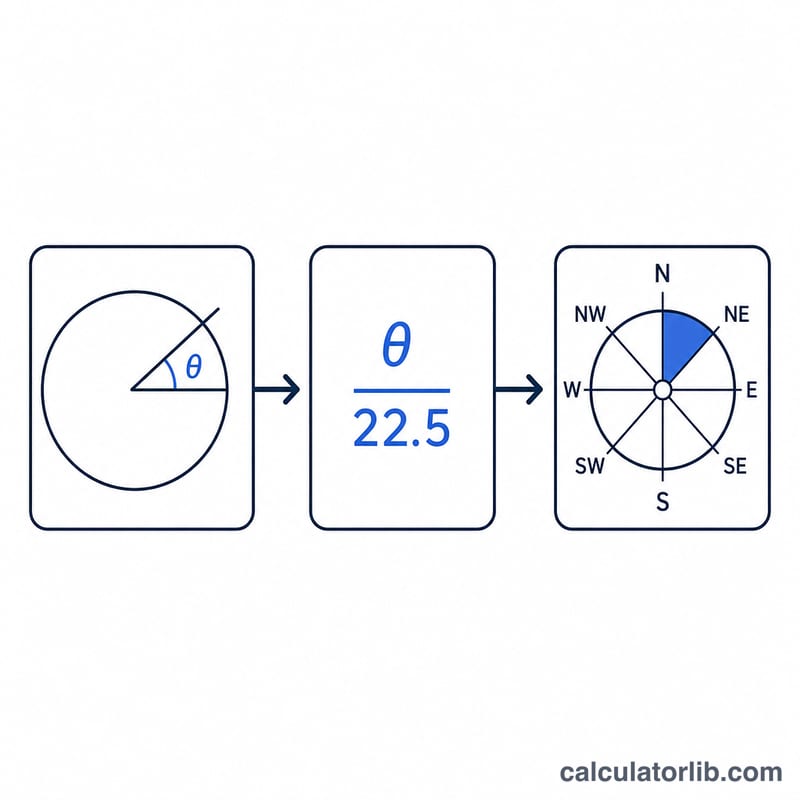
Worked example
For 200°: \(200 \div 22.5 = 8.888\ldots\), which rounds to 9. Index 9 in the list is SSW (South-Southwest). For 90°: \(90 \div 22.5 = 4\), index 4 is E (East). For 360°: it normalizes to 0, then \(0 \div 22.5 = 0\), giving N (North).
FAQ
Does 0° equal 360°? Yes — both point due North. The calculator normalizes 360° to 0° before converting.
What's the difference between 8-point and 16-point compasses? An 8-point compass uses 45° sectors (N, NE, E, SE…). This tool uses the finer 16-point system with 22.5° sectors for greater precision.
Can I use negative degrees? Yes. Negative angles are wrapped into the 0–360 range, so -90° becomes 270° (West).