
What this calculator does
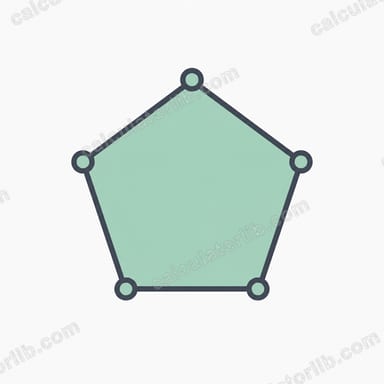
This tool computes the enclosed area and the perimeter of an arbitrary simple polygon defined by an ordered list of (x, y) coordinate points in a 2D plane. It uses the classic shoelace (Gauss) formula for area and the sum of Euclidean edge lengths for perimeter. Coordinates are treated as plain numbers in any single consistent length unit (meters, feet, pixels, etc.); the area is returned in that unit squared and the perimeter in that unit. No unit conversion is applied.
How to use it
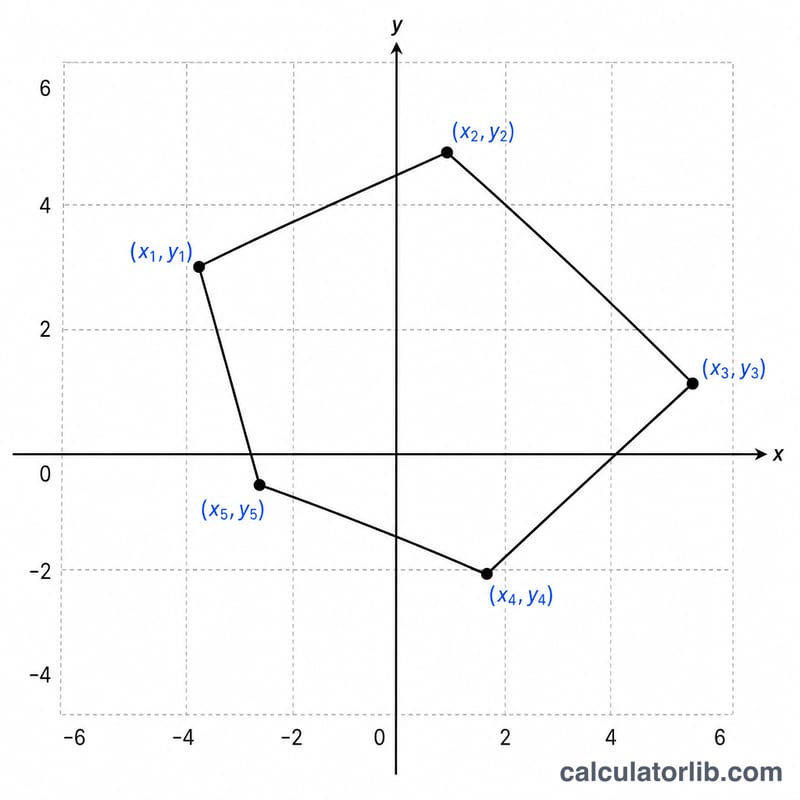
Enter each vertex on its own line as x, y in the order you walk around the polygon (clockwise or counterclockwise both work). You do not need to repeat the first point at the end — the closing edge from the last vertex back to the first is added automatically. Pick a display precision and read off the area and perimeter.
The formula explained
The shoelace formula sums the cross-terms \((x_j - x_{j+1})(y_j + y_{j+1})\) around the loop, halves the total, and takes the absolute value. Geometrically this accumulates signed trapezoid areas under each edge; opposite edges cancel except for the enclosed region. The perimeter simply adds the straight-line distance of every edge, including the closing edge.
$$A = \frac{1}{2}\left| \sum_{j=1}^{n} (x_j - x_{j+1})(y_j + y_{j+1}) \right| \qquad P = \sum_{j=1}^{n} \sqrt{(x_j - x_{j+1})^2 + (y_j - y_{j+1})^2}$$ $$\text{where}\quad \left\{ \begin{aligned} (x_j, y_j) &= \text{Coordinate Points} \\ (x_{n+1}, y_{n+1}) &= (x_1, y_1) \end{aligned} \right.$$
Worked example
For a 4×3 rectangle with vertices (0,0), (4,0), (4,3), (0,3): the shoelace sum is \(0 + 0 + 24 + 0 = 24\), so \(S = 24/2 = \)12 square units. The edge lengths are \(4 + 3 + 4 + 3\), giving a perimeter of 14 units. A triangle (0,0), (4,0), (0,3) yields \(S = 6\), matching \(\frac{1}{2} \times \text{base} \times \text{height}\).
FAQ
Does vertex order matter? The direction (clockwise vs counterclockwise) does not change the result because the absolute value is taken, but the points must be in sequential boundary order — not scrambled.
Does it work for self-intersecting shapes? The shoelace formula is exact only for simple (non-self-intersecting) polygons. If edges cross, you get the algebraic signed-region area, not the visible enclosed area.
What about just two points? Two points give area 0; because the closing edge is also counted, the perimeter equals twice the segment length. Use three or more points for a real polygon.