
What is the Tanh Calculator?
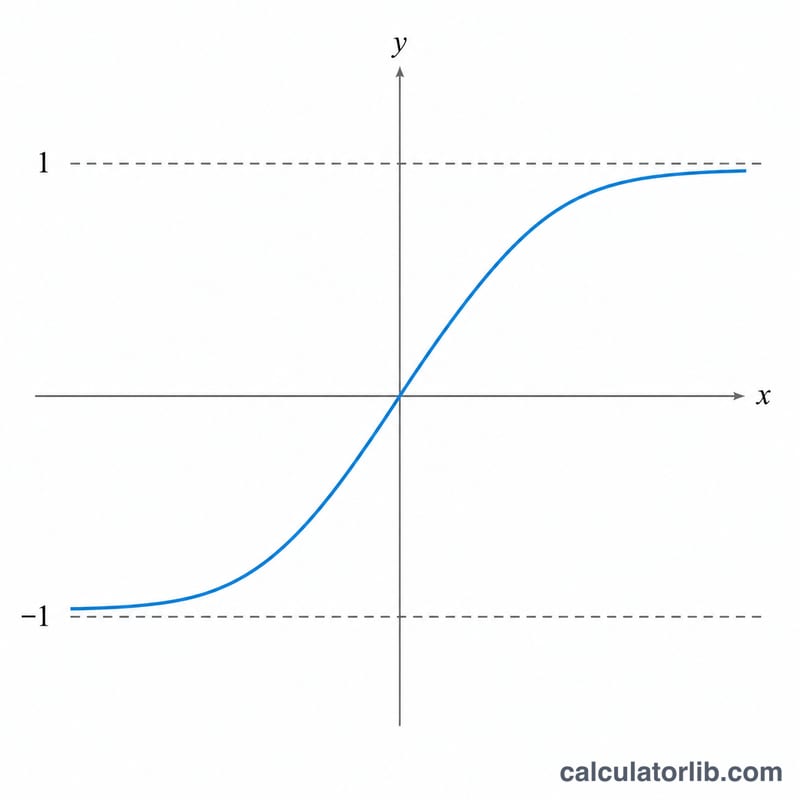
The hyperbolic tangent, written \(\tanh(x)\), is one of the fundamental hyperbolic functions. It maps any real number x to a value strictly between -1 and 1, making it a smooth, S-shaped (sigmoidal) function. This calculator computes \(\tanh(x)\) for any input, and also returns the companion functions \(\sinh(x)\) and \(\cosh(x)\).
How to use it
Enter any real number for x — it can be positive, negative, a decimal, or zero — and the calculator returns \(\tanh(x)\) along with \(\sinh(x)\) and \(\cosh(x)\). No units are required; these are pure mathematical functions.
The formula explained
The hyperbolic tangent is defined directly from the exponential function:
$$\tanh(x) = \frac{e^{x} - e^{-x}}{e^{x} + e^{-x}}$$
This is the ratio of the hyperbolic sine, \(\sinh(x) = \frac{e^{x} - e^{-x}}{2}\), to the hyperbolic cosine, \(\cosh(x) = \frac{e^{x} + e^{-x}}{2}\). As x grows large and positive, \(\tanh(x)\) approaches 1; as x grows large and negative, it approaches -1; and \(\tanh(0) = 0\).
Worked example
For x = 1: \(e^{1} \approx 2.718282\) and \(e^{-1} \approx 0.367879\). Then $$\tanh(1) = \frac{2.718282 - 0.367879}{2.718282 + 0.367879} = \frac{2.350402}{3.086161} \approx 0.761594.$$ The calculator also reports \(\sinh(1) \approx 1.175201\) and \(\cosh(1) \approx 1.543081\).
FAQ
What is the range of tanh(x)? The output always lies in the open interval \((-1, 1)\), no matter how large x is.
Is tanh an odd function? Yes. \(\tanh(-x) = -\tanh(x)\), so it is symmetric about the origin.
Where is tanh used? It appears in neural networks as an activation function, in physics for describing relativistic velocity addition, and in solutions to differential equations.