
What is the Floor Joist Calculator?
This tool estimates how many floor joists you need to frame a floor of a given length at a chosen on-center (OC) spacing. Joists are the horizontal members that carry the subfloor and floor load. Knowing the count up front helps you order the right amount of lumber and plan your layout.
How to use it
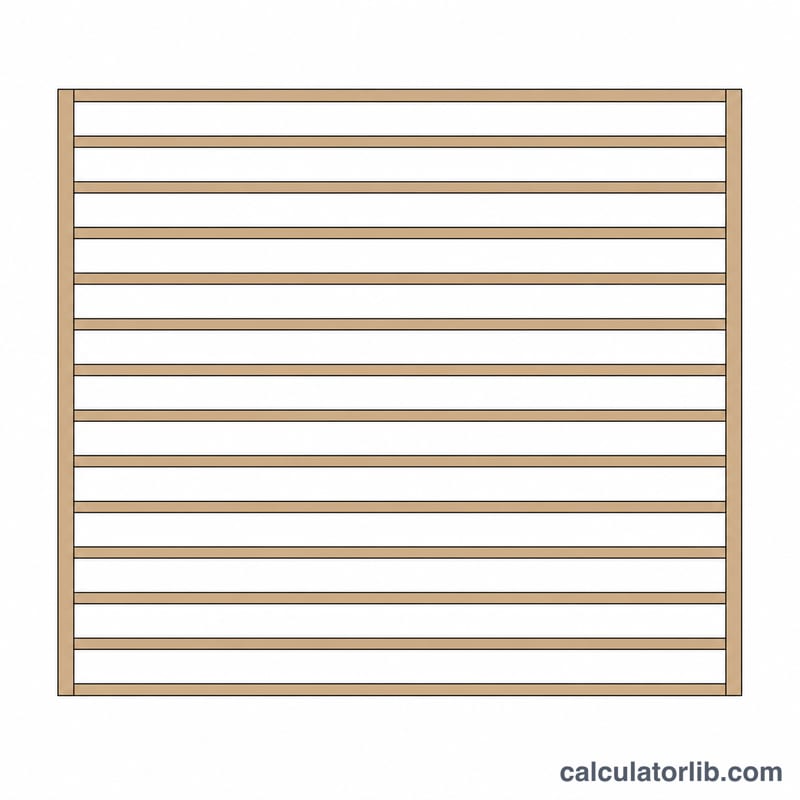
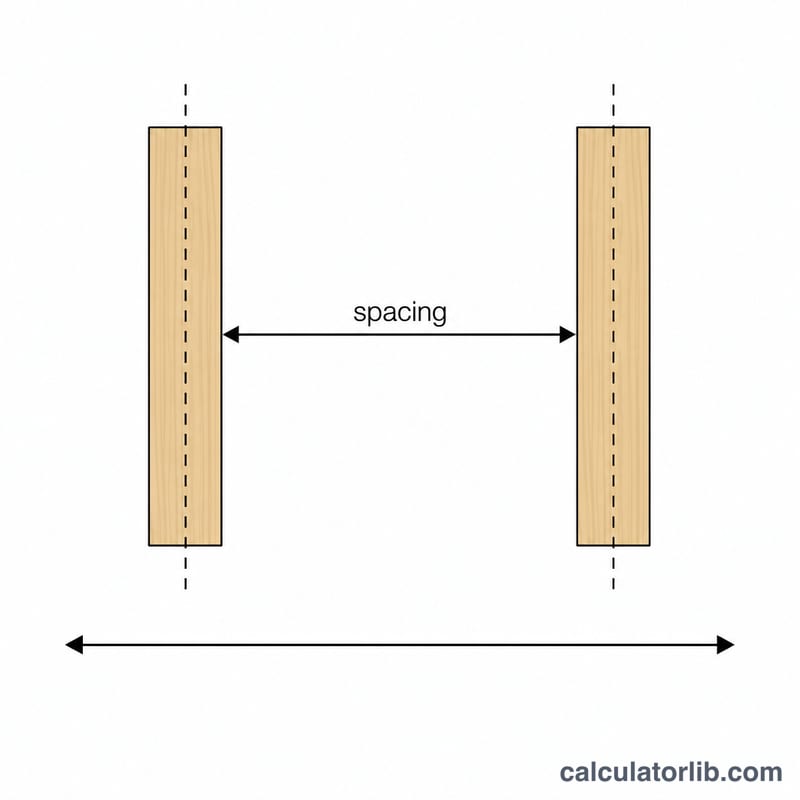
Enter the floor length — the distance the joists must run across (perpendicular to the joists) — in feet. Then pick a standard on-center spacing: 12, 16, 19.2, or 24 inches. The calculator returns the total number of joists, including a joist at each end of the run.
The formula explained
The number of equal spaces (bays) is the floor length divided by the spacing, rounded up so the last space is never skipped:
$$\text{joists} = \left\lceil \frac{\text{floorLength}}{\text{spacing}} \right\rceil + 1$$
Spacing is first converted to feet (e.g. \(16\ \text{in} = 1.333\ \text{ft}\)). We add 1 because fencing-style counting always needs one more member than the number of gaps — the start and end of the run each get a joist.
Worked example
Suppose your floor is 20 ft long with joists 16 in OC. Convert spacing: \(16 \div 12 = 1.333\ \text{ft}\). Spaces $$= 20 \div 1.333 = 15$$ exactly, rounded up \(= 15\). Joists $$= 15 + 1 = 16\ \text{joists}$$.
FAQ
Does this include blocking or rim joists? No. It counts the field joists across the span. Add rim/band joists and blocking separately for your layout.
Why does spacing of 24 in use fewer joists? Wider spacing means fewer joists but may require deeper or stronger lumber to meet span and load codes — always check your local building code and span tables.
Which dimension is the floor length? Use the dimension running perpendicular to the joists — the wall length the joists are nailed along.