
What is the Pond Volume Calculator?
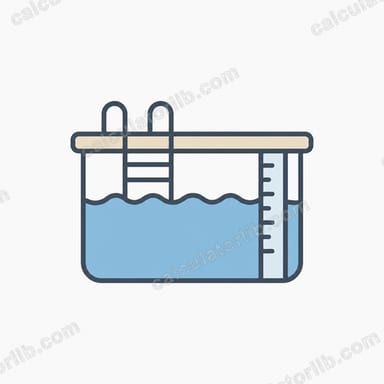
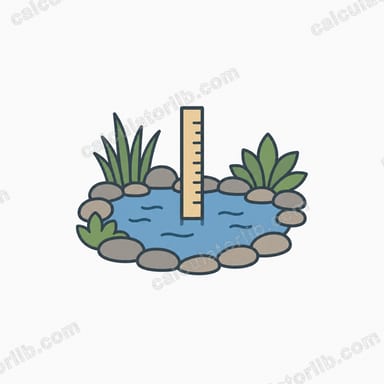
This tool estimates how much water a rectangular pond holds. Knowing your pond's volume is essential for correctly dosing water treatments, sizing pumps and filters, stocking fish safely, and calculating liner or evaporation needs. Enter the three measurements and get the capacity instantly in US gallons, liters, and cubic feet.
How to use it
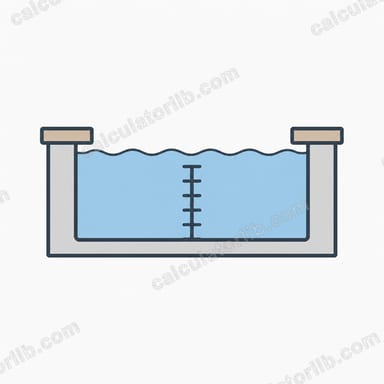
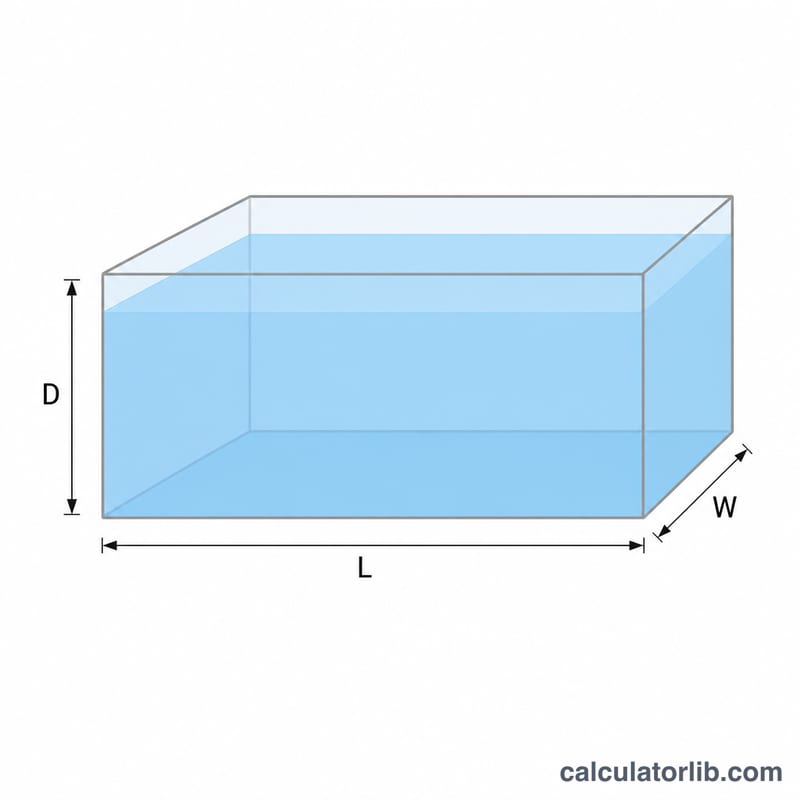
Measure your pond's length, width, and average depth in feet. Average depth matters more than maximum depth — if the bottom slopes, take several depth readings and average them. Enter all three values and the calculator returns the volume. For irregular ponds, approximate with the closest rectangle for a quick estimate.
The formula explained
The pond's volume in cubic feet is simply length \(\times\) width \(\times\) average depth. Since one cubic foot of water equals about 7.48 US gallons, multiplying cubic feet by 7.48 gives US gallons. To get liters, we use the exact conversion of 28.3168466 liters per cubic foot.
$$\text{Volume (gallons)} = L \times W \times D \times 7.48$$$$\text{Volume (liters)} = L \times W \times D \times 28.3168466$$
Worked example
For a pond 10 ft long, 8 ft wide, and 3 ft deep: the volume is $$10 \times 8 \times 3 = 240 \text{ cubic feet}.$$ That is $$240 \times 7.48 = 1{,}795.2 \text{ US gallons},$$ or $$240 \times 28.3168466 \approx 6{,}796 \text{ liters}.$$
FAQ
Should I use average or maximum depth? Always use average depth. Using maximum depth overestimates volume for ponds with sloping sides.
Why does the liter figure differ from gallons \(\times\) 3.785? The liter value is computed directly from cubic feet using the exact 28.3168466 L/ft³ factor, which is slightly more precise than chaining through the rounded 7.48 gallons factor.
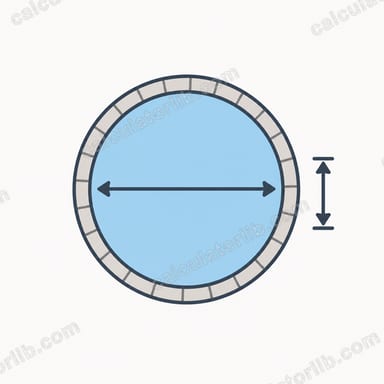
Does this work for round ponds? This calculator assumes a rectangular shape. For round ponds, multiply the area (\(\pi \times \text{radius}^2\)) by depth and by 7.48 separately.