
What is a permutation without repetition?
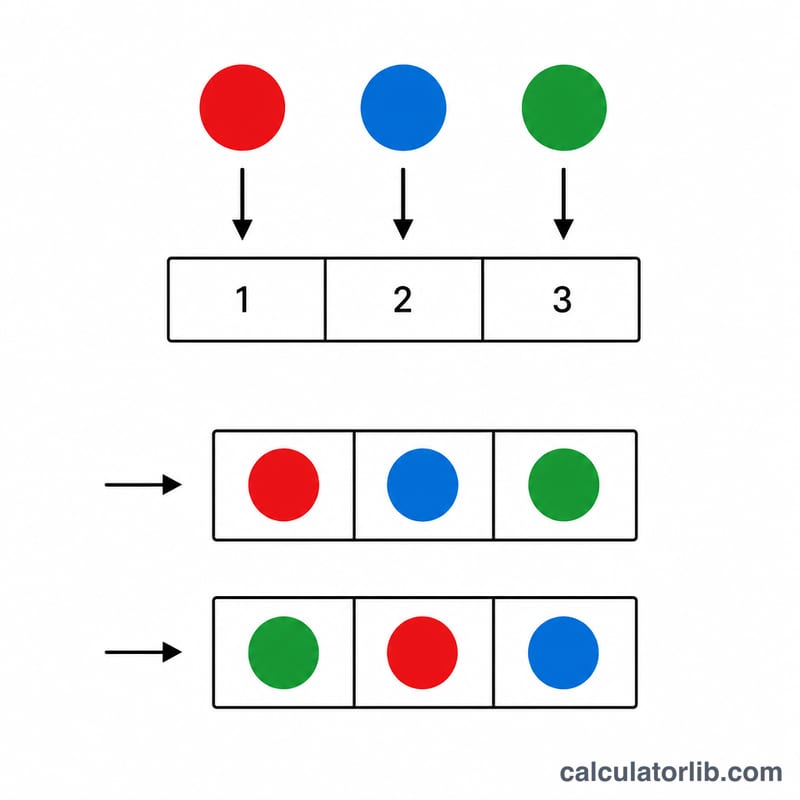
A permutation without repetition counts the number of distinct ordered arrangements you can make by selecting r items from a set of n different items, where no item may be reused. Because order matters, the arrangement ABC is counted separately from CBA. This is one of the cornerstones of combinatorics, used in probability, scheduling, password strength estimation, and ranking problems.
How to use this calculator
Enter the total number of distinct items n and the number you want to arrange r. The calculator instantly returns P(n, r), the number of ordered arrangements. The value of \(r\) must be less than or equal to \(n\); if \(r\) is larger, the result is 0 because you cannot pick more items than exist.
The formula explained
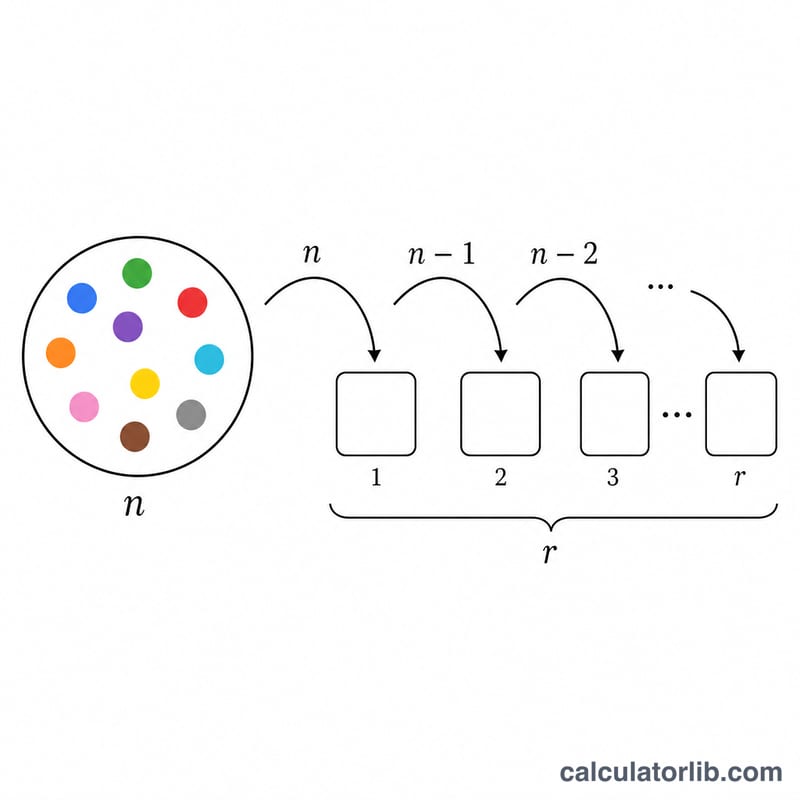
The formula is $$P(n, r) = \frac{n!}{(n - r)!}.$$ The factorial \(n!\) is the product of all positive integers up to \(n\). Dividing by \((n - r)!\) cancels the trailing terms, leaving the product of the top \(r\) descending factors: \(n \times (n - 1) \times \ldots \times (n - r + 1)\). This calculator multiplies those \(r\) terms directly, which avoids computing huge factorials and keeps the result accurate.
Worked example
Suppose 8 runners compete and you want the number of possible gold–silver–bronze podiums (\(r = 3\), \(n = 8\)). Then $$P(8, 3) = 8 \times 7 \times 6 = 336.$$ So there are 336 different ordered podium outcomes.
FAQ
How is this different from a combination? A combination ignores order, so it divides \(P(n, r)\) by \(r!\). Permutations count ordered arrangements; combinations count unordered selections.
What if r equals n? Then \(P(n, n) = n!\), the number of ways to arrange all items in a sequence.
Can n or r be zero? Yes. \(P(n, 0) = 1\) (one way to arrange nothing), and \(P(0, 0) = 1\).