
What Is a Combination Without Repetition?
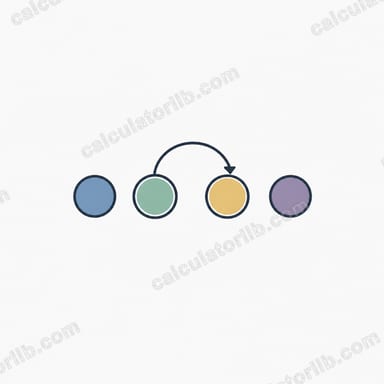
A combination without repetition counts the number of distinct groups you can form by choosing r items from a set of n different items, where the order of selection does not matter and no item can be picked more than once. It answers questions like "how many 5-card poker hands exist?" or "how many ways can a committee of 3 be picked from 10 people?"
How to Use This Calculator
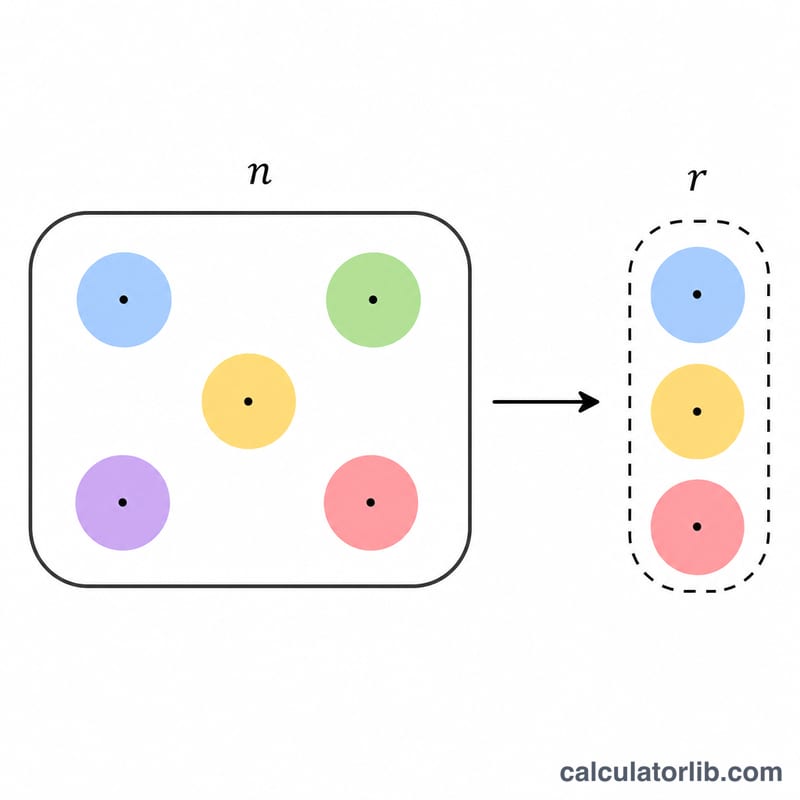
Enter the total number of available items as n and the number of items you want to choose as r. The calculator instantly returns \(C(n, r)\), the number of unique combinations. Note that \(r\) cannot exceed \(n\); if it does, the result is 0 because you cannot choose more items than exist.
The Formula Explained
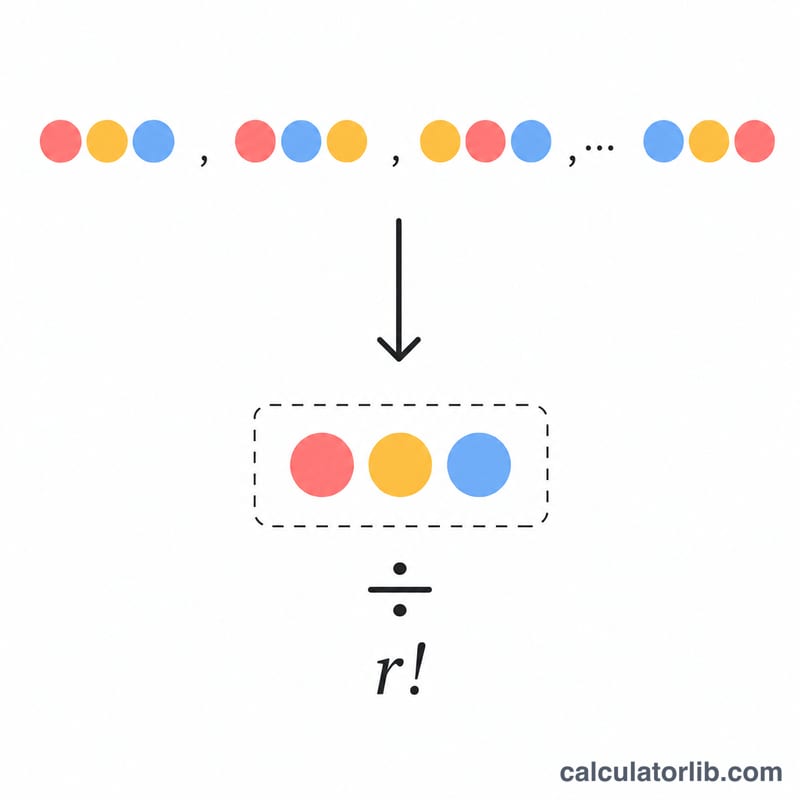
The formula is $$C(n, r) = \frac{\text{n}!}{\text{r}!\,\left(\text{n} - \text{r}\right)!}$$ where "!" denotes a factorial (the product of all positive integers up to that number). The numerator \(n!\) counts every ordered arrangement, while dividing by \(r!\) removes the orderings within the chosen group and dividing by \((n - r)!\) removes the orderings of the items left out. To stay accurate with large numbers, this tool computes the result iteratively instead of evaluating huge factorials directly.
Worked Example
How many ways can you choose 2 toppings from 5? $$C(5, 2) = \frac{5!}{2!\,\cdot\,3!} = \frac{120}{2 \cdot 6} = \frac{120}{12} = \mathbf{10}$$ There are 10 distinct pairs of toppings.
FAQ
What's the difference between combination and permutation? A permutation cares about order (AB \(\neq\) BA); a combination does not (AB = BA). Combinations are always fewer than or equal to permutations.
What is \(C(n, 0)\)? It equals 1 — there is exactly one way to choose nothing.
Does "without repetition" matter here? Yes. Without repetition means each item can appear at most once in a group, which is the standard nCr scenario this calculator solves.