
What Is the DnD Dice Roller Calculator?
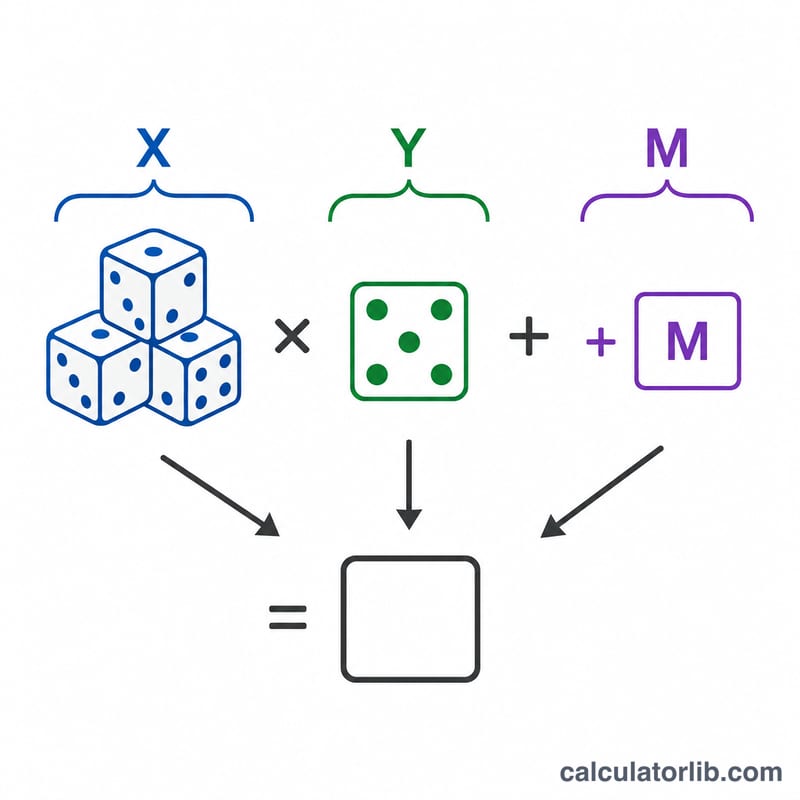
The DnD Dice Roller Calculator simulates rolling tabletop role-playing dice using the standard XdY notation, where X is the number of dice and Y is the number of sides on each die. Whether you need a quick 2d6 for damage, a d20 for an attack roll, or 4d8 for a fireball, this tool rolls them instantly and adds any modifier (bonus or penalty) to give your final total.
How to Use It
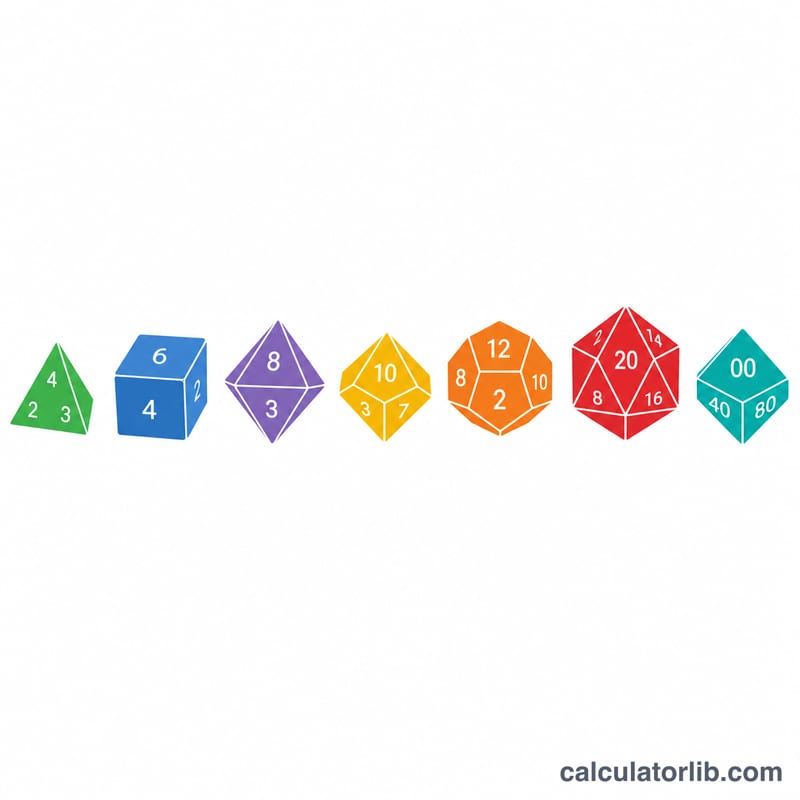
Enter the number of dice, the sides per die (4, 6, 8, 10, 12, 20, 100 are common in DnD), and an optional modifier (use a negative number for a penalty). Press calculate to see the total roll, the raw dice sum, the average roll per die, and the minimum and maximum possible outcomes so you understand the full range.
The Formula Explained
Each die is rolled as \(\lfloor \operatorname{random}() \times Y \rfloor + 1\), producing a uniform integer from 1 to Y. The calculator sums these across all X dice and adds the modifier M:
$$\text{total} = \sum \left( \lfloor \operatorname{random}() \times Y \rfloor + 1 \right) + M$$
The statistical average of a single fair die is \(\frac{Y+1}{2}\), so the expected total over many rolls is $$X \cdot \frac{Y+1}{2} + M.$$
Worked Example
Rolling 2d6 + 3: each d6 averages \((6+1)/2 = 3.5\), so two dice average 7, and with the +3 modifier the statistical average is 10. The minimum possible is \(2 \times 1 + 3 = 5\) and the maximum is \(2 \times 6 + 3 = 15\). Your actual rolled total each press will land somewhere in that 5–15 range.
FAQ
Is the roll truly random? It uses the system's pseudo-random generator, which is statistically uniform and fair for gameplay.
Can I roll a d100 or huge dice? Yes — sides can go up to 1000 and you can roll up to 100 dice at once.
How do I subtract a modifier? Enter a negative number, e.g. -2, in the modifier field.