What is the D10 Dice Roller?
The D10 Dice Roller is a free online tool that simulates rolling one or more ten-sided dice (D10). Each die yields a uniformly random whole number between 1 and 10. It is ideal for tabletop role-playing games such as the Storyteller/World of Darkness systems, percentile checks, board games, classroom probability demonstrations, or any situation where you need a fair random number without physical dice.
How to use it
Enter how many D10 dice you want to roll (1 to 100) and an optional modifier that is added to the combined total. Click calculate and the tool shows every individual roll, the sum of the dice, your modifier, and the grand total. Refreshing or recalculating produces a brand-new random roll each time.
The formula explained
A single die uses \(\text{roll} = \lfloor \operatorname{rand}() \times 10 \rfloor + 1\), where \(\operatorname{rand}()\) is a random fraction between 0 and 1. Multiplying by 10 and flooring gives 0–9, and adding 1 shifts the range to 1–10. The final total is the sum of all dice plus your modifier: $$\text{total} = (\text{roll}_1 + \text{roll}_2 + \dots + \text{roll}_n) + \text{modifier}$$
Worked example
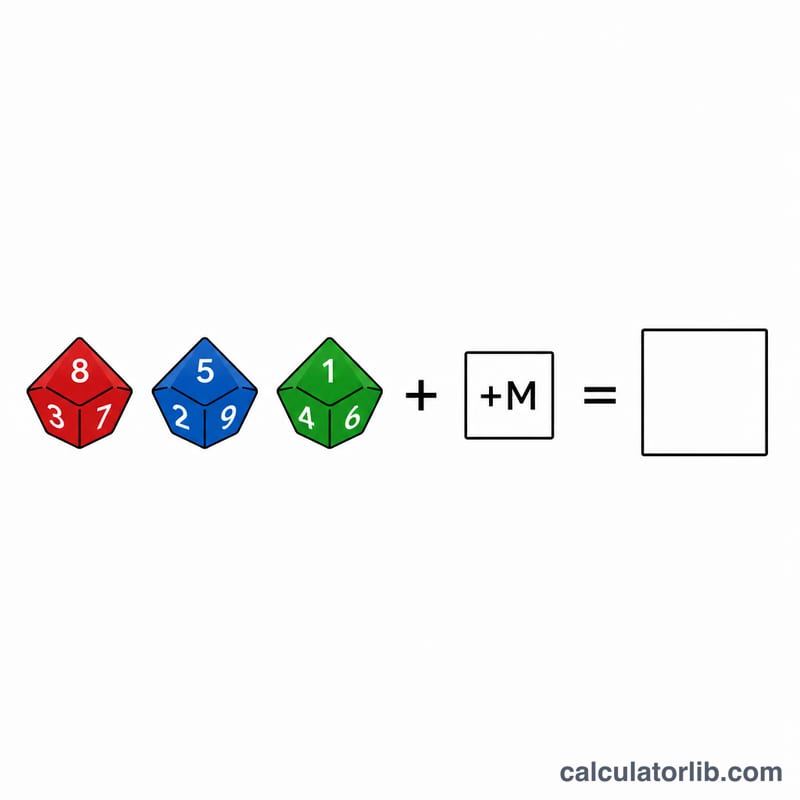
Suppose you roll 3 dice and they land on 4, 9, and 2, with a modifier of +5. The sum of the dice is \(4 + 9 + 2 = 15\). Adding the modifier gives \(15 + 5 = 20\), your total result.
D10 Roll Statistics by Number of Dice
A fair ten-sided die (D10) shows each face from 1 to 10 with the same probability: \(1/10\), or 10%. One die has a mean of \(5.5\) and a variance of \((10^2-1)/12 = 99/12 = 8.25\). Each die is rolled independently, so for \(n\) dice the mean and the variance are both multiplied by \(n\):
$$\text{Min} = n,\quad \text{Max} = 10n,\quad \mu = 5.5n,\quad \sigma^2 = 8.25n,\quad \sigma = \sqrt{8.25n}$$| Number of dice (n) | Minimum (n) | Maximum (10n) | Mean (5.5n) | Variance (8.25n) | Standard deviation (√(8.25n)) |
|---|---|---|---|---|---|
| 1 | 1 | 10 | 5.5 | 8.25 | ≈ 2.87 |
| 2 | 2 | 20 | 11 | 16.5 | ≈ 4.06 |
| 3 | 3 | 30 | 16.5 | 24.75 | ≈ 4.97 |
| 5 | 5 | 50 | 27.5 | 41.25 | ≈ 6.42 |
| 10 | 10 | 100 | 55 | 82.5 | ≈ 9.08 |
| 20 | 20 | 200 | 110 | 165 | ≈ 12.85 |
Effect of the modifier: the modifier is a fixed number added once to the dice sum. It moves the minimum, maximum and mean by exactly that amount and leaves the variance and standard deviation unchanged. For example, 3D10 + 4 can total anywhere from \(3+4=7\) to \(30+4=34\), with a mean of \(16.5+4=20.5\). Its standard deviation is still about 4.97.
Interpreting Your Roll Total
One die is uniform. With a single D10, the values 1 through 10 are all equally likely, at 10% each. A roll of 1 is exactly as likely as a 5 or a 10.
Two or more dice cluster around the middle. When you add dice together, sums near the centre can be made in more ways than sums at the edges. Two dice give a triangular distribution, and three or more give a curve that looks more and more like a bell, centred on \(5.5n\). The 100 equally likely outcomes of 2D10 give this exact distribution:
$$P(S = s) = \begin{cases} \dfrac{s-1}{100}, & 2 \le s \le 11 \\[6pt] \dfrac{21-s}{100}, & 11 \le s \le 20 \end{cases}$$| Sum (2D10) | Ways | Probability |
|---|---|---|
| 2 or 20 | 1 | 1% each |
| 3 or 19 | 2 | 2% each |
| 4 or 18 | 3 | 3% each |
| 5 or 17 | 4 | 4% each |
| 6 or 16 | 5 | 5% each |
| 7 or 15 | 6 | 6% each |
| 8 or 14 | 7 | 7% each |
| 9 or 13 | 8 | 8% each |
| 10 or 12 | 9 | 9% each |
| 11 | 10 | 10% |
The most likely 2D10 sum is 11, at \(10/100 = 10\%\). The extremes, 2 (1 + 1) and 20 (10 + 10), each have only a \(1/100 = 1\%\) chance. The probabilities add up to 100%: \(2(1+2+\dots+9)+10 = 90+10 = 100\).
Reading larger rolls. As the number of dice grows, the distribution of the total gets closer to a normal distribution (central limit theorem). Under that approximation, about 68% of totals land within one standard deviation of the mean, and about 95% within two. For example, 10D10 has a mean of 55 and a standard deviation of about 9.08, so roughly 68% of its totals fall between about 46 and 64. Because dice totals are whole numbers, this is an approximation, and it is less accurate for small numbers of dice. A modifier shifts the whole range by its value without changing these proportions.
FAQ
Are the rolls truly random? They use a pseudo-random number generator, which is fair and unpredictable for everyday gaming and learning purposes.
Can the modifier be negative? Yes. Enter a negative number and it will be subtracted from the dice total.
What is the maximum I can roll? You can roll up to 100 dice at once, for a maximum dice sum of 1000 before any modifier.