
What Is the Dice Average Calculator?
The Dice Average Calculator tells you the average (expected) total you will roll when throwing a set of fair dice. Whether you are rolling two standard six-sided dice in a board game or several twenty-sided dice in a tabletop role-playing game, this tool gives the long-run mean of the combined total instantly.
How to Use It
Enter the number of dice you are rolling and how many sides each die has, then read off the average total. The calculator also shows the smallest possible total (all dice show 1) and the largest possible total (all dice show their maximum face).
The Formula Explained
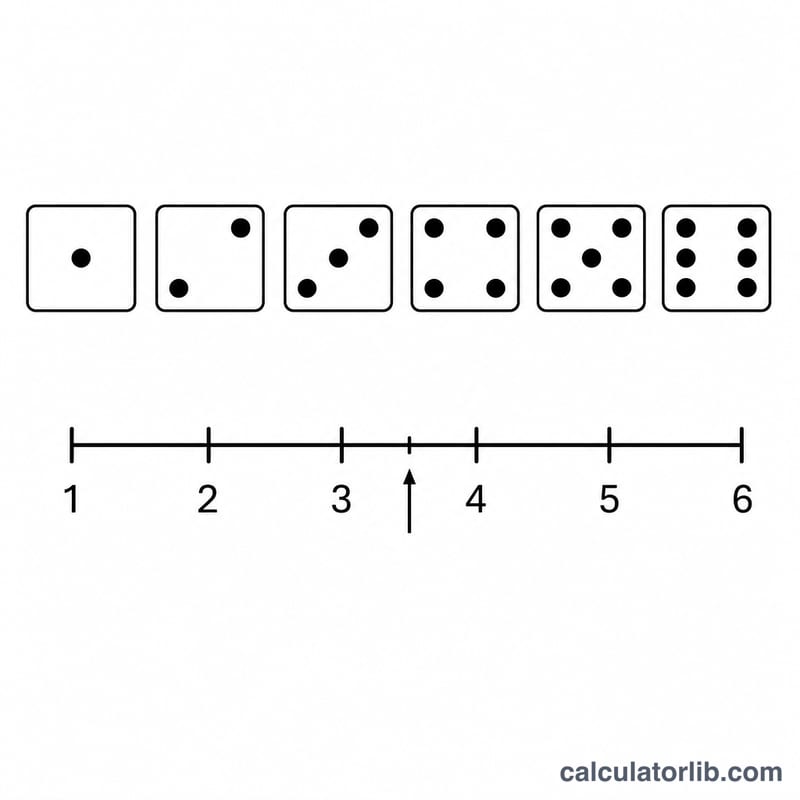
A single fair die with s sides shows each face with equal probability. Its average value is the midpoint of 1 and s, which is \(\frac{s + 1}{2}\). Because the average of a sum equals the sum of the averages, rolling n identical dice gives:
$$\text{Average} = n \times \frac{s + 1}{2}$$
This assumes every die is fair and independent — the result does not depend on how the individual outcomes correlate, only on each die's own mean.
Worked Example
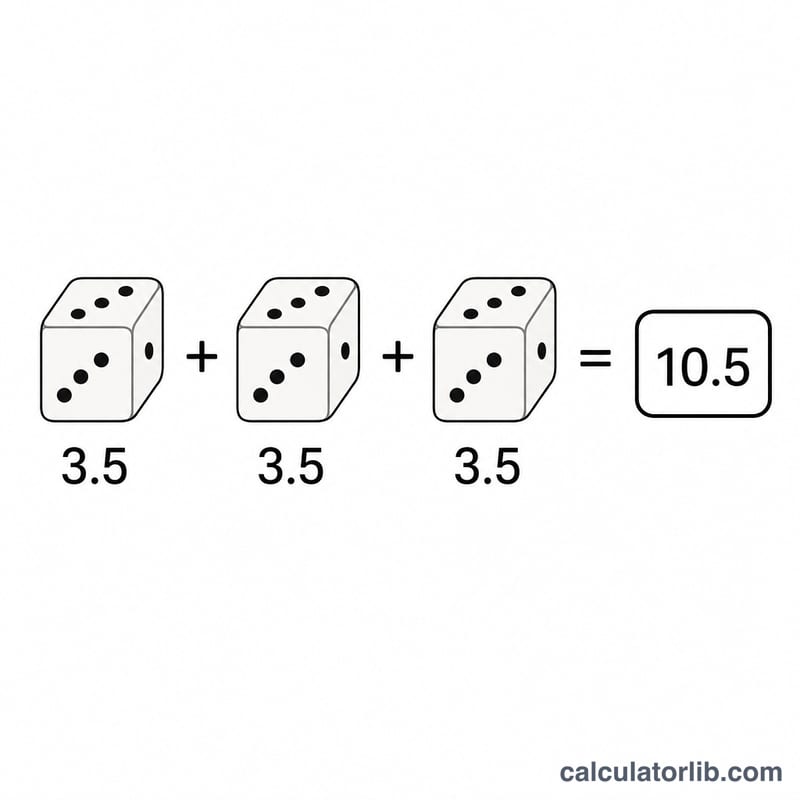
Suppose you roll 3 standard six-sided dice. Each die averages \(\frac{6 + 1}{2} = 3.5\). For three dice: \(3 \times 3.5 = \mathbf{10.5}\). The minimum total is 3 (three 1s) and the maximum is 18 (three 6s), so 10.5 sits exactly in the middle, as expected for symmetric dice.
FAQ
Why is the average not a whole number? The mean of a single die is often a fraction (3.5 for a d6), so totals frequently end in .5 even though any actual roll is a whole number.
Does this work for mixed dice like a d6 and a d20? This tool assumes all dice have the same number of sides. For mixed sets, add the individual die averages: \(\frac{s_1+1}{2} + \frac{s_2+1}{2} + \dots\)
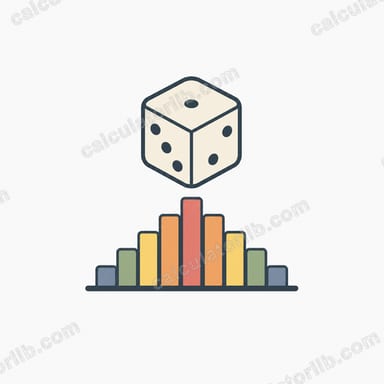
Is the average the most likely total? For two or more dice the average coincides with the most likely (modal) total, since the distribution is symmetric and peaks in the center.