
What is the Dice Roller?
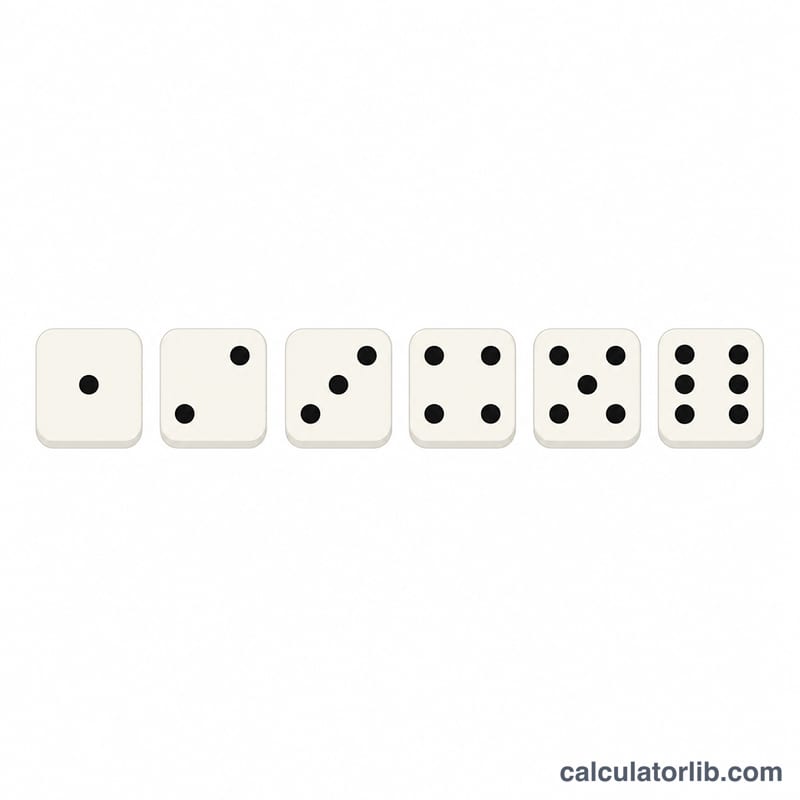
This Dice Roller is a virtual replacement for physical dice. Choose how many standard six-sided dice you want — anywhere from 1 to 6 — and the tool instantly rolls each die fairly and shows you every face along with the combined total. It is handy when you have lost your dice, need a quick random number, or want a clean way to play board and dice games like Yahtzee, backgammon, craps, or dice poker.
How to use it
Pick the number of dice from the dropdown (1, 2, 3, 4, 5, or 6) and submit. Each die is rolled independently, so every result is fresh and unpredictable. The output lists the individual faces (for example [5, 1]) and the total of all dice. The table also reminds you of the lowest and highest totals possible for that many dice.
The formula explained
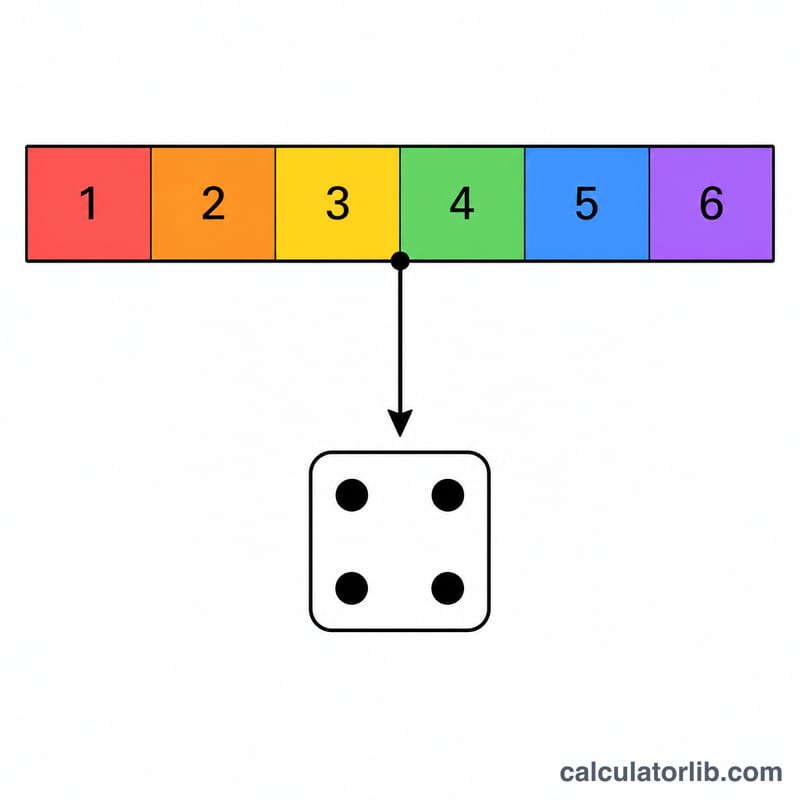
For each die the tool generates a uniform random number \(r\) between 0 (inclusive) and 1 (exclusive), then computes $$\text{face} = 1 + \lfloor r \times 6 \rfloor.$$ Because \(r\) is uniform, each of the six outcomes 1, 2, 3, 4, 5, 6 occurs with probability \(\tfrac{1}{6}\), exactly like a fair die. The total is simply the sum of all faces: $$\text{total} = \sum_{i=1}^{n} \text{face}_i.$$ For \(n\) dice the total ranges from \(n\) (all ones) to \(6n\) (all sixes).
Worked example
Suppose you roll 2 dice and the random draws are 0.83 and 0.05. Die 1: $$1 + \lfloor 0.83 \times 6 \rfloor = 1 + \lfloor 4.98 \rfloor = 1 + 4 = 5.$$ Die 2: $$1 + \lfloor 0.05 \times 6 \rfloor = 1 + \lfloor 0.30 \rfloor = 1 + 0 = 1.$$ So the faces are [5, 1] and the total is \(5 + 1 = 6\).
FAQ
Are the dice fair? Yes. Each face has an equal \(\tfrac{1}{6}\) chance, and the dice are independent of each other.
What is the most likely total with two dice? A total of 7 is the most common, occurring with probability \(\tfrac{6}{36} = \tfrac{1}{6}\), while 2 and 12 are the rarest at \(\tfrac{1}{36}\) each.
Why do I get different results each time? The roller uses a random source, so like real dice the outcome changes on every roll.