What is ERA?
Earned Run Average (ERA) is the classic measure of a pitcher's effectiveness in baseball and softball. It expresses the average number of earned runs a pitcher would give up over a full game's worth of innings. A lower ERA means a more effective pitcher. Only earned runs count — runs that score because of fielding errors or passed balls are excluded.
How to use this calculator
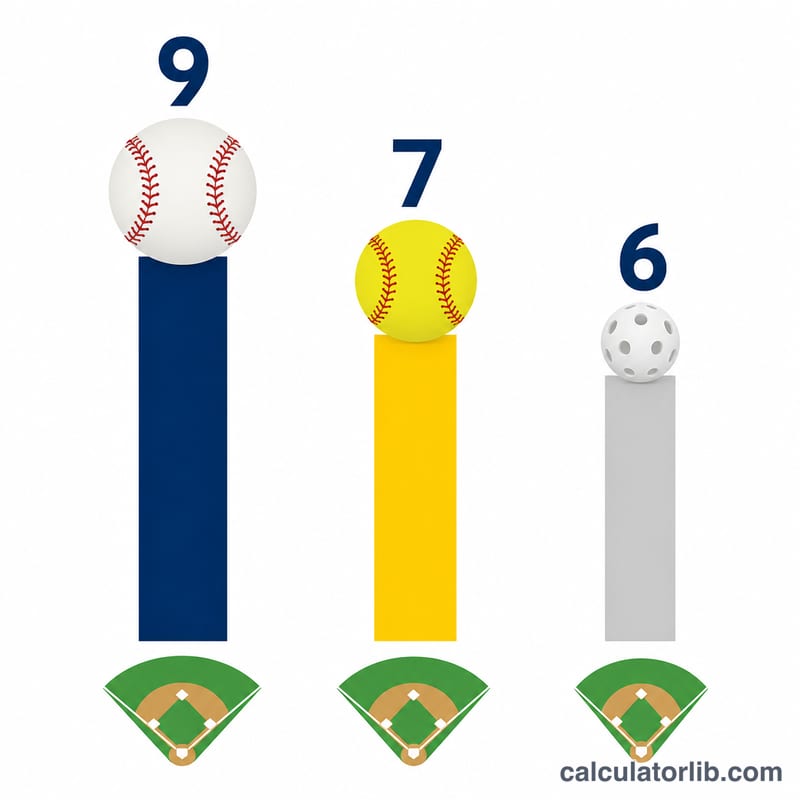
Enter the number of earned runs (ER) the pitcher allowed, the number of full innings pitched, and pick how many outs were recorded in any incomplete final inning (0, 1 or 2). Then choose the game length: 9 innings for standard baseball, 7 for softball, or 6 for Little League. The calculator returns the ERA rounded to two decimal places.
The formula explained
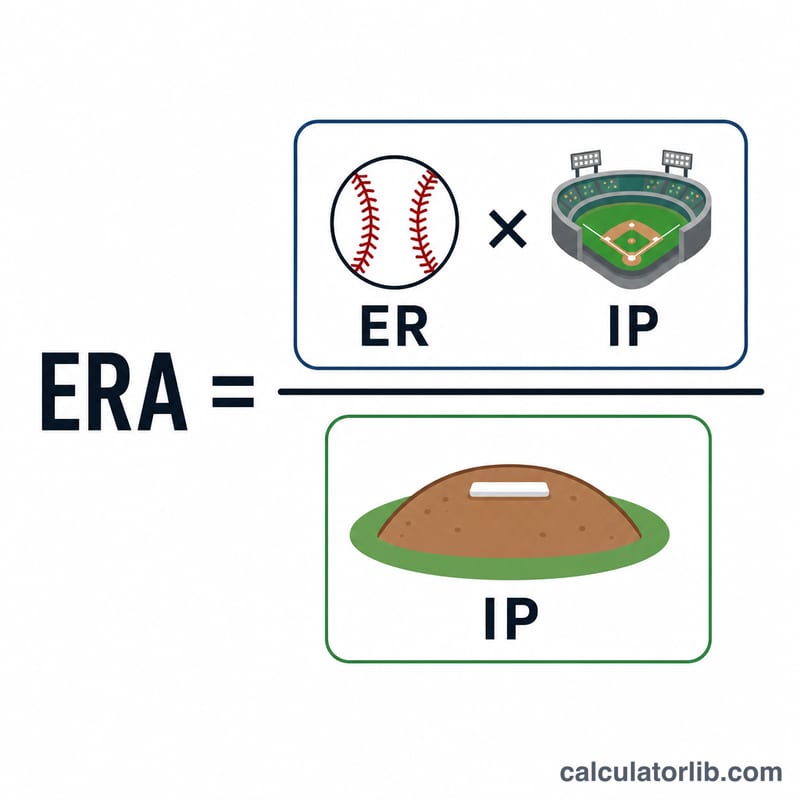
ERA is computed as:
$$\text{ERA} = \dfrac{\text{ER} \times \text{Innings per Game}}{\text{IP}}$$
where innings pitched (IP) = full innings + outs/3. Because each out equals one-third of an inning, this calculator asks for the raw number of outs to avoid the confusing "6.1 = 6â…“" decimal notation used on scoreboards.
Worked example
A baseball pitcher allows 3 earned runs over 6 full innings plus 2 outs (6â…” innings). \(\text{IP} = 6 + 2/3 = 6.6667\). $$\text{ERA} = \dfrac{3 \times 9}{6.6667} = \dfrac{27}{6.6667} = 4.05$$
Interpreting Your ERA
ERA (earned run average) is the number of earned runs a pitcher allows per full game's worth of innings. Lower is better. The rough bands below are for MLB-style 9-inning baseball. They are general guidelines, not official standards.
| ERA (9-inning baseball) | General reading |
|---|---|
| Under 3.00 | Excellent, ace-level run prevention |
| 3.00 to 3.99 | Good, above average |
| About 4.00 to 4.50 | Around league average in many recent seasons |
| 4.51 to 5.00 | Below average |
| Above 5.00 | Poor, usually a struggling pitcher |
Context matters. League-average ERA changes from year to year and differs by level (MLB, minor leagues, college, high school, youth). A 4.00 ERA can be strong in a high-scoring environment and mediocre in a low-scoring one. Compare a pitcher with the average for the same league and season.
Game length matters. This calculator scales ERA to 9 innings for baseball, 7 for softball, or 6 for Little League. Because each ERA is per a different game length, values from different leagues are not directly comparable. A 3.00 ERA in a 6-inning league is not the same rate as a 3.00 in a 9-inning league.
Sample size matters. ERA is very volatile over few innings. One bad outing early in a season can push it above 10.00, and a few clean innings can make it 0.00. Treat ERA from small samples with caution.
ERA Comparison Across Game Lengths
The same pitching line gives a different ERA depending on innings per game, because ERA = earned runs × innings per game ÷ innings pitched. The table uses two fixed lines: 3 earned runs in 6.0 IP, and 2 earned runs in 4.1 IP (4⅓ innings, or 13/3).
| Pitching line | 9-inning ERA | 7-inning ERA | 6-inning ERA |
|---|---|---|---|
| 3 ER in 6.0 IP | 4.50 | 3.50 | 3.00 |
| 2 ER in 4.1 IP | 4.15 | 3.23 | 2.77 |
Worked substitution for the first line:
$$\text{ERA}_9 = \frac{3 \times 9}{6} = 4.50,\quad \text{ERA}_7 = \frac{3 \times 7}{6} = 3.50,\quad \text{ERA}_6 = \frac{3 \times 6}{6} = 3.00$$
Worked substitution for the second line, where 4.1 IP means \(4 + \tfrac{1}{3} = \tfrac{13}{3}\) innings:
$$\text{ERA}_9 = \frac{2 \times 9}{13/3} = \frac{54}{13} \approx 4.15,\quad \text{ERA}_7 = \frac{42}{13} \approx 3.23,\quad \text{ERA}_6 = \frac{36}{13} \approx 2.77$$
FAQ
What counts as an earned run? A run the pitcher is responsible for without help from defensive errors or passed balls. Unearned runs are not included in ERA.
What if 0 innings were pitched? If a pitcher records no outs but allows earned runs, ERA is mathematically undefined (often shown as "INF"). This calculator displays an undefined message instead of dividing by zero.
Why choose innings per game? The multiplier scales the rate to a full game. Baseball uses 9, softball 7, and Little League 6, so selecting the right league gives an accurate, comparable ERA.