
What Is Earned Run Average (ERA)?
Earned Run Average (ERA) is the most widely used statistic for measuring a baseball pitcher's effectiveness. It represents the average number of earned runs a pitcher allows per nine innings pitched. A lower ERA indicates a more effective pitcher. Earned runs exclude runs that score due to fielding errors or passed balls, isolating the pitcher's own performance.
How to Use This Calculator
Enter the total number of earned runs the pitcher has allowed, the total innings pitched, and the number of innings per game (9 for Major League Baseball, 7 for many softball or high-school leagues). The calculator instantly returns the ERA, the recognized industry standard for comparing pitchers.
The Formula Explained
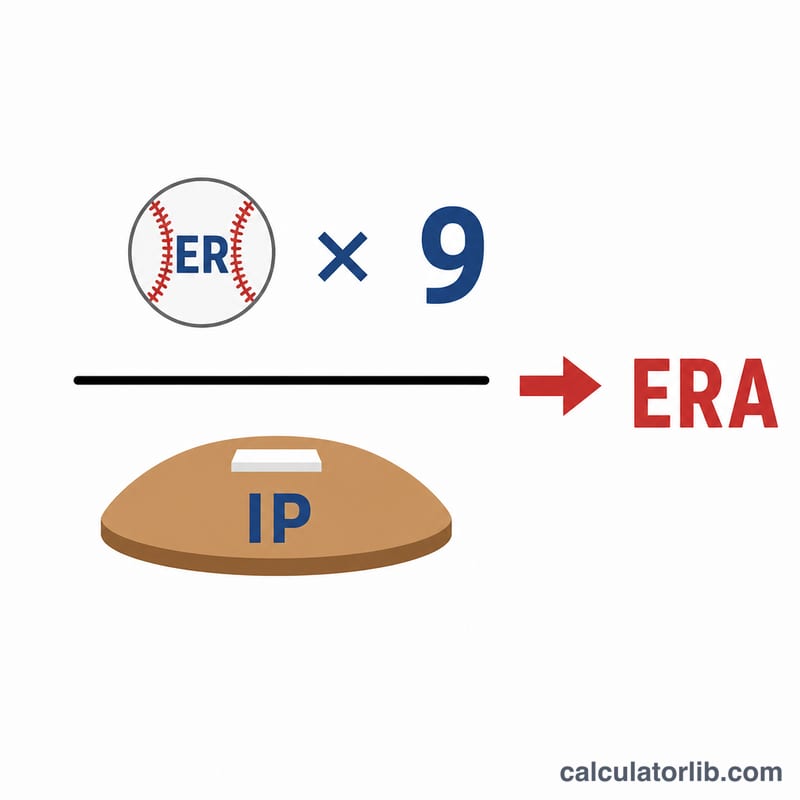
The formula is: $$\text{ERA} = \dfrac{\text{Earned Runs} \times \text{Innings per Game}}{\text{Innings Pitched}}$$ Multiplying earned runs by the innings-per-game figure scales the rate to a full game, and dividing by actual innings pitched normalizes it regardless of how long the pitcher worked. For standard baseball this is \(\dfrac{\text{ER} \times 9}{\text{IP}}\).
Worked Example
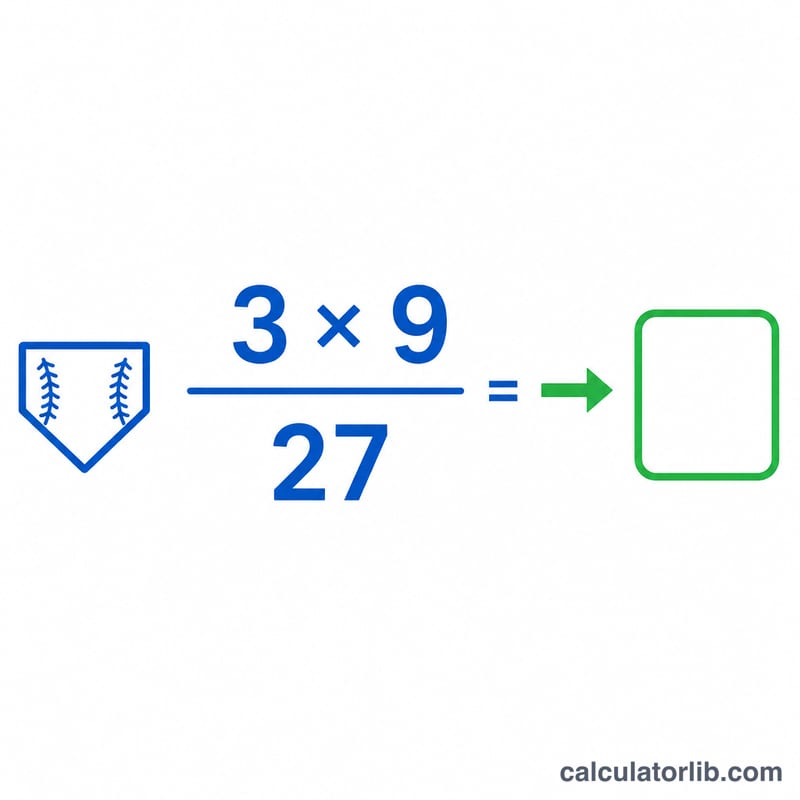
Suppose a pitcher has allowed 30 earned runs over 180 innings pitched in a 9-inning league. $$\text{ERA} = \dfrac{30 \times 9}{180} = \dfrac{270}{180} = \mathbf{1.50}$$ An ERA of 1.50 would be considered elite, well below the typical league average of around 4.00.
FAQ
What is a good ERA? Generally, an ERA under 3.00 is excellent, 3.00–4.00 is solid, and above 5.00 is poor at the professional level.
Are unearned runs included? No. Only earned runs count toward ERA; runs scored because of errors or passed balls are excluded.
How are partial innings entered? Express partial innings as decimals (e.g., 6.1 innings in box-score notation equals 6.33 innings; enter the decimal value for the most accurate result).