
What Is Earned Run Average (ERA)?
Earned Run Average (ERA) is the most common statistic used to measure a baseball or softball pitcher's effectiveness. It expresses the average number of earned runs a pitcher allows per nine innings pitched. A lower ERA indicates a more effective pitcher. Earned runs exclude runs that score as a result of fielding errors or passed balls — only runs that result from a pitcher's own performance count.
How to Use This Calculator
Enter the total number of earned runs the pitcher has allowed and the total innings pitched. Innings can be a decimal — in baseball notation, ".1" means one out (one-third of an inning) and ".2" means two outs (two-thirds), but for this calculator you may simply enter the decimal equivalent (e.g. 6.67 for 6⅔). Click calculate to see the ERA instantly.
The Formula Explained
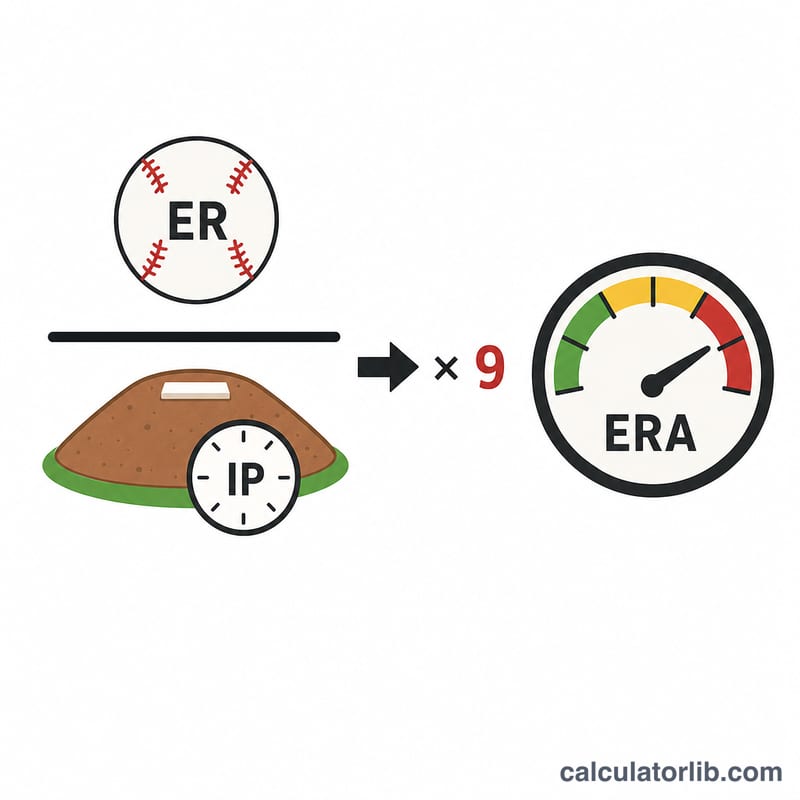
The formula is $$\text{ERA} = \frac{\text{Earned Runs}}{\text{Innings Pitched}} \times 9$$. We divide earned runs by innings pitched to get earned runs per inning, then multiply by 9 to scale the figure to a standard nine-inning game. This normalization lets you compare starters and relievers on the same scale regardless of how many innings they have thrown.
Worked Example
Suppose a pitcher has allowed 30 earned runs over 180 innings pitched. $$\text{ERA} = (30 \div 180) \times 9 = 0.1667 \times 9 = \mathbf{1.50}$$ An ERA of 1.50 is excellent — elite starting pitchers often finish a season in the 2.00–3.00 range.
FAQ
What is a good ERA? Generally, an ERA below 3.00 is considered very good, 3.00–4.00 is solid, and above 5.00 is poor at the major-league level.
What counts as an earned run? A run charged to a pitcher that scored without the aid of a fielding error or passed ball.
Does this work for softball? Yes, but softball games are typically 7 innings, so some leagues multiply by 7 instead of 9. This calculator uses the standard baseball factor of 9.