

What is the Marketplace Selling Price Calculator?
This tool tells you exactly what list price to set on an online marketplace such as Amazon, eBay, or Etsy so that — after you pay your item cost, shipping, marketplace selling fees, payment-processor fees, and remit collected sales tax — you hit the return you want. Choose your goal as a fixed profit in dollars, a target gross margin percent, or a target markup percent, and the calculator solves for the price and shows a complete cost, revenue, and profit breakdown. It is currency-agnostic: the "$" symbol is cosmetic and all fee and tax rates are entered by you, so it works for any region.
How to use it
Pick your "Desired Return" type and enter its value. Enter your item cost, the shipping you pay the carrier, and the shipping you charge the buyer. Enter the sales-tax rate and choose whether tax also applies to the shipping you charge. Finally enter the marketplace selling fee (percent + fixed) and the transaction/payment fee (percent + fixed). The result is the Selling Price to list, plus itemized costs, revenue, profit, margin, and markup.
The formula
Let \(P\) be the selling price. Sales tax is collected and remitted, so it is neither revenue nor a cost.
$$P + S_c - \left[ C + S_p + f_s(P+S_c) + F_s + f_t(P+S_c+T) + F_t \right] = \text{target}$$
\(\text{taxAmt} = \text{taxRate} \times (P + \text{shipCharged if taxed})\) · \(\text{sellingCost} = \text{sellPct} \times (P + \text{shipCharged}) + \text{sellFixed}\) · \(\text{transactionCost} = \text{tranPct} \times (P + \text{shipCharged} + \text{taxAmt}) + \text{tranFixed}\) · \(\text{totalCost} = \text{itemCost} + \text{shipPaid} + \text{sellingCost} + \text{transactionCost}\) · \(\text{revenue} = P + \text{shipCharged}\) · \(\text{profit} = \text{revenue} - \text{totalCost}\). Because every term is linear in \(P\), the equation \(\text{profit} = \text{target}\) (or margin/markup condition) is solved algebraically for \(P\).
$$\text{Profit} = (P + S_c) - (C + S_p + \text{sellFee} + \text{tranFee})$$
$$\text{Margin}\% = 100\cdot\frac{\text{Profit}}{\text{Revenue}},\quad \text{Markup}\% = 100\cdot\frac{\text{Profit}}{\text{Total Cost}}$$
Worked example
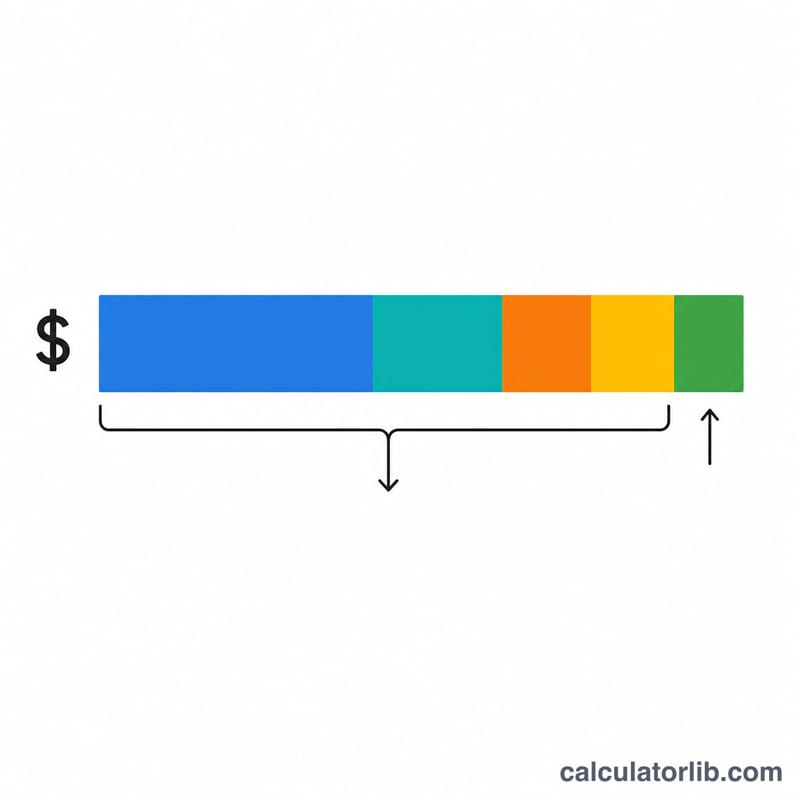
Item cost $16.00, shipping paid $6.99, shipping charged $5.00, sales tax 6.25% on shipping too, selling fee 15% + $0.35, transaction fee 2.9% + $0.30, target Markup 100%. The solver returns a Selling Price of about $69.06: revenue $74.06, selling cost $11.46, transaction cost $2.58, total cost $37.03, profit $37.03 — a 100% markup and 50% margin.
FAQ
What's the difference between margin and markup? Margin is profit as a percent of revenue; markup is profit as a percent of total cost. A 100% markup equals a 50% margin.
Why are the fee dollars higher than the percent of bare price? Marketplaces charge fees on the full buyer payment, which includes shipping (and, for the transaction processor, sales tax), not just the item price.
Why might it say no solution? If your combined percentage fees are too high, no positive price can satisfy the target — lower the target or the fees.