
What is the normal approximation to the binomial?
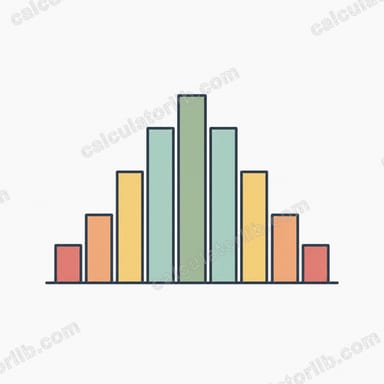
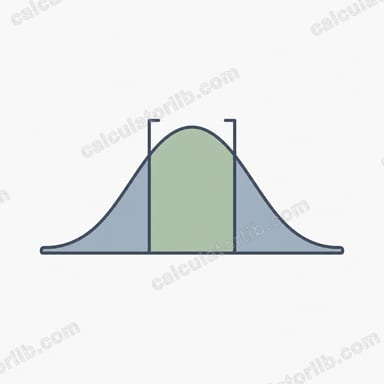
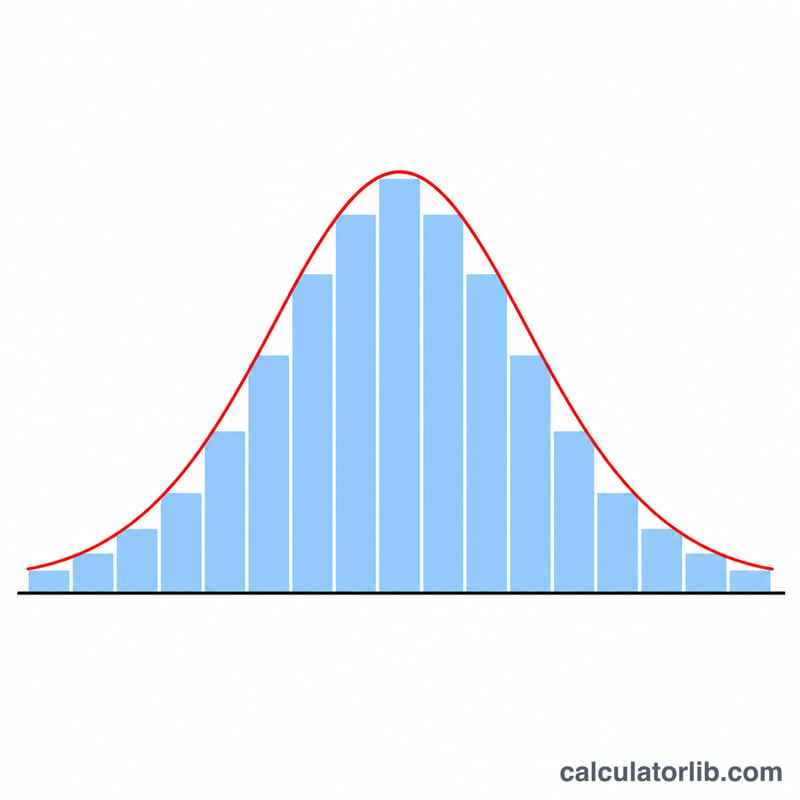
When the number of trials in a binomial experiment is large, computing exact binomial probabilities becomes tedious. The normal approximation replaces the discrete binomial distribution with a continuous normal distribution that has the same mean and variance. A binomial random variable X with parameters n and p has mean \(\mu = np\) and standard deviation \(\sigma = \sqrt{np(1-p)}\). For X we then use a normal distribution \(N(\mu, \sigma^2)\) to estimate cumulative probabilities.
How to use this calculator
Enter the number of trials n, the probability of success on each trial p (between 0 and 1), choose the probability type (≤, <, ≥, >, or =), and the value x. The calculator returns μ, σ, the continuity-corrected z-score(s), and the approximate probability. The approximation is reliable when both \(np \ge 5\) and \(n(1-p) \ge 5\).
The continuity correction
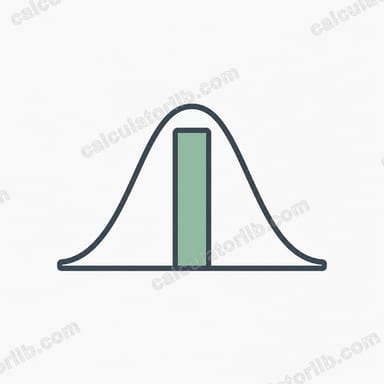
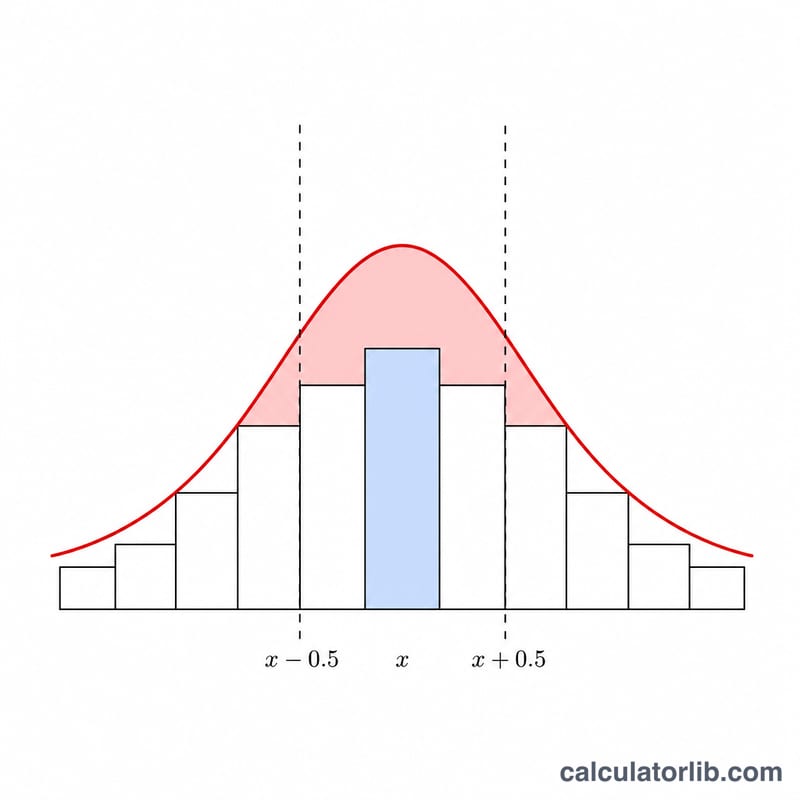
Because the binomial is discrete but the normal is continuous, we widen or shrink the boundary by 0.5 — the continuity correction. For example, \(P(X \le x)\) uses \(x + 0.5\), \(P(X \ge x)\) uses \(x - 0.5\), and \(P(X = x)\) spans from \(x - 0.5\) to \(x + 0.5\). Each adjusted boundary is converted to a z-score using $$ z = \frac{(x \pm 0.5) - \mu}{\sigma} $$ then evaluated with the standard normal CDF.
Worked example
Suppose \(n = 20\), \(p = 0.5\), and we want \(P(X \le 12)\). Then $$ \mu = 20 \times 0.5 = 10 $$ and $$ \sigma = \sqrt{20 \times 0.5 \times 0.5} = \sqrt{5} \approx 2.2361 $$ With continuity correction, $$ z = \frac{12.5 - 10}{2.2361} \approx 1.118 $$ The standard normal CDF gives \(\Phi(1.118) \approx 0.868\), so \(P(X \le 12) \approx 0.868\) — very close to the exact binomial value.
FAQ
When is the approximation valid? A common rule is \(np \ge 5\) and \(n(1-p) \ge 5\). When p is far from 0.5 you may need a larger n.
Why ±0.5? The 0.5 continuity correction compensates for approximating discrete bars with a smooth curve, improving accuracy.
Does this give the exact probability? No — it is an approximation. For exact results use a binomial probability calculator, especially for small n.