
What is the Equilibrium Constant (Kc)?
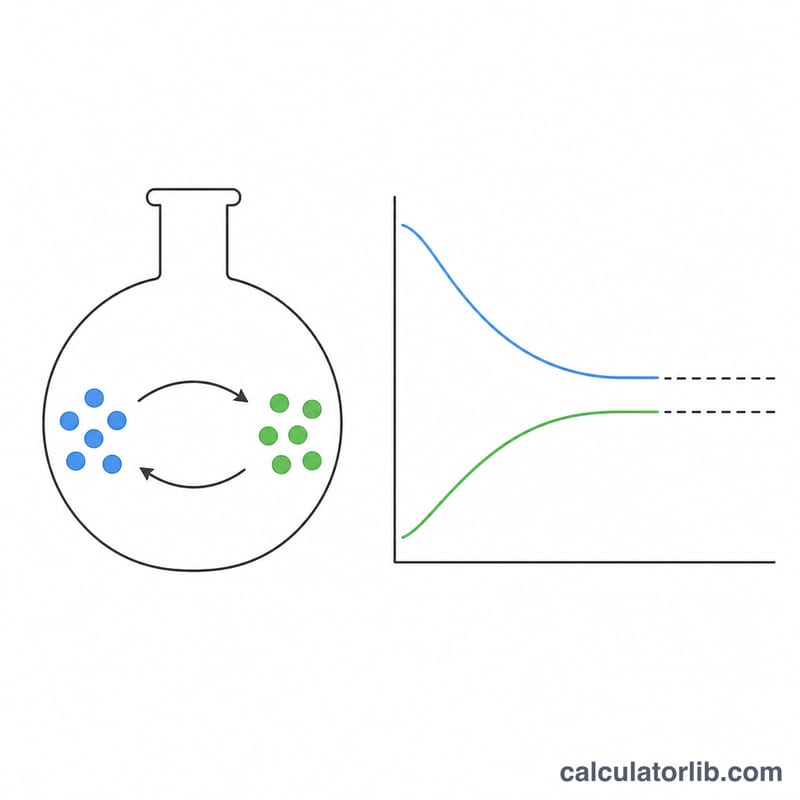
For a reversible reaction at equilibrium, the equilibrium constant Kc expresses the ratio of product concentrations to reactant concentrations, with each concentration raised to the power of its stoichiometric coefficient. A large Kc means products dominate at equilibrium; a small Kc means reactants dominate. Kc is dimensionless when defined with respect to standard concentrations.
How to Use This Calculator
Enter the molar concentration (mol/L) of each product and reactant at equilibrium, along with its balanced-equation coefficient. The calculator supports up to two products and two reactants — leave a second species blank (or 0) if your reaction has only one. It then computes the products term, the reactants term, and their ratio, Kc.
The Formula Explained
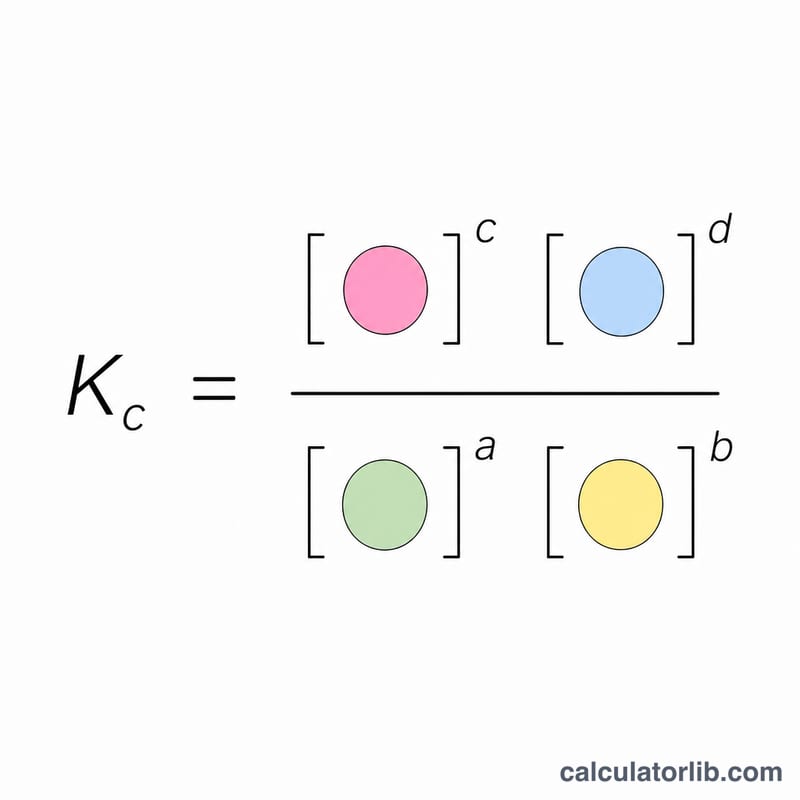
For the general reaction aA + bB ↔ cC + dD, the constant is:
$$K_c = \frac{[\text{C}]^{c} \cdot [\text{D}]^{d}}{[\text{A}]^{a} \cdot [\text{B}]^{b}}$$
Only species in the same phase as the solution (aqueous or gaseous) are included; pure solids and liquids are omitted. Use a coefficient of 0 to exclude an optional second species.
Worked Example
Consider 2A ↔ B, with \([\text{A}] = 0.2\) mol/L and \([\text{B}] = 0.5\) mol/L at equilibrium. The numerator is \([\text{B}]^{1} = 0.5\). The denominator is \([\text{A}]^{2} = 0.2^2 = 0.04\). So $$K_c = \frac{0.5}{0.04} = 12.5.$$
FAQ
What is the difference between Kc and Kp? Kc uses molar concentrations, while Kp uses partial pressures for gas-phase reactions.
Does Kc have units? By convention Kc is treated as dimensionless, since concentrations are expressed relative to a standard 1 mol/L state.
What does a Kc greater than 1 mean? It indicates the forward reaction is favored and products predominate at equilibrium.