

What Is Standard Cell Potential?
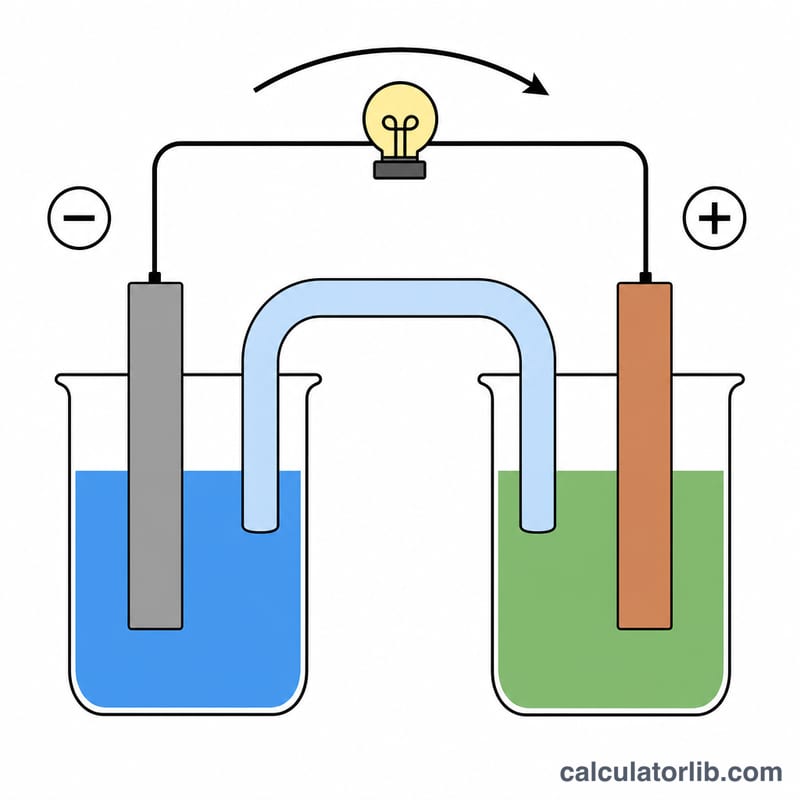
The standard cell potential, written \(E^{\circ}_{cell}\), is the voltage produced by an electrochemical (galvanic) cell when all species are at standard conditions: 1 M concentration for solutions, 1 atm (or 1 bar) for gases, and a temperature of 25 °C (298.15 K). It is a direct measure of how strongly a redox reaction tends to push electrons through an external circuit. A positive \(E^{\circ}_{cell}\) indicates a spontaneous reaction, the hallmark of a battery that can do useful work.
How to Use This Calculator
Look up the standard reduction potentials for both half-reactions from a standard table (both must be written as reductions). Enter the value for the electrode where reduction actually occurs (the cathode) and the value for the electrode where oxidation occurs (the anode). The calculator subtracts the anode value from the cathode value and tells you whether the resulting cell is spontaneous.
The Formula Explained
The governing equation is:
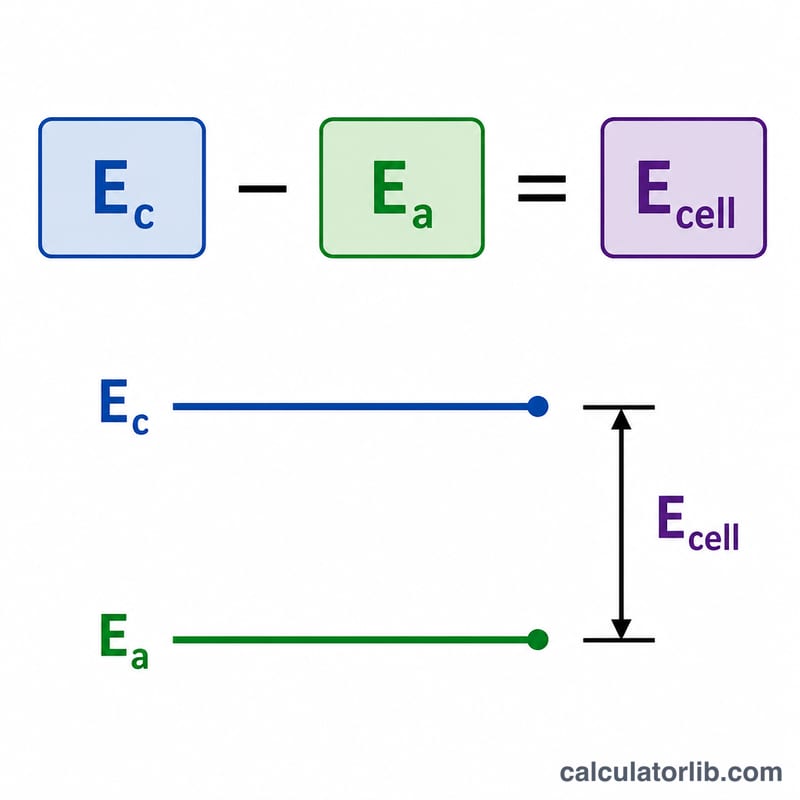
$$E^{\circ}_{cell} = \text{E}^{\circ}_{cathode} - \text{E}^{\circ}_{anode}$$
Here both \(\text{E}^{\circ}_{cathode}\) and \(\text{E}^{\circ}_{anode}\) are taken as standard reduction potentials straight from the table — you do not flip the sign of the anode yourself; the subtraction already accounts for the fact that oxidation is the reverse of reduction. The cathode is always the half-reaction with the more positive reduction potential in a spontaneous galvanic cell.
Worked Example
Consider the classic Daniell cell with copper and zinc. Copper is reduced at the cathode (\(E^{\circ} = +0.34\ \text{V}\)) and zinc is oxidized at the anode (its reduction potential is \(E^{\circ} = -0.76\ \text{V}\)). Then:
$$E^{\circ}_{cell} = 0.34 - (-0.76) = 1.10\ \text{V}.$$
Because 1.10 V is positive, the reaction is spontaneous, which is exactly why a zinc–copper cell works as a battery.
FAQ
Do I flip the sign of the anode potential? No. Enter both values as standard reduction potentials. The minus sign in the formula handles the reversal automatically.
What does a negative \(E^{\circ}_{cell}\) mean? A negative value means the reaction is non-spontaneous as written; it would require an external power source (electrolysis) to proceed.
How is \(E^{\circ}_{cell}\) related to free energy? They are linked by \(\Delta G^{\circ} = -nFE^{\circ}_{cell}\), where \(n\) is moles of electrons transferred and \(F\) is Faraday's constant. A positive \(E^{\circ}_{cell}\) gives a negative \(\Delta G^{\circ}\), confirming spontaneity.